(#362) Small Acts of Gratitude


“Silent gratitude is not much use to anyone.”
– Gertrude Stein –

Saying “thank you.” Giving a cheerful “good morning!” Expressing appreciation. Providing a hug, emotionally if not physically.  Each of these requires a tiny investment of energy.  The result compounds in ways we may not anticipate.

I have been spending time lately listening to my podcast episodes and reacquainting myself with the wonderful insights of my guests.  After I re-listen to an episode, I take a few minutes to send an email thanking the guest for his/her contributions to the community.  Literally, the email takes about 180 seconds to create and “send.”

The goal is simple: recognition and validation of a person. A small act.

Almost to a person, their responses (which I was not expecting) said something along the lines of “you don’t know how much your email means to me.”  One individual was having a particularly rough week (which I had no way of knowing).  The email told me, “Thanks for the email…appreciate the little things in life!”

Five years ago, I dedicated myself to a year a gratitude. You can read about here.  I committed myself to a simple daily discipline—and it continues to give back to others.  (I still have people, to whom I sent a gratitude note, share that they have kept and cherish my handwritten note.)

Think of the small acts of kindness done for you—and that you do for others.  It does not take much effort to say thank you or recognize a job-well-done.

Thank you for reading and sharing my blog. Thank you for the gratitude you share with your community.

Thank you.

P.S.  A few hours after I wrote this blog post, I received an unexpected “Thank You Note” from a friend. She simply wanted to thank me for being in her life.  A card that I will tuck away in my gratitude file.

Nice.

Thank you!


Video recommendation for the week.

I have shared this video before.  It never gets old because it helps us connect with one another on a personal, meaningful, and authentic level.


Make it an inspiring week and H.T.R.B. as needed.

For information about and to order my new book, Stories About Teaching, Learning, and Resilience: No Need to be an Island, click here.

You can subscribe to my newsletter by clicking here.

Check out my latest podcasts at The Growth and Resilience Network™
(http://stevepiscitelli.com/media-broadcast/podcast).

Check out my website  (http://stevepiscitelli.com/programs/what-i-do) for programming information as well as details about upcoming webinars  (http://stevepiscitelli.com/programs/webinars).

Pearson Education publishes my student textbooks for life success—Choices for College Success (3rd edition) and Study Skills: Do I Really Need This Stuff? (3rd edition).

(c) 2017. Steve Piscitelli. All rights reserved.

Posted in authenticity, awareness, Being REMARKABLE, Civility, collaboration, Community, Connection-Disconnection, curiosity, empathy, engagement, fortitude, Friendship, generativity, Gratitude, happiness, Life lessons | Tagged , , , , , , | 4 Comments

(#361) Where’s My Trophy?


How would you develop a meaningful and effective employee recognition program?
What represents “average” and what looks like “excellent” at your workplace?

Transformational leaders understand the importance of timely, authentic, and meaningful employee recognition.   The leader knows her people and what best motivates them. (For instance, accolades must resonate with the different generational mindsets that may be in the work setting.  Boomers may crave financial reward and titles, while millennials favor flexibility benefits.)

Even though the All Stars generally standout, there will be shortsighted, why-not-me workplace citizens who have difficulty recognizing and acknowledging the good work of others. What’s a leader to do in order to connect with all team members?

One of the last scenarios in my new book gives readers the opportunity to grapple with the best way to recognize employee efforts.  While I wrote the scenario specifically for college and university faculty, you can apply it to other professions. Take out the reference to “faculty” and insert your occupation or job title, for example.  Instead of “department chair,” use “manager” or “supervisor.”

Whether we talk about faculty, corporate managers, dockworkers, or administrative assistants recognizing them for a “job well done” seems like commonsense to overall personnel development.

Your work environment may adeptly understand and expertly execute employee recognition. If so, I would like to learn about your system. Leave a comment on this blog.


Video recommendation for the week.

Let me set the stage for the scenario.

For more hands-on introductory videos, visit my video playlist.


As you and your colleagues grapple with this scenario, consider if Professor Hadit works in an environment where everyone believes he or she is excellent. If that is the case, then hasn’t “excellent” in that environment actually become “average”? Excellent indicates far above the average. What represents average and what looks like excellent at your workplace?

The scenario:

“Got a moment?” asked Professor Hadit as he stood at his colleague’s office door.

“Sure, come on in, Don. Have a seat.” Professor Binder pointed to the seat at the side of his desk. Both professors taught in the English department on their campus. Don Hadit it was the current department chair. He had been in that position for two years.

“Not sure where to start, Ann, other than this is the stereotypical case of doing what I thought was right only to catch grief from every direction. Remember the campus meeting we had last week with the campus president?”

“Yeah,” replied Ann. “I thought it went well. Very positive. Especially the recognition of the ‘all-stars’ in each of the departments. Finally, nice to see faculty recognized for what they do well.”

“Well, there’s the rub,” said Don with a sigh. “We, the department chairs, were asked to pass along the names of some of our faculty who have done something well over the last semester. We could only give four or five names. The president wanted to reach out and thank those folks. So, I did that. Thought it was a good idea, too. Unfortunately, my phone has not stopped ringing, the email inbox keeps dinging, and there have been a few unpleasant conversations—or should I say diatribes—in my office.”

“I don’t understand,” offered a confused-looking Ann. “About positive recognition?”

“Yeah. It seems people got very upset—I mean red-in-the-face mad—that they weren’t recognized. Some went as far as to tell me why the people I chose were not deserving of such recognition. I’m flabbergasted. Feeling a bit blindsided. Even had one person claim the only reason you were recognized is because we are friends outside of campus. Gee. Since I observe every teacher in this department and conduct thorough evaluations, I thought I was in the best place to be objective.”

Ann raised her eyebrows and blew a slow breath.

“I’m not sure how to rebound from this one. Frankly, I’m mad as hell. Got any thoughts?” asked Professor Hadit as he slumped into the chair and stared straight ahead at the wall. “I feel like we’re stuck in a place where everyone has to get a trophy!”

Reflect on This

  • If you were in Professor Hadit’s position, would you have proceeded any differently when asked by the campus president for a few of the “All Stars” in your department? Briefly explain.
  • How does your workplace recognize its All Stars? How should it recognize the All Stars?

Make it an inspiring week and H.T.R.B. as needed.

For information about and to order my new book, Stories About Teaching, Learning, and Resilience: No Need to be an Island, click here.

You can subscribe to my newsletter by clicking here.

Check out my latest podcasts at The Growth and Resilience Network™
(http://stevepiscitelli.com/media-broadcast/podcast).

Check out my website  (http://stevepiscitelli.com/programs/what-i-do) for programming information as well as details about upcoming webinars  (http://stevepiscitelli.com/programs/webinars).

Pearson Education publishes my student textbooks for life success—Choices for College Success (3rd edition) and Study Skills: Do I Really Need This Stuff? (3rd edition).

(c) 2017. Steve Piscitelli. All rights reserved.

Posted in accountability, amplifying, Appreciation, collaboration, collegiality, Connection-Disconnection, employee evaluation, employee recognition, institutional culture, Integrity, intentionality, leadership, Life lessons, relevance, transformational leadership | Tagged , , , , | 3 Comments

(#360) Embrace Life’s Fragility


A reminder to appreciate.

Attending the screening premier last week reminded me of life’s fragility. In a good way.

Embracing the fragility recognizes that this part of the journey is limited.  The embrace, for me, brings appreciation and respect.  It, also, nudges me to treasure the precious life source rather than focus on fear and what-ifs.

Over the course of our lifetime we do a lot, see a lot, gather a lot, read a lot, work a lot, write a lot, plan a lot, talk a lot, tweet a lot, post a lot, Instagram a lot, and ____ (you fill in the blank). Each one of those experiences represents a dot on your lifeline. We have gathered thousands of those dots on our journey. And we will gather thousands more. What, however, do we do with those dots?

A colleague of mine from California wonders if we spend too much time collecting dots and not enough time connecting those dots.

Are the dots in our lives meaningful? Do we savor and appreciate them? Do we discern? Or do we just collect?

I used to challenge my students to pause often and examine what they were doing with their education and experiences.  Why were they doing what they were doing?  Did their goals involve building a transcript or constructing and living a meaningful and worthwhile life?

Take a moment this week and reflect on the dots.


Video recommendation for the week.

Sting sings, “How fragile we are. How fragile we are.”

A reminder to appreciate.

Hug your life.


Make it an inspiring week and H.T.R.B. as needed.

For information about and to order my new book, Stories About Teaching, Learning, and Resilience: No Need to be an Island, click here.

You can subscribe to my newsletter by clicking here.

Check out my latest podcasts at The Growth and Resilience Network™
(http://stevepiscitelli.com/media-broadcast/podcast).

Check out my website  (http://stevepiscitelli.com/programs/what-i-do) for programming information as well as details about upcoming webinars  (http://stevepiscitelli.com/programs/webinars).

Pearson Education publishes my student textbooks for life success—Choices for College Success (3rd edition) and Study Skills: Do I Really Need This Stuff? (3rd edition).

(c) 2017. Steve Piscitelli. All rights reserved.

 

Posted in Appreciation, awareness, Goals, life success, relevance | Tagged , , , , | 6 Comments

(#359) Collisions and Serendipity


If managers across the company landscape remain insular,
they can end up repeating redundant routines
and retreating behind territorial barriers.

Collisions” represent opportunities.

Visionary Tony Hsieh believes we need to “maximize collisions to accelerate serendipity.” That is, we need to put ourselves in the position to connect with as many pertinent resources as possible in order to increase chances for progress, growth, learning, and connections. Unthinking isolation can create separation.

During my campus days, I loved going into the classroom each day, closing the door, and working with my students.  The autonomy represented a benefit of teaching.  It, also, had a potentially devastating drawback. If I (and my colleagues) did not stay vigilant, we lost opportunities to maximize collisions.  We could become insular.  Chances for serendipity (growth) decreased.

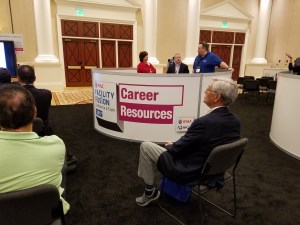
The same holds true in a corporate setting. If managers across the company landscape remain insular, they can end up repeating redundant routines and retreating behind territorial barriers. Organizations like the International Facility Management Association provide space and time for members to collide and create. I saw this first-hand at their Facility Fusion Conference and Expo in Las Vegas last week.

In addition to small workshop settings and coffee breaks, the Expo hall (think vendors) provided a central location for attendees to meet, learn about new technology, and connect for worthwhile purposes to advance the calling. The collisions went beyond mere sales opportunities to teaching and learning moments.  The area “accelerated serendipity.”

This week, in Jacksonville, Florida, I will work with the IFMA Jacksonville chapter at their annual Professional Development Forum (at the University of North Florida).  The membership will have the time to listen, learn, share, and grow with their colleagues as they explore the challenges, vagaries, and opportunities of change management. The association allows them to amplify their knowledge base and strategize for optimal customer service.

Whether you work in facility management, higher education, or healthcare, consider how you break down silos and build bridges. Look at your workplace or community-based activities. Consider all the great resources you have. How do you share them?  How do you maximize collisions so that others know what you do and what you need? How do you generate new ideas when it comes to growth, resilience, and collaboration?

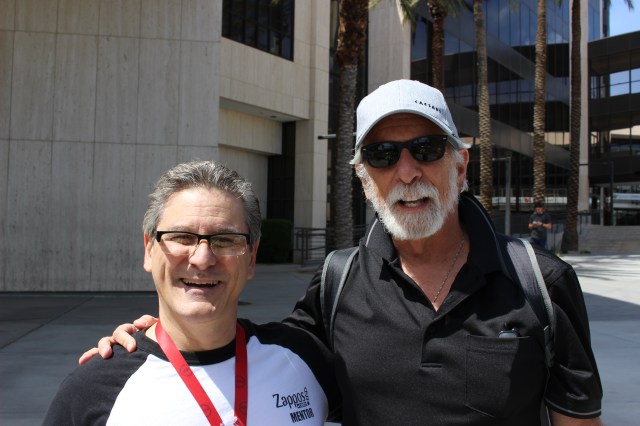
Speaking of Serendipity.  Last week, Laurie and I spent an afternoon touring the architecture and history of Downtown Las Vegas (off “The Strip”) with Paco, the Art Curator for Zappos. I had been hoping for a chance encounter to shake hands and get a photo with Tony Hsieh.  Chances were slim.  However, during the last five minutes of our more than two-hour walking tour, who did we bump into on the sidewalk? Tony Hsieh.

Collisions leading to serendipity.


Video recommendation for the week.

Tony Hsieh shares Zappos Ten Culture Values.  Can you see how collisions and serendipity connect?


Make it an inspiring week and H.T.R.B. as needed.

For information about and to order my new book, Stories About Teaching, Learning, and Resilience: No Need to be an Island, click here.

You can subscribe to my newsletter by clicking here.

Check out my latest podcasts at The Growth and Resilience Network™
(http://stevepiscitelli.com/media-broadcast/podcast).

Check out my website  (http://stevepiscitelli.com/programs/what-i-do) for programming information as well as details about upcoming webinars  (http://stevepiscitelli.com/programs/webinars).

Pearson Education publishes my student textbooks for life success—Choices for College Success (3rd edition) and Study Skills: Do I Really Need This Stuff? (3rd edition).

(c) 2017. Steve Piscitelli. All rights reserved.

Posted in accountability, amplifying, customer service, decision making, leadership, plussing, Reflection, Relationship, self-efficacy | Tagged , , , , , , , , , , , | 1 Comment

(#358) “I Don’t Want To Burn Out”


How can we raise our awareness, question our assumptions,
and create meaningful actions for improvement?

One researcher found that 29% of American employees say they thrive in their jobs (or 71% do not thrive).  A study out of the Stanford Business School noted ten factors that may be killing you in your workplace. Another source explains that “burnout syndrome” can manifest in three forms: overload, boredom, and worn-out.

What causes burnout? Does the individual hold responsibility? Do poor managers create it? Do we see out-of-work place factors (like family-work integration or financial considerations) creating in-workplace stressors? All of the above? Something else?

One of the early scenarios of my new book gives the reader a chance to confront the issue of burnout straight on and consider coping strategies. While I wrote the scenario specifically for college and university faculty, I believe you can apply it to other professions. Take out the reference to “faculty” and insert your occupation, for example.

You may work in the ideal environment where burnout is minimal to non-existent. If so, I would like to learn about what makes it so. Leave a comment on this blog.

For those who either deal with burnout personally (as an employee or manager) or work/live with someone in a slow burnout, I offer the text of my Scenario #6: “I Don’t Want To Burnout” below. Following the scenario, you will find reflection questions to serve as conversation starters about burnout and strategies to deal with it.  How can you recognize warnings of stress and burnout? What steps can you take to address these issues?


Video recommendation for the week.

Let me set the stage with a quick 57-second video.

For more hands-on introductory videos, visit my video playlist.


The Scenario:

Professor Johnson decided to clear a space in her calendar to attend a series of on-campus reflective practice discussions. Even though this is her first semester as a full-time faculty member, her faculty mentor suggested she consider this workshop. “It will provide you with strategies to become more aware of what and why you do what you do in the classroom.”

At the initial meeting, the workshop facilitator asked the participants why they had signed up for these reflective practice sessions. Professor Johnson was prepared to say jokingly that her mentor made her do it—but as she listened to her more senior colleagues share their reasons, she came to a different and more sobering realization.

Of the nine faculty members participating in this workshop, two said they were present because they had burned out and had lost their passion for teaching. They hoped this might help rekindle their spirits. Four other colleagues said they were in the process of a slow burnout. They were experiencing difficulty connecting with their students as they once had done. They could sense they were losing patience with their students and colleagues. Each said it had become tougher to find meaning in their work.

Professor Johnson took in each of these genuine responses. When her turn came around, she simply stated, “I don’t want to burn out. That is why I am here. I want to learn from you what to do and what not to do.”

Reflect on This

  • What causes burnout?
  • Can we avoid burnout?
  • If Professor Johnson came to you and asked you for strategies to avoid burnout, what would be your top two or three strategies?
  • What resources are available at your institution to help faculty avoid or at least recognize burnout?

Like our professor in the above scenario, recognition can (and needs to) generate questions about why we find ourselves in such situations. How can we raise our awareness, question our assumptions, and create meaningful actions for improvement?

Make it an inspiring week and H.T.R.B. as needed.

For information about and to order my new book, Stories About Teaching, Learning, and Resilience: No Need to be an Island, click here.

You can subscribe to my newsletter by clicking here.

Check out my latest podcasts at The Growth and Resilience Network™
(http://stevepiscitelli.com/media-broadcast/podcast).

Check out my website  (http://stevepiscitelli.com/programs/what-i-do) for programming information as well as details about upcoming webinars  (http://stevepiscitelli.com/programs/webinars).

Pearson Education publishes my student textbooks for life success—Choices for College Success (3rd edition) and Study Skills: Do I Really Need This Stuff? (3rd edition).

(c) 2017. Steve Piscitelli. All rights reserved.

Posted in assumptions, awareness, Balance, growth, habits, health, intentionality, leadership, Mindfulness, Personal growth, Reflection, Reflective practice, self-efficacy | Tagged , , , , , , , , , | 1 Comment

(#357) Perspective


Our attention will determine our interpretation.

What thoughts and feelings come to mind when you see the photo below?


Now, same question as you expand the view and context of the photo?

Hmm. Marriages performed juxtaposed with a bedpan–with a prickly little cactus.

How about this view?

My, my. Marriages performed connected to a bedpan with a smirking vulture (with beads, no less) standing guard.

When I first saw the scene (in Cedar Key, Florida), my eyes were immediately drawn to the vulture. “Is this an art gallery or second-hand shop?”   As my eyes drifted to the right, I saw the sign.  I said to Laurie, “I’ve got to have a photo of that. It’s priceless.”

It was not until later in the day that I spied the bedpan. I laughed at what I had missed and another spin on the message popped into my mind.

A scene, situation, or dilemma takes on different meanings depending on where our gaze falls.  Our attention will determine our interpretation.

We have to understand perspective if we want a clear (or clearer) picture of a situation at hand.

One definition of perspective requires “seeing all relevant data in a meaningful relationship.”

It’s something to consider with collaboration and relationships. Do we narrowly frame a situation and thus miss opportunities? Do we start with answers and, consequently, miss the important questions?  Do we think of moving the spotlight or adjusting the focus so we go a little off-center?

We all have to be aware of our cognitive traps. This week, consider moving the spotlight a little. Whether you find a smirking vulture or not, your shifting perspective could help you better understand what you need to do in a perplexing situation.


Video recommendation for the week.

Do you believe what you perceive you receive?  Consider this perspective!


Make it an inspiring week and H.T.R.B. as needed.

For information about and to order my new book, Stories About Teaching, Learning, and Resilience: No Need to be an Island, click here.

You can subscribe to my newsletter by clicking here.

Check out my latest podcasts at The Growth and Resilience Network™
(http://stevepiscitelli.com/media-broadcast/podcast).

Check out my website  (http://stevepiscitelli.com/programs/what-i-do) for programming information as well as details about upcoming webinars  (http://stevepiscitelli.com/programs/webinars).

Pearson Education publishes my student textbooks for life success—Choices for College Success (3rd edition) and Study Skills: Do I Really Need This Stuff? (3rd edition).

All photos taken by Steve Piscitelli. (c) 2017.

(c) 2017. Steve Piscitelli. All rights reserved.

Posted in assumptions, awareness, collaboration, confirmation bias, Critical Thinking, Failure, focus, Goals, growth, habits | Tagged , , , , , , | 2 Comments

(#356) Are You Listening Or Adding To The Noise?


With a world full of noise, how can we fine-tune the needed listening skill?

This past week I facilitated a San Francisco workshop examining how colleges and universities envision and implement faculty development.  My session subtitle: What Important Questions Should We Be Asking?

While in the City by the Bay, I had the opportunity to talk with a person who has been instrumental in training thousands of higher education leaders around our nation.  What did he see as a critical skill for effective leadership? The ability to listen and then act.

In Meaningful: The Story of Ideas That Fly, Bernadette Jiwa reminds us “We don’t change the world by starting with our brilliant idea or dreams. We change the world by helping others to live their dreams.”

Ask questions and then wait for responses.  Understand what information you need. Then act.  All require listening. Often mentioned. Just as frequently ignored or drowned out by an overwhelming onslaught of information and misinformation.  With a world full of noise, how can we fine-tune the needed listening skill?

We have to distinguish and separate the noise from the non-noise in the world around us.  Shawn Achor provides an insightful rubric for doing just that.  Once we understand and apply the criteria for noise, we have a better chance of limiting its debilitating effects on the lives of colleagues, loved ones, and ourselves.

Ask yourself, Achor proposes, if what you attend to (or what you endlessly speak about) is unusable, untimely, hypothetical, or distracting.  More specifically,

  1. Unusable. Will the information you continuously “take in/give out” change your behavior? If not, you are probably wasting time.

*Example. You follow a particular news story—repeatedly.  The information remains the same (since the initial “news alert”). Nonetheless, you spend hours listening to talking heads give their interpretation. Or you constantly scan your smart phone for social media updates (other people’s agendas). Maybe you spend hours following celebrity stories or the latest intelligence on the NFL draft.  And…the information will have no effect on your behavior. Nothing changes. Noise.

  1. Untimely. Will you use the information, now? Will it more than likely change in the future when you might use it?

*Example.  You get a hurricane alert. It might make landfall in five days. At that point, you have useful information to notice and consider preparations.  However, if you stay glued to the weather channels endlessly for hours—with no updated information coming in—you need to ask what the benefit is other than getting more worried about something that you cannot control and that is still a long way from happening.  And, in the case of a weather forecast, it will likely change a number of times.  Noise.

  1. Hypothetical. Do we focus on what “could be” rather than what “is”?

*Example. I am not picking on the weather prognosticators (really) but do you base plans on the predictions—that may very well be inaccurate.  One of my podcast guests, Neil Dixon (February 2017), has an answer to the meteorological hypothetical.  When the forecast calls for 80% rain, he makes a golf tee time. Why? Because there is 20% for sunshine.  Think about economic forecasts.  How accurate? How often? Noise.

  1. Distracting. Does the information deter you or stop movement toward your goals?

*Example. Your goals relate to your career, relationships, health, finances, intellectual development, emotional stability, and spiritual wellbeing.  How much of the onslaught of information you get hit with (and allow yourself to be hit with) relate to those goals? How much gets in the way of goal achievement?  Noise.

This week consider where, when, and how you can eliminate noise. Listen to your goals and move in those directions.


Video recommendation for the week:

In this TED talk, Julian Treasure suggests five strategies to fine-tune our listening.


Make it an inspiring week and H.T.R.B. as needed.

For information about and to order my new book, Stories About Teaching, Learning, and Resilience: No Need to be an Island, click here.

You can subscribe to my newsletter by clicking here.

Check out my latest podcasts at The Growth and Resilience Network™
(http://stevepiscitelli.com/media-broadcast/podcast).

Check out my website  (http://stevepiscitelli.com/programs/what-i-do) for programming information as well as details about upcoming webinars  (http://stevepiscitelli.com/programs/webinars).

Pearson Education publishes my student textbooks for life success—Choices for College Success (3rd edition) and Study Skills: Do I Really Need This Stuff? (3rd edition).

(c) 2017. Steve Piscitelli. All rights reserved.

Posted in Appropriate Behavior, awareness, Discipline, Excellence, faculty development, Goals, Gratitude, growth, habits, Life lessons, Purpose, self-efficacy, self-regulatory behavior, Social Media, Social responsibility, wisdom | Tagged , , , , , , , , | 7 Comments

(#355) Go-Go or No-Go?


Do you allow people into your head who would not invite into your home?

Angelina Ahrendts’ (Senior VP @ Apple) letter to her daughters this week offers the following advice:

…Stay in your lane…the path will illuminate itself
so long as you stay present,
open to the signs, and follow your passions.
It’s all related.

Be true to yourself. Be mindful. Be open.

Not only do we need to be present when it comes to our passions and curiosity, we have to be mindful of who we allow on the journey.  Three “types” can have widely disparate influences (if you allow it) on your path.  You may have read about them and encountered them yourself.

The No-Goes. These folks will get in your way, attempt to block you, and tell you things can’t be done like you envision them. They may want to control you. Maybe they fear your progress bodes ill for them. Or they may be fearful and reticent types, always remaining in their self-defined narrow limits. They seem to hold their breath a lot.

The Slow-Goes. The slow-goes won’t out-and-out block you, but they remain so tentative they get in your way.  They may not throw obstacles at you like their stifling cousins the No-Goes, but that wet blanket they toss around your shoulders slows your momentum nonetheless. Happy to plod along, our slow-go friends don’t make much progress; kind of stuck in 2nd gear.  While they don’t hold their breath, you may see them hyperventilating often.

The Go-Goes. Consider these the early adopters of life, its wonders, and ever-present opportunities. They innovate for themselves and for others.  They thrive on movement, experimentation, and evaluated feedback. They risk vulnerability and failure. They breathe deeply and live life.

Caution: Not every No-Go or Slow-Go should be considered an antagonist to shun or anchor to cast off.  At times, each can provide valuable and prudent counsel. A trusted mentor, a wise friend, and thoughtful family members may well have needed perspective you lack.  Listen, however, with all of your senses. Consider carefully.

And we have to understand our role with others.  That is, do we serve as No-Goes, Slow-Goes, or Go-Goes for other people’s aspirations?  Do we help or hinder? Do we encourage or suffocate?

One woman at our gym, for example, constantly provides negative commentary—whether you want it or not—about how dangerous this or that group of people will be for our nation.  Her jaw appears clenched and her eyes remain vigilant and wide-open as if scouring the floor for the soon-to-arrive saber toothed tiger that will enter the front door and devour her.  She shares a constant stream of negativity. A definite No-Go from the perspective of holding an educational or enlightening conversation. Perhaps you know similar people.  Maybe you have that tendency.

Do you want these people on your journey?

In his latest book, Before Happiness, Shawn Achor points out that our brains process millions upon millions of bits of information each day. We only attend to a miniscule fraction of these stimuli. His research shows, however, that we usually attend to the same kind of information and ignore the alternatives or contradictory data. You know, like the people who no matter how sunny it is will always be focused on that one cloud on the horizon. Where we see brightness they see potential—nay, impending—doom.  We have a choice.

This week, pay attention to your goals. Be mindful of who you let influence your travels. Or as I have heard, why would we let someone into our mind who we would not even allow into our home?


Video recommendation for the week:

Sometimes we “no-go” ourselves because of fear.  As this TEDx talk reminds us, it might not be as scary as it looks.  Where is the edge of your comfort zone?


Make it an inspiring week and H.T.R.B. as needed.

For information about and to order my new book, Stories About Teaching, Learning, and Resilience: No Need to be an Island, click here.

You can subscribe to my newsletter by clicking here.

Check out my latest podcasts at The Growth and Resilience Network™
(http://stevepiscitelli.com/media-broadcast/podcast).

Check out my website  (http://stevepiscitelli.com/programs/what-i-do) for programming information as well as details about upcoming webinars  (http://stevepiscitelli.com/programs/webinars).

Pearson Education publishes my student textbooks for life success—Choices for College Success (3rd edition) and Study Skills: Do I Really Need This Stuff? (3rd edition).

(c) 2017. Steve Piscitelli. All rights reserved.
Posted in accountability, Being REMARKABLE, courage, creating your future, curiosity, Dreams, Failure, fear, Goals, potential, resilience | Tagged , , , , , , , , , , | 1 Comment

(#354) What Can You Really Control?


Perhaps understanding and accepting the uncertainty
will allow you to see additional choices and paths to success.

Last week seven words focused my attention.

Are you afraid to ad-lib your life?

Do you have to script each moment as you attempt to control each outcome (professional or personal) of your day? Unfortunately, too often I attempt to do that. And I exhaust myself!  The good news: I am aware.  I am a work in progress.

Scripting allows me the illusion of control. More so, it feeds my need to control. I create an urgency that commands (and commends!) me to orchestrate every step of the journey with the intent to control all outcomes.  And it drives me to distraction.

We have to recognize that we do have control over our thoughts, words, and actions. Think of a goal you reached.  It originated with a thought, you put it to words, and you took action. To a certain degree, you maintained control over the goal process. But you really could not control the outcome.  So many other factors came into play.

w-img_0914-2

Before any presentation, I take responsibility for the preparation process:  my words, visuals, mode of presentation, research, my handouts, speech patterns, and mannerisms.  I hope that my rehearsal and attention to detail will produce a certain outcome for the audience.

The reality remains that I cannot control the audience outcome.  Sure, I can say with a bit of certitude that certain demonstrations will invariably produce this result or that.  But I have no control over who walks into the room that day. Or what they have just experienced in their personal lives.

At times, I torture myself with whether or not a flight will be on time or a connection through Atlanta gives me enough time to dash to the next concourse.  No matter how meticulously I plan the itinerary, I have zero control over delays.  Yes, I can attempt to minimize the chances for delays. But I have zip for influence.  On days that I accept that certainty, I feel more relaxed.

When my wife went through chemotherapy, initially and naively I attempted to control the situation. I quickly discovered (what my wife already knew) that I could not control the dropping of her blood counts. In fact, those blood counts became a certainty throughout treatment that neither of us could do much to control. I had to learn how to handle that and the entire process. Once I did, I became a better partner for that journey.

w-img_0734

There will always be uncertainty. For my own wellbeing, I have to accept (embrace?) that ambivalence. Whether it is an audience reaction, the success of a podcast, the on-time arrival of a connecting flight, or the sales of a book, there is only so much Stevie can do.  When I lose that perspective, I go into a downward spiral of stress. And I am not much good to anyone, least of all myself.

You may have worked for a boss who attempted to control everything—every little step and process—of your day.  How did you feel? Maybe you are that dominating boss. How’s that working for your health and those you lead? (Do you really think your employees awaken each morning, stretch their arms over their heads, and say, “Gee, I can’t wait to get to work so my supervisor can attempt to control every step of my day, belittle me, and browbeat me. I am so motivated!”)

When it comes to the need to control, consider addressing the underlying issues at hand. What is it you really need? Can you get beyond answers like, “I need to meet my quarterly numbers”?  What are the underlying motivations for a control obsession?

Understanding and accepting the uncertainty may allow you to see additional choices and paths to success. And, by chance, you may be able to ad-lib a bit of your day.


Video recommendation for the week:

Times of change can lead us to control what semblance of an old order we can lasso. That is not change management. That resembles someone attempting to manage disappointment.  An older video of mine reminds us that when it comes to change we have a four-step process. You will notice that control does not factor into the equation.

logo-island


Make it an inspiring week and H.T.R.B. as needed.

For information about and to order my new book, Stories About Teaching, Learning, and Resilience: No Need to be an Island, click here.

You can subscribe to my newsletter by clicking here.

Check out my latest podcasts at The Growth and Resilience Network™
(http://stevepiscitelli.com/media-broadcast/podcast).

Check out my website  (http://stevepiscitelli.com/programs/what-i-do) for programming information as well as details about upcoming webinars  (http://stevepiscitelli.com/programs/webinars).

Pearson Education publishes my student textbooks for life success—Choices for College Success (3rd edition) and Study Skills: Do I Really Need This Stuff? (3rd edition).

(c) 2017. Steve Piscitelli. All rights reserved.

Posted in Anxiety, awareness, change, change management, creating your future, Critical Thinking, decision making, Discipline, empathy | Tagged , , , , , , , , , | 2 Comments

(#353) Change Management


We all are in the change management business.

Did you know that about 500,000 jobs exist in the “change management” field? Titles like, “Culture Change Manager…Change Management Analyst…Change Management Lead…Change Management Specialist….”

Who knew?

As I prepare for two corporate programs—one in Las Vegas and one here in Florida—that scrutinize the topic of “change management,” two questions guide my thinking.

  1. Haven’t we been managing change at one level or another for a long time? After all, Heraclitus offered more than two centuries ago, “Change is the only constant in life.”
  2. Since change is not new, then what is new about it in the current context and—why should we care?

We could make an argument that to every generation the change it faces is monumental, huge, and precedent busting. No one has ever faced anything like it before or will again.  Or, at least so they think in the moment—their moment.

Photo by Steve Piscitelli

Photo by Steve Piscitelli

Maybe the change involved technology (assembly line), government (the Constitutional Convention), women’s rights (suffrage amendment), equal access (Brown v. Board of Education), aviation (the Wright Brothers) or education (Title IX). You can name many more.

One measure used by economic historians to measure the rate of change looks at how long it takes 50% of the households to adopt the change. By that standard, it took electricity and TV about twenty-eight years.  Radio, television, and the Internet, less than a decade.

Again, Heraclitus told us that, “Everything changes and nothing stands still.”

Bottom line, we all are in the change management business. Whether we hold responsibility for workplace productivity, renovating our home, or handling a healthcare crisis, change faces us. If we think that we will drown in change, know that we have been through it before and will confront it again.

Everyone thinks of changing the world,
but no one thinks of changing himself.
― Leo Tolstoy—

The first thing to do is consider what change we need to consider. The CEO may look at change as it relates to technology, rapidity, different generational attitudes, uncertainty, institutional culture, and/or sustainability.

I would suggest, at the least, we need to understand the professional and personal perspective from which to address change. When we talk about change, what do we expect those we lead and ourselves to do? Consider this short list as you move forward with change management in your life. What do you want to do as it relates to change? Do you want to

  • Accept it?
  • Anticipate it?
  • Cause it?
  • Control it?
  • Follow it?
  • Ignore/resist it?
  • Slow/speed it?
  • Understand it?
  • Question it?
  • Do something else?

Some choices move us forward. Others, not.

“Those who cannot change their minds cannot change anything.” 
― George Bernard Shaw


Video recommendation for the week:

Change will happen. So, what do you do with the change resistors? Click here for one strategy.


Make it an inspiring week and H.T.R.B. as needed.

For information about and to order my new book, Stories About Teaching, Learning, and Resilience: No Need to be an Island, click here.

55031146_high-resolution-front-cover_6597771-1

You can subscribe to my newsletter by clicking here.

Check out my latest podcasts at The Growth and Resilience Network™
(http://stevepiscitelli.com/media-broadcast/podcast).

Check out my website  (http://stevepiscitelli.com/programs/what-i-do) for programming information as well as details about upcoming webinars  (http://stevepiscitelli.com/programs/webinars).

Pearson Education publishes my student textbooks for life success—Choices for College Success (3rd edition) and Study Skills: Do I Really Need This Stuff? (3rd edition).

(c) 2017. Steve Piscitelli. All rights reserved.

Posted in accountability, Appreciation, Appropriate Behavior, awareness, change, change management, collaboration, Critical Thinking, decision making, leadership, transformational leadership | Tagged , , , , , | 1 Comment