
(#412) Choices: Where Do You Choose To Be?


Once we choose who we want to be, people grow
“to the way in which they have been exercised.”
– William James –

One of my yoga practices this past week, inspired this blog.  As the instructor coached us into various stretches she encouraged us to “soften” into the pose rather than “resist” it.  Be “firm” but “not rigid.”  She reminded us that we need to remain mindful about our choices.

Dichotomies can be simplistic.  This-That. Black-White. Pro-Con. They can reduce important points to confusing and off-putting polarities. And they can lead to what is known as a “Black and White Fallacy” or a “False Dichotomy.” (See recommended video link below for more.)

They, also, help frame a conversation or thought to present apparent bookends for further examination.

Dichotomies can help us understand how we have exercised ourselves to be who we have become on the way to becoming who we will become. Where do our beliefs and habits fall? Closer to “this” or “that.” And what does that (or this) say about us? How do we feel about that message?  We need, though, to understand the nuances.

On the cover of a journal my wife gave me are the words: “When you reduce life to black and white you miss the rainbows.”

I offer the following list as conversation starters for ourselves and our communities; reminders for us to remain mindful about the choices we make each day that affect ourselves and our relationships.

I know you can add more to the list.

  • Accept-Reject
  • Ahh-Ugh
  • Calm-Storm
  • Clench-Release
  • Close-Open
  • Collaborate-Dictate
  • Collective Monologue-Conversation
  • Commit-Vacillate
  • Companion-Stranger
  • Control-Flow
  • Fear-Confidence
  • Free-Shackled
  • Friend-Traitor
  • Give-Take
  • Grow-Stagnate
  • Gullible-Informed
  • Habit-Disorder
  • Help-Hinder
  • Hope-Loss
  • I exist-You exist
  • Inhale-Exhale
  • Love-Manipulate
  • Passion-Apathy
  • Responsible-Hurtful
  • Solace-Angst
  • Talk-Listen
  • Truth-Lie
  • Yell-Discuss
  • Yes-No
  • Yummy-Yucky
  • ! – .

Who and where do you choose to be?


Video recommendation for the week:

Click here for a brief video describing Black and White Fallacy.


Make it an inspiring week and H.T.R.B. as needed.

For information about and to order my book, Stories about Teaching, Learning, and Resilience: No Need to be an Island, click here.  A number of colleges and one state-wide agency have adopted it for training and coaching purposes. Contact me if you and your team are interested in doing the same.

The paperback price on Amazon is now $14.99 and the Kindle version stands at $5.99.

My podcasts: The Growth and Resilience Network® (http://stevepiscitelli.com/media-broadcast/podcast).

My programs and webinars: website  (http://stevepiscitelli.com/programs/what-i-do) and (http://stevepiscitelli.com/programs/webinars).

Pearson Education publishes my student textbooks for life success—Choices for College Success (3rd edition) and Study Skills: Do I Really Need This Stuff? (3rd edition).

(c) 2018. Steve Piscitelli. All rights reserved.

Posted in assumptions, awareness, Choice, collaboration, collegiality, decision making, empathy, Excuses, Gratitude, Haters, Life lessons, Mindfulness, resilience | Tagged , , , , , , , , | 2 Comments

(#411) Perhaps, A Human Good Citizenship Test?


If only we treated our fellow human beings (citizens of the world)
with the same dignity as the CGC expects of its participants.

This past week Roxie and I passed the “final exam” for the Canine Good Citizen certification (AKC).  Our ultimate goal includes being a volunteer pet therapy team that makes a difference in the lives of fellow human beings in hospitals, nursing homes, hospice care, memory centers, elementary school reading circles, and DeStress days for high school or college students.

With the help of an expert training team, Roxie and I learned more about each other and became more attuned to being good citizens to and for those around us.

Looking at the ten step program/test items reminded me that we can learn so much from our canine companions.  If only we treated our fellow human beings (citizens of the world) with the same dignity as the CGC expects of its participants.  For instance:

  • I had to sign a pledge to take care of Roxie’s “health needs, safety, exercise, training and quality of life.”
  • Test item #1 requires the dog remain calm and polite when approached by a “friendly stranger.” The dog is not to jump or growl at the person.
  • Test item #3 looks for a dog that is of healthy weight, properly groomed, and alert. The handler is reminded to provide praise and encouragement for the dog. Tone of voice is important.
  • Test item #5 has the team walk through a “crowd” to test the dog’s ability to remain focused and not to show resentment for those around her.
  • Test item #9 tests the dog’s ability to handle distractions. Can the dog remain focused in the midst of environmental noise?
  • Test item #10 demonstrates that the dog can quietly and calmly endure a separation from its person. During the separation (the person and the dog cannot see each other for three minutes) the dog “will maintain training and good manners.”

Wow.  Caring for health needs and quality of life. Remaining calm, not jumping on, or showing resentment toward another person. Practicing and applying strategies to remain focused on the present and not be distracted by environmental noise.

Perhaps we should have a Human Good Citizen test.

Roxie says, “Woof!”


Video recommendation for the week:

Here is the impact of one pet therapy team. While programs may have different rules guiding therapy teams, the bottom line remains to make a positive difference in lives of others who wish to interact and engage. Hope. Determination. Comfort. Peace. Calm. Balance.


Make it an inspiring week and H.T.R.B. as needed.

For information about and to order my book, Stories about Teaching, Learning, and Resilience: No Need to be an Island, click here.  A number of colleges and one state-wide agency have adopted it for training and coaching purposes. Contact me if you and your team are interested in doing the same.

The paperback price on Amazon is now $14.99 and the Kindle version stands at $5.99.

My podcasts: The Growth and Resilience Network® (http://stevepiscitelli.com/media-broadcast/podcast).

My programs and webinars: website  (http://stevepiscitelli.com/programs/what-i-do) and (http://stevepiscitelli.com/programs/webinars).

Pearson Education publishes my student textbooks for life success—Choices for College Success (3rd edition) and Study Skills: Do I Really Need This Stuff? (3rd edition).

(c) 2018. Steve Piscitelli. All rights reserved.

Posted in acceptance, accountability, Appreciation, Appropriate Behavior, Choice, Civility, confidence, empathy, focus, growth, Making a Difference, Mindfulness, Purpose, resilience | Tagged , , , , , , , | 1 Comment

(#410) Your Backstory


Who are two people who have had the biggest impact on your life?

Bernadette Jiwa’s new release, Story Driven: You Don’t Need to Compete When You Know Who You Are, “invites you to begin retracing your steps on you journey to now…those happenings that have been the making of you.”

Using case studies she highlights the importance of your

  • Backstory
  • Values
  • Purpose
  • Vision
  • Strategy

When we examine each of the above we come to have a better understanding of what we do, what we need to do, and, just as important, what we do not need to do.   In short, we discover/re-discover who we are. We gain clarity. And, yes, this takes on-going reflection and work. We need to ask ourselves lots of questions.

Consider this backstory question by Jiwa: Who are two people who have had the biggest impact on your life and what did you learn from them?

Photo and Effects by Steve Piscitelli (c)

That’s tough. I have ten on my list—so far.  And as I reflect on each person I come to a clearer understanding of why I value what I do.

Before I share a part of my list, I challenge you to pause and draft your list along with lessons learned from the people on that list.  Then continue to refine the list over the next week.

My initial list includes:

  • Aunt Philomena. My father’s baby sister. Early in life I came to appreciate the power and idiosyncrasies of family.  She always cooked wonderful Italian food. The gatherings, however, were not about food. They were about people, relationships, and passion. And laughter.
  • Norman Pollock and Betty Winstead. Two of my college professors and mentors during my undergraduate years. They widened my world view, encouraged me to stretch my curiosity to find my passion, and helped me understand the power of an inclusive community. The power of seeing people’s worth.

  • Garland Allen Rushing. Phenomenal department chair when I taught high school. Reinforced the power of respect in building a team. He was buttoned down (tie, jacket, and short hair). I wore clogs, earrings, and hair to my shoulders. He set and modeled high standards. He took personal interest in his team, stretched us (in a good way), and empowered us to find our own stories as teachers. He listened. He built solid relationships and fostered discipline and a strong work ethic.
  • Laurie Hopper Piscitelli. We have encouraged each other, supported each other, and challenged each other along these four+ decades.  We have NEVER “kept score.” You know, the kind of relationship you might hear something like, “Well, I did such and such last week…so you have to do such and such this week.” We give each other space to be ourselves.  And, I continue to learn about resilience from her.
  • Charles Bailey. My personal trainer. I have written on this blog of his power on my life. The key takeaway for me from him during his all too brief journey on this earth: “How do you walk around in something you were born with [your body] and not know anything about it or not be aware of what affects it?” How do you expect to reach your goals and make a difference in the world if you fail to nourish your body, mind, and spirit?

Each person above, and so many more, shared a piece of their story with me. They helped me be my authentic self.


Video recommendation for the week:

This short video (68 seconds) introduces the first scenario of my book Stories about Teaching, Learning and Resilience: No Need to be an Island.  While I am speaking to teachers here, the message applies well beyond the classroom, campus and college culture. I shot this about 18 months ago. It resonates with Jiwa’s recent release.

See link below for more about the book and free videos.


Make it an inspiring week and H.T.R.B. as needed.

For information about and to order my book, Stories about Teaching, Learning, and Resilience: No Need to be an Island, click here.  A number of colleges and one state-wide agency have adopted it for training and coaching purposes. Contact me if you and your team are interested in doing the same.

The paperback price on Amazon is now $14.99 and the Kindle version stands at $5.99.

My podcasts: The Growth and Resilience Network® (http://stevepiscitelli.com/media-broadcast/podcast).

My programs and webinars: website  (http://stevepiscitelli.com/programs/what-i-do) and (http://stevepiscitelli.com/programs/webinars).

Pearson Education publishes my student textbooks for life success—Choices for College Success (3rd edition) and Study Skills: Do I Really Need This Stuff? (3rd edition).

(c) 2018. Steve Piscitelli. All rights reserved.

Posted in accountability, Appreciation, authenticity, Being REMARKABLE, Choice, creating your future, Failure, Friendship, Goals, resilience | Tagged , , , , | 1 Comment

(#409) More with Less or Less with More?


If the “more-with-less crisis” is followed by another “more-with-less crisis” and yet another, simple arithmetic indicates with each “more” there is a lot “less.” And then that becomes the norm.  

Toward the end of my high school teaching career the principal presented the assembled faculty with something like this at the end-of-the-year school meeting….

We have a budget crunch coming at us next school year. So everyone will end up with a few more students in your classes.  Only 2 or 3 more.  Also, the duplicating budget will be drastically reduced. We have less in the way of resources to do our jobs.
But you can do it.  After all, it’s all about the students.

That announcement became a ritual for a number of years.  The news was not much better at the college level.  We would get emails along the lines of….

Due to shrinking budgets and decreasing enrollment we will need to… stop providing you with printing cartridges/close the department office/eliminate professional development funding for conferences/reduce the number of classes/increase the students per class/require faculty to teach on more than one campus….

A director of a national training and recruitment organization shared how she and her colleagues have endured multiple reorganizations and increased work responsibilities.

We have to do more with less.

One college mis-manager reportedly told employees after a bloodletting reorganization, salary reduction (for those remaining), and approximately a 50% layoff of staff….

Don’t complain. Be happy you have a job.

More with less has been in my experience a mantra that never ends.  If the “more-with-less crisis” is followed by another “more-with-less crisis” and yet another, simple arithmetic indicates we end up requiring more of the team ad nauseam. And with each more there is a lot less. And then that becomes the norm.  I never witnessed a return to the point when there were more resources followed by a concomitant reduction in load. Never saw more accompanied by less.  Wasted opportunities on so many levels.

Those subscribing to such notions can hurt their mission, customer base, and employees’ wellbeing.

Consider what enterprising leaders can do in those times of less.  Instead of overwhelming and stressing their team, they could use the “down time” as a time for more personal and professional development.  If we have, for the time being, less clients to serve maybe we could provide our staff with more:

  • Meaningful professional and personal development opportunities.
  • Wellbeing coaching.
  • Career counseling (as in, how can we help our employees develop beyond their current job capacities even if means they find employment elsewhere).
  • Conversations about weak signals.
  • Opportunities for community service.
  • Empowerment to jettison archaic, clunky, and no longer useful practices.

Transformational leaders provide opportunities for developing, serving, and nourishing more during times of less. And they understand that lean times can offer the chance to streamline process—not add to the process in the name of “do this to keep your job.”

Transactional leaders ask for more with less until their team members have less and less of themselves to give or develop.

Video recommendation for the week:

Make it an inspiring week and H.T.R.B. as needed.

For information about and to order my book, Stories about Teaching, Learning, and Resilience: No Need to be an Island, click here.  A number of colleges and one state-wide agency have adopted it for training and coaching purposes. Contact me if you and your team are interested in doing the same.

My podcasts: The Growth and Resilience Network® (http://stevepiscitelli.com/media-broadcast/podcast).

My programs and webinars: website  (http://stevepiscitelli.com/programs/what-i-do) and (http://stevepiscitelli.com/programs/webinars).

Pearson Education publishes my student textbooks for life success—Choices for College Success (3rd edition) and Study Skills: Do I Really Need This Stuff? (3rd edition).

(c) 2018. Steve Piscitelli. All rights reserved.

Posted in accountability, assumptions, authenticity, awareness, boundaries and limits, Critical Thinking, curiosity, leadership, Personal Wellbeing, resilience, Success, vulnerability, wisdom | Tagged , , , , , | 1 Comment

(#408) Self-Evaluation


Narrow the focus and help yourself understand
what does or does not serve and nourish your soul.

I have a quick four question survey I ask audiences to complete for me.  It asks them to consider what we did during the workshop and rate it on a scale of 1 through 4. Rather than the generic 1 = poor and 4 = awesome, I give them a little guidance:

1: This program needs life support.

2: This program needs to hit the reset button.

3: This program energizes me!

4: This program inspires me to act!

Consider the same four-point rubric to give yourself feedback about your goals progress.

Goal setting requires vision and planning. Goal achieving requires a lot work.

At times we can get discouraged on the journey. On occasion, we might feel lost by the various challenges in front of us, not really sure what we need to do next or where to focus our energies.  We can get lost in a mantra like “just do it” while we do not know exactly what that looks like. We may have lost the passion we had at the beginning of the goal setting process.

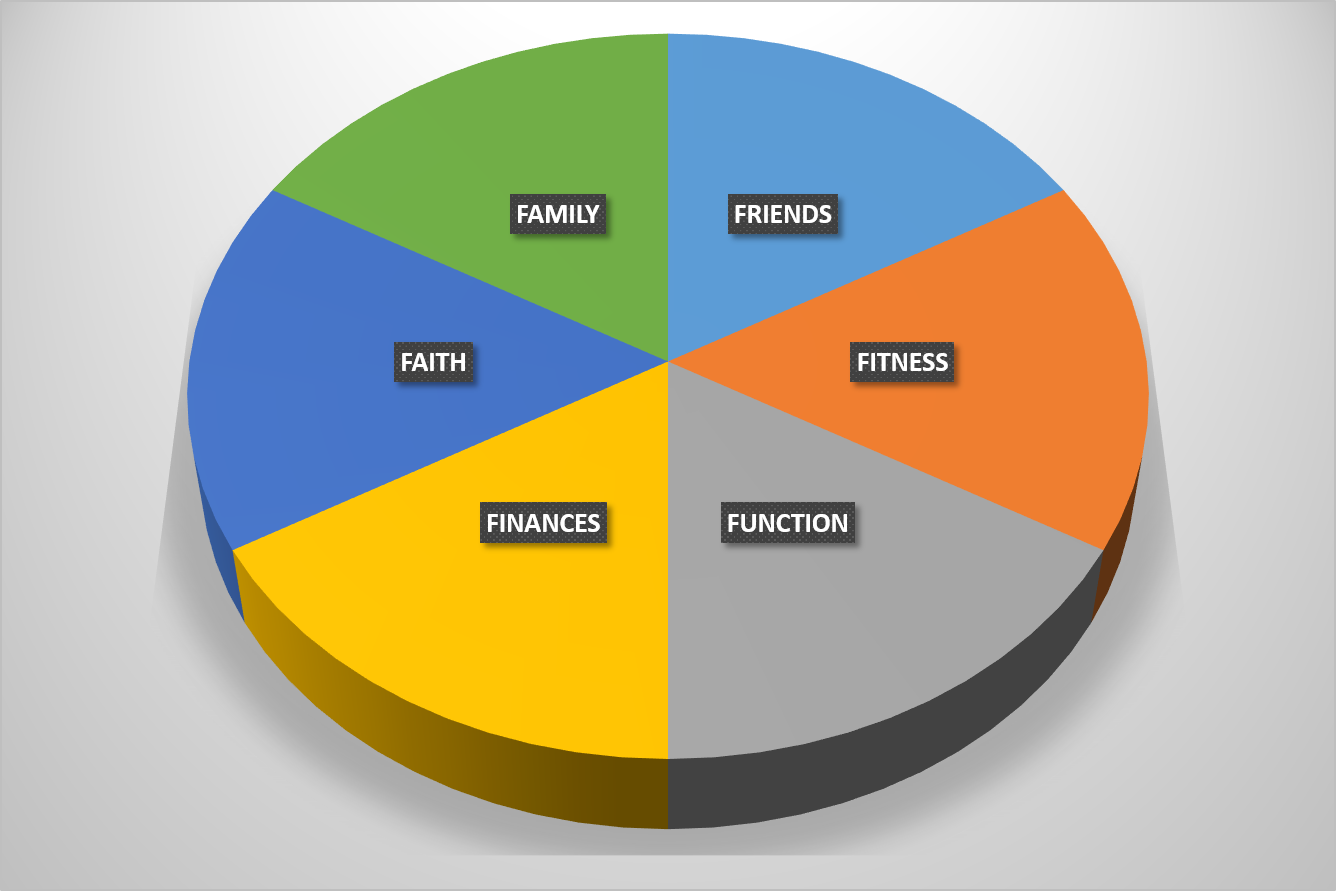
Think of one significant goal you have at this point in time. More than likely it falls into one of the Six Fs: Family, friends, fitness, finances, function, or faith.  Once you have the goal in mind, apply the above rubric to it on a broad scale.

Six Fs (Steve Piscitelli)

Example 1. Review your fitness routine at the gym. Let’s say you rate your daily workout with a “2”   (needs to hit the reset button). Now drill down for insights.  What in particular do you need to shake up? Is it your cardio exercise? Have you plateaued on the cross trainer and need more of a challenge? Same question for your resistance training.  Or perhaps you need a few sessions with a trainer. In this manner you don’t walk away from the entire fitness program. Rather you refocus your energies on those pieces that no longer serve or nourish you.

Example 2.  Consider what you do for a living—for your calling, your purpose, or your function.  Whether you report to an office each day or participate in the gig economy, survey what you do.  Does what you do inspire you to get up out of bed each day and act?  Or would you rather hide under the bed sheets? If you score yourself a “1” does that reflect how you feel about the entirety of what you do each day? Is there any part of your workday that earns a “3” or a “4”?

Narrow the focus, once again, to help yourself understand what does or does not serve and nourish your soul.

Video recommendation for the week:

I asked my students, “Are you building a transcript or building a life?” Same for our callings, “Are we building a resume or a life?” One path can stifle us. The other inspires us to act.  While this short clip speaks about students, the premise holds as well for life success and meaning in general.  How do you stay in tune? How and when do you hit the reset button?

Make it an inspiring week and H.T.R.B. as needed.

For information about and to order my book, Stories about Teaching, Learning, and Resilience: No Need to be an Island, click here.  A number of colleges and one state-wide agency have adopted it for training and coaching purposes. Contact me if you and your team are interested in doing the same.

My podcasts: The Growth and Resilience Network® (http://stevepiscitelli.com/media-broadcast/podcast).

My programs and webinars: website  (http://stevepiscitelli.com/programs/what-i-do) and (http://stevepiscitelli.com/programs/webinars).

Pearson Education publishes my student textbooks for life success—Choices for College Success (3rd edition) and Study Skills: Do I Really Need This Stuff? (3rd edition).

(c) 2018. Steve Piscitelli. All rights reserved.

Posted in Appropriate Behavior, assumptions, authenticity, Being REMARKABLE, change, change management, consideration, creating your future, curiosity, Life lessons, Mindfulness, self-awareness | Tagged , , , , , , , | 1 Comment

(#407) Are You Just Doing Stuff?


We can easily get caught up in the “noise” around us
if we allow that to happen.
The wrong things end up pushing the right things to the side.

An upcoming speaking engagement reminds me of a truism when it comes to goal setting. We not only have to take action, we need to engage in the correct actions.

One exercise I have facilitated has people first identify their top three priorities. This is followed by listing the top three things that typically claim most of their time in a week.  When they compare the two sides, more times than not, they discover disconnections between the stories they tell themselves and the stories they live. If these scenarios play out week after week, I suggest they have a serious conversation with themselves, a mentor, or coach.

We can easily get caught up in the “noise” around us.  Those people, things, or issues that distract us from our priorities are more than likely what we have allowed into our lives.  The wrong things end up pushing the right things to the side.  We end up doing a lot of stuff—but not the right stuff.

Video recommendation for the week:

This video has risen to the third-most-viewed video on my YouTube channel.  I conducted the demonstration about 6 years ago in one of my classes. It is a great metaphor for how we can let other agendas crowd out our goals.

The video comes to you in three parts: (1) the set up; (2) the problem; and (3) the conclusion and lesson.  Listen to the observations and thoughts from the people participating in this video with me.

Classroom teachers who may be reading this blog: Consider this as one way to introduce and/or reinforce the concept of priority management to your students. You could actually show it in three segments; pause the video after each segment; have the students write a reflection; then conclude with a group discussion.

Office managers, consider it as a reminder for your team to focus on the right stuff.

Have fun with it!

Make it an inspiring week and H.T.R.B. as needed.

For information about and to order my book, Stories about Teaching, Learning, and Resilience: No Need to be an Island, click here.  A number of colleges and one state-wide agency have adopted it for training and coaching purposes. Contact me if you and your team are interested in doing the same.

My podcasts: The Growth and Resilience Network® (http://stevepiscitelli.com/media-broadcast/podcast).

My programs and webinars: website  (http://stevepiscitelli.com/programs/what-i-do) and (http://stevepiscitelli.com/programs/webinars).

Pearson Education publishes my student textbooks for life success—Choices for College Success (3rd edition) and Study Skills: Do I Really Need This Stuff? (3rd edition).

(c) 2018. Steve Piscitelli. All rights reserved.

Posted in accountability, action, authenticity, awareness, Connection-Disconnection, consideration, creating your future, Critical Thinking, Goals, growth, Priority management, Words and Action | Tagged , , , , , , , | 1 Comment

(#406) Purpose and Authenticity


Mortality salience often leads you
to ask questions about the meaning in your life.

In his book, The Blue Zones of Happiness: Lessons from the World’s Happiest People, Dan Buettner builds a case for well-being consisting of three strands: pleasure, purpose, and pride.

Let’s drill down on purpose.

Buettner says that purpose “has to do with living out your values and passions in the service of … doing what is worth doing.” (21)

David Chan, the Director of the Behavioral Sciences Institute and a Professor of Psychology, writes that “that people experience ‘mortality salience’ when they encounter events that expose the fragility of life. This refers to the heightened awareness that our death is inevitable and unpredictable… Mortality salience causes anxiety and stress. But it is not necessarily negative. One positive impact is that it often leads you to ask questions about the meaning in your life.”

Chan offers five components for living a life with meaning:

  1. Complementarity
    • Your life reflects your desires. Your actions match your passions. Your work has meaning. It resonates and touches your core.
  2. Congruence
    • You speak and live truth to self. Rather than follow someone else’s script, you write your own. You live an authentic life.
  3. Commitment
    • Concrete and realistic goals that represent a larger purpose for life. Chan advises that you move from general goals to concrete goals that translate intent of purpose to action. Your goals represent high and sustained commitment.
  4. Contribution
    • You make a difference in others’ lives. You move from you-centric to people-centric. As one artist explained it, move from “I exist” to “they exist.”
  5. Community
    • You join and share interests, values, beliefs, and a common cause. You belong.

Yes, we still confront and carry out those tasks that do not necessarily bring us joy.  As cliché as it sounds, that’s life. And, when we make consistent and considered efforts to live a meaningful life—the Five Cs above—we develop our purpose.  Chan found that

When we realize that life is short and fragile but we have a strong sense of our meaning in life, our fear of death and anxiety will be replaced with aspirations and inspirations that translate into positive attitudes and actions.

Video recommendation for the week:

Listen to Dan Buettner speak about where you can find the Blue Zones and “9 Secrets for Happiness.”

Make it an inspiring week and H.T.R.B. as needed.

For information about and to order my book, Stories about Teaching, Learning, and Resilience: No Need to be an Island, click here.  A number of colleges and one state-wide agency have adopted it for training and coaching purposes. Contact me if you and your team are interested in doing the same.

My podcasts: The Growth and Resilience Network® (http://stevepiscitelli.com/media-broadcast/podcast).

My programs and webinars: website  (http://stevepiscitelli.com/programs/what-i-do) and (http://stevepiscitelli.com/programs/webinars).

Pearson Education publishes my student textbooks for life success—Choices for College Success (3rd edition) and Study Skills: Do I Really Need This Stuff? (3rd edition).

(c) 2018. Steve Piscitelli. All rights reserved.
Posted in authenticity, fortitude, generativity, Goals, Gratitude, Integrity, intentionality, Life lessons, Passion, Purpose, resilience | Tagged , , , , , | 2 Comments

(#405) Communication or Statement?


Are we listening to others—and to ourselves?

One activist described communication as understanding someone else’s experience and presenting a point within that experience. “Even the most elementary grasp of the fundamental idea that one communicates within the experience of his audience—and gives full respect to the other’s values….” [Emphasis added]

How often is “communication” confused with “statement”?  Because I make a statement of my belief does not mean I am communicating. Think of a social media thread you may have followed where two or more disparate views present themselves.  How often is there an attempt at “communication”—sharing ideas and making efforts to connect with someone with a different perspective?  Rather than listen, question, listen, question, think, question, learn, question, how often does the rhetoric ramp up to yelling? (You know they are yelling, for example, by the multiple exclamation points!!!!!!!!!!!!!! When that fails we’ll see name calling or shift of attention.)

In the opening paragraph of this post, to make a point, I gave you two links to credit the words I cited. I did not state the name of the person or the book. If I had credited Saul Alinsky and his primer Rules for Radicals some readers may have stopped “listening” and formulated why they loved or hated those words. Based on a name, a reputation, or a publication.  Statements would flow about why he was the devil or the savior of community organization.

It’s easy to have a conversation when we speak with those with whom we agree. It becomes difficult when the other party or we believe nothing can be learned from our disagreements and continued conversation.

The fifth energy chakra—the Throat chakra—connects to clear voice; integrity of message. And it is associated with the sense of hearing.  To have a clear and authentic message, we need to hear what the other person/group/ideologues say. That requires listening, not statements.

Alinsky speaks of the Haves, the Have-Nots, and the Haves-Little but Want More.  The moral compass of each group can shift when we change positions. We see it in politics and history. One example shows Samuel Adams as a leading figure of the American Revolution, challenging the authority of the Haves (the British government in favor of the status quo). Adams was a revolutionary ideologue.  But in the 1790s when The Whiskey Rebellion (American citizens challenging the new American government) broke out in western Pennsylvania, he supported the American government’s (now in the position of Haves) suppression of the rebellion. Did he become an anti-revolutionary ideologue who now supported the new status quo?

Alinsky’s first rule: “One’s concern with the ethics of means and ends varies inversely with one’s personal interest in the issue.”

Are we listening to others—and to ourselves?

Video recommendation for the week:

Consider Celeste Headlee’s TED Talk about ten basic rules for effective conversation.

Make it an inspiring week and H.T.R.B. as needed.

For information about and to order my book, Stories about Teaching, Learning, and Resilience: No Need to be an Island, click here.  A number of colleges and one state-wide agency have adopted it for training and coaching purposes. Contact me if you and your team are interested in doing the same.

My podcasts: The Growth and Resilience Network® (http://stevepiscitelli.com/media-broadcast/podcast).

My programs and webinars: website  (http://stevepiscitelli.com/programs/what-i-do) and (http://stevepiscitelli.com/programs/webinars).

Pearson Education publishes my student textbooks for life success—Choices for College Success (3rd edition) and Study Skills: Do I Really Need This Stuff? (3rd edition).

(c) 2018. Steve Piscitelli. All rights reserved.
Posted in assumptions, awareness, blame, change, Communication, Community, growth, Haters, ideologies, intentionality, Mindfulness, resilience, self-awareness, self-efficacy | Tagged , , , , , , , | 5 Comments

(#404) Risk, Empty Spaces, and Self: Lessons from the Stage


“There is no failure in result; there is only failure in process.”

Sam Wasson’s Improv Nation: How We Made A Great American Art provides more than an improv history lesson. He deftly lays out a philosophy of life.  For all their talents and human frailties, these men and women lived life in the present moment. In fact, from an improv point of view, there is no other way to live life.  We must experience it, listen to it, step out of the comfort zone, enhance our partners, and embrace the story we create.

The following quotes were among the many that spoke to me. I have included a few personal reflections. I encourage you to do the same.

  • Director Mike Nichols about his improv partner, Elaine May “Elaine gave me myself.” (p. 87)
    • Who in your life helps to draw out yourself?
    • Who in your life allows you to be you?
    • Who in your life forces you to confront yourself?
    • In what ways do you allow others to embrace their own selves?
  • Paul Sills: “You can’t reject outside authority until you realize you have a self.” (128)
    • Again, how do we go about embracing our own selves and all they have to offer?
    • Do we allow others to dictate who we are and will be?
  • A common improv coaching imperative: “You have to get there together.” (98)
    • Think of your collaborative attempts. Are you getting there together or are you just engaging in collective monologues?
    • I recently heard a supervisor talk about how the team needed to collaborate. Unfortunately, a lot of what I heard included the pronoun “I.”

  • Gilda Radner: “…Be a child again for a little while, be naïve, have empty spaces that can be filled in. What’s so sad about so many grown-ups is they lose those spaces.” (178)
    • How can we nurture those empty spaces?
    • How can you help others nurture their empty spaces?
  • Bernie Sahlins: “Once you start worrying about your career you don’t want to take risks. Once you avoid risks you’re hemmed in.” (249)
    • If we don’t risk, can we grow? How can we find the empty spaces and be childlike?
  • Sigourney Weaver: “There’s this Second City theory that says if you help people around you to be good, you’ll also bring out the best in yourself.” (278)
    • When on stage a true improv artist will not deny his/her partner. Partners grow because of one another.

  • One of the master coaches of improv, Del Close: “There is no failure in result; there is only failure in process.” (318)
    • How often do we stop and dive deeper into the process—beyond the result?

How can we apply improv to life for good?

Video recommendation for the week:

Tina Fey offers basic improv advice that moves to the heart of true collaboration. A two-minute lesson with broad implications for life beyond the stage.

Make it an inspiring year and H.T.R.B. as needed.

For information about and to order my book, Stories About Teaching, Learning, and Resilience: No Need to be an Island, click here.  A number of colleges and one state-wide agency have adopted it for training and coaching purposes. Contact me if you and your team are interested in doing the same.

My podcasts: The Growth and Resilience Network™ (http://stevepiscitelli.com/media-broadcast/podcast).

My programs and webinars: website  (http://stevepiscitelli.com/programs/what-i-do) and (http://stevepiscitelli.com/programs/webinars).

Pearson Education publishes my student textbooks for life success—Choices for College Success (3rd edition) and Study Skills: Do I Really Need This Stuff? (3rd edition).

(c) 2018. Steve Piscitelli. All rights reserved.
Posted in acceptance, amplifying, assumptions, authenticity, awareness, Being REMARKABLE, childlike, confidence, Mindfulness, risk-taking, Teaching, teaching and learning, vulnerability, wisdom, Words, Words and Action | Tagged , , , , , , , , | 1 Comment

(#403) Create Your Own Story Or Someone Else Will


It may be too late.

Perhaps you have witnessed it.  People in a leadership position who fail to communicate clearly and effectively. An organization experiences gut-wrenching turnover, service decline, loss of client base, and eroding collegiality.  The people charged with making decisions have not been forthcoming—or worse, they point fingers and double down on questionable (at best) courses of action.

In these situations, the leaders sacrifice direct and honest conversation. They move to circling the wagons. Communication becomes “brand-oriented” not “people-centric.”

They don’t get it.

When leaders do not authentically share the organization’s story with their employees, the employees will create the story. Worse, the leader loses authority/power/control and influence.

For instance, if you (the leader):

  • Lack transparency with your staff, they will create your story.
  • Refuse to acknowledge that the team and clients create the brand, they will create your story.
  • Attempt to isolate so-called non-team players, they will create your story.
  • Play it close to the vest and release cryptic information, they will create your story.
  • Reorganize without clear direction, reason, humanity, or explanation, they will create your story.
  • Provide incorrect information, they will create your story.
  • Refuse to listen to (or even allow) criticism and employee feedback, they will create your story.
  • Fail to prioritize effective and timely email or phone replies, they  will create your story.
  • Promise and do not deliver, they will create your story.
  • Read scripted remarks and refuse to take questions, they will create your story.
  • Fall back on “That’s how (not how) we do things around here,” they will create your story.
  • Provide vanilla answers, they will create your story.
  • Stonewall, they will create your story.
  • Lie, they will create your story
  • Bully, they will create your story.
  • Disrespect, they will create your story.
  • Attempt to reclaim your story, they have already created your story.

It may be too late.

Video recommendation for the week:

The above can also apply to personal relationships.  “Communication Breakdown” by Roy Orbison.

Make it an inspiring year and H.T.R.B. as needed.

For information about and to order my book, Stories About Teaching, Learning, and Resilience: No Need to be an Island, click here.  A number of colleges and one state-wide agency have adopted it for training and coaching purposes. Contact me if you and your team are interested in doing the same.

My podcasts: The Growth and Resilience Network™ (http://stevepiscitelli.com/media-broadcast/podcast).

My programs and webinars: website  (http://stevepiscitelli.com/programs/what-i-do) and (http://stevepiscitelli.com/programs/webinars).

Pearson Education publishes my student textbooks for life success—Choices for College Success (3rd edition) and Study Skills: Do I Really Need This Stuff? (3rd edition).

(c) 2018. Steve Piscitelli. All rights reserved.

Posted in boundaries and limits, change management, collegiality, Communication, decision making, Excuses, Failure, Integrity, intentionality, leadership, Life lessons, resilience, responsibility, self-awareness, self-efficacy, self-regulatory behavior, workplace bullies | Tagged , , , , , , , , | 3 Comments