
(#312) Organizational Climate and Culture


Those who don’t understand the importance of relationship building
to affect culture change are not leading but simply taking a meandering walk.

At the end of this month I’ll address an audience in Austin, Texas on strategies to motivate people within an organization to take charge of their own professional growth and resilience. One of the categories for conversation is that of incentives and disincentives, within an organization, for professional and personal development.  When I shared the items on this list with my wife, she asked about two in particular.

“What is the difference,” she asked, “between institutional culture and institutional climate?”

Every organization would do well to ask itself the same question.  They are connected but they most definitely differ.

Photo by Steve Piscitelli

Photo by Steve Piscitelli

Culture refers to the deeply held behaviors and expectations that an organization has built over time. It’s more than the way we do things around here. It’s the way we have done things around here for a long time.

Climate more aptly describes “the shared perceptions and attitudes about the organization” that have an impact on the employees and the clients they serve. These can change with new leadership. The climate change, however, in of itself does not necessarily create culture change.

In other words, people will come and go but culture remains over time.

Consider a meteorological metaphor.  This past Christmas season saw unseasonably warm temperatures in many areas of the nation.  In the Northeast for example, traditional ugly holiday sweaters gave way to shorts and t-shirts.  Can we conclude that due to this recent temperature change that the culture of that part of the nation will change? Will people decide to toss out their boots and parkas and forever replace them with flip flops and tank tops? Doubtful.  The momentary (climatologically speaking) change will not have a sustainable impact on the behaviors and expectations that have accumulated over the years.

The same in an organization.  A new leader can come in and offer a vision of cultural change. But if the leader cannot deliver then she will not affect cultural change. I’ve seen it in higher education. A new president arrives promising sweeping changes (always touted for the better in his or her perception).  Two, three or more years later and the culture remains. Why, because the new management provides superficial climate changes.

Perhaps the new management team presents something along the lines of “we will right-size our workforce to better serve our client base. We will be more nimble and responsive.” In addition to “reorganization” management brings in new people with needed “skill-sets.” The spoken word implies a cultural change to provide more appropriate service delivery.   Changing the workforce will not in and of itself bring cultural change. In fact, if the new people (part of the climate change) do not fit with the existing culture damage may be done to what had been working in the culture.  What the people of the organization may only see is massive job loss and/or salary reductions–and new people who do not appreciate what they have done to build the organization to that point.

Video recommendation of the week.

Listen to what Tony Hsieh experienced in his pre-Zappos culture-and what he created at Zappos.

Yes, the climate has changed with the new management initiatives. But if the message is explicitly or implicitly delivered that “you should be happy that you still have a job,” well do you really think that will lead to sustainable cultural change? Again, doubtful.

Edgar Schein, a recognized expert in the area of workplace culture, says that employee engagement (part of the culture) is dependent upon managers understanding the human factors of leadership.  As Schein states, “There is beginning to be recognition that relationships matter. Our pragmatic culture that’s all about get the work done, don’t bother me with feelings and relationships, is working less and less well…”

Those who don’t understand the importance of relationship building to affect culture change are not leading but simply taking a meandering walk. And their climate change may just result in a walk in the rain without an umbrella.

Make it an inspiring week as you pursue your authentic “hell, yeah!” goals.—H.T.R.B. as needed.

You can subscribe to my newsletter by clicking here.

You can find my podcast series at Growth and Resilience (http://stevepiscitelli.com/video-media/podcasts). 

Check out my website  (http://www.stevepiscitelli.com/programs.html) for programming information as well as details about upcoming webinars (http://www.stevepiscitelli.com/webinars).

My books Choices for College Success (3rd edition) and Study Skills: Do I Really Need This Stuff?  (3rd edition) are published by Pearson Education.

(c) 2016. Steve Piscitelli. All rights reserved.

 

Posted in faculty development, institutional climate, institutional culture, professional development, Relationship, relevance | Tagged , , , , , , | 1 Comment

(#311) Grade Inflation: Have We Arrived In Lake Wobegon?


Grade inflation/distortion has consequences for
self-efficacy, self-awareness, and self-competence.

For most colleges and universities around the nation, graduation time has arrived. Professors have evaluated the final exams, grades have been submitted, and students anxiously await their grades. Or, more to the point of this post, they await their expected “A.”

Grade inflation

The condition that, if you stop and think, moves toward making everyone average.  If “A” is supposed to represent “Superior” or “Stand Out” but the majority of students are getting As, doesn’t that mean that the “A” has become more average than a rank of superiority? After all, if 40%, 50% or more of the students have inflated grades, how do the truly exceptional stand out and how do employers identify the great ones from the less-than great?

Maybe, we now live in the land where everyone is superior.  Doubtful.

Image: prakairoj@FreeDigitalPhotos

Image: prakairoj@FreeDigitalPhotos

Does grade inflation actually exist?

One extensive study pinpoints two eras of high grade inflation: The Vietnam War Era and the Student as Consumer Era (1980s to present era). The grade of “A,” according to this research (and more) is the most common grade now at both four and two-year institutions. A few years ago a Harvard professor “stirred up controversy by criticizing rampant grade inflation at his institution.”

The obvious question: Why does this exist?

While each institution may differ, some of the reasons put forth for grade inflation include:

  • Inflated high school grades do not equip incoming college students with the experience of receiving grades other than an “A.”
  • The student as “customer” mentality where the customer is always right creates expectations that have to be fulfilled.
  • Higher tuition costs are a fact and, thus, parents clamor to get what they paid for (high grades).
  • Student evaluations of faculty—and the use of those evaluations for tenure, promotion or renewal of contract can intimidate faculty.
  • Students have become obsessed with receiving (not necessarily earning) nothing less than an “A” for their graduate school application.
  • Where there is a larger reliance (at community colleges, for instance) on adjunct instructors—their concern for job retention may influence grades.
  • A lack of consistent standards across a department or discipline can create a wild west of grade distribution.

Video recommendation of the week.

In this video, The Economist takes a look at forces associated with grade inflation.

Inflation or Distortion?

But does grade inflation actually exist?  If we follow an economic argument, it does not. In true economic inflation there is no cap on prices. They keep rising. But in what passes for grade inflation, there is, in fact, a cap. There is no grade higher than an “A.” So what we really have is grade distortion.

Time for Question-storming

Whatever we call it, it exists. But what or who causes it? Certain departments? Particular courses? The same instructors?

Interesting anecdotal observation: When the charge of grade inflation is leveled, it generally appears to be aimed at the previous classes or instructors. The finger tends to point to another colleague, another campus, or another school as the culprit.

Can grade inflation be attributed to “academic freedom”? That is, each instructor can establish the best way to gauge and rank progress for her students.

If a student got an “A” in a feeder course and is struggling in the next level, is that because of grade inflation or does the current instructor deserve some scrutiny as well?

If they do not already exist, would agreed-upon departmental objectives, standards, performance benchmarks, and/or assessments help eliminate or prevent or, at least, minimize grade inflation?

What is the connection, if any, between grades issued and faculty evaluations? If a relationship exists, can it be transparently proven? If a relationship exists, should it be discontinued?

What have been the consequences of grade inflation? Does it lead to a poorly-prepared and a deceptively-delivered product (diplomas or certifications) for the future employers?

And will students who have come to expect inflated (or distorted) grades come to expect the same on employee evaluations, salary raises, and promotions? After all, if I got top grades should I not get top dollar as well?

If we believe the research, we find ourselves where more and more students are average and it’s not a fictional town. It has consequences for self-efficacy, self-awareness, and self-competence.

Make it an inspiring week as you pursue your authentic “hell, yeah!” goals.—H.T.R.B. as needed.

You can subscribe to my newsletter by clicking here.

You can find my podcast series at Growth and Resilience (http://stevepiscitelli.com/video-media/podcasts). 

Check out my website  (http://www.stevepiscitelli.com/programs.html) for programming information as well as details about upcoming webinars (http://www.stevepiscitelli.com/webinars).

My books Choices for College Success (3rd edition) and Study Skills: Do I Really Need This Stuff?  (3rd edition) are published by Pearson Education.

(c) 2016. Steve Piscitelli. All rights reserved.


Posted in accountability, adjunct faculty, Appropriate Behavior, assumptions, awareness, college retention, confidence, courage, Dreams, Education, education reform, emotional intelligence, Grit, Integrity, Life lessons, Personal growth | Tagged , , , , , , , , , , | 3 Comments

(#310) Plussing + Amplification = Authentic Quality


What can you do this week to plus a situation and amplify someone’s position?

Seasoned Improv players understand and regularly use the “Yes, And” strategy. “Yes, And” moves a scene and its players along. “Yes, But” is a scene killer. Transformational leaders and creative collaborators understand and use some form of “Yes, And.”  Consider the following:

  • Walt Disney called it “plussing” whereby he/his people would constantly add more value to the product or service they provided for their customer.
  • In The Captain: The Journey of Derek Jeter, Ian O’Connor relates the story of a Yankee coach saying that Derek Jeter always “pluses the experience.” Whether playing on the filed, stopping to talk with little kids, or improving his physical conditioning, Jeter looked for ways to add positively to the situation at hand.
  • In medicine, plussing refers to “reducing the negative consequences and augmenting the potency of a given remedy.”
  • Randy Nelson of Pixar (2010) said that his teams moved beyond collaboration to “amplification.”  The collaboration that matters is the collaboration that keeps us from getting in the way of one another. And it goes beyond just cooperating. We have to bring our separate skills and creativity to a situation. The resource remains in listening to one another—not manipulating or cowing or intimidating one another.

Video recommendation of the week.

Listen to what amplification means for Pixar.

One writer describes the Pixar transformative process thusly: “Rather than randomly critique a sketch or shoot down an idea, the general rule is that you may only criticize an idea if you also add a constructive suggestion. Hence the name plussing.”

You can only criticize if you add.  You have to be constructive—not demeaning, dismissive and/or disdainful.

Plussing.

Think of your favorite band. Don’t they “plus” for you?

Your coach, your mentor, your favorite teacher.  Chances are they all “plussed” for you.

The handyman you hire time and again? A “plusser”!

The colleague who constantly helps to amplify your ideas by “plussing”—not denigrating.  She looks at what you present and then adds, “Yes, what if….”

And, chances are somebody thinks of you as one who amplifies rather than muffles.  Keep it up. The world needs more of you desperately.

Photo by Steve Piscitelli

Photo by Steve Piscitelli

Yes, we have all been with the “non-plussing” people. Those that find fault with most anything we bring to the table. They don’t (at all) add to our suggestions. They tear them down.  They serve as resident energy vampires. The “non-plussers” of life. Theirs is a miserable existence on many levels.

What can you do this week to “plus” a situation; to “amplify” a colleague’s proposal—even if it falls short of the mark; to truly listen and say “Yes, And”…”What if we”… “Let’s authentically build on what you brought to the table”?

Make it an inspiring week as you pursue your authentic “hell, yeah!” goals.—H.T.R.B. as needed.

You can subscribe to my newsletter by clicking here.

You can find my podcast series at Growth and Resilience (http://stevepiscitelli.com/video-media/podcasts). 

Check out my website  (http://www.stevepiscitelli.com/programs.html) for programming information as well as details about upcoming webinars (http://www.stevepiscitelli.com/webinars).

My books Choices for College Success (3rd edition) and Study Skills: Do I Really Need This Stuff?  (3rd edition) are published by Pearson Education.

(c) 2016. Steve Piscitelli. All rights reserved.


Posted in Appropriate Behavior, assumptions, authenticity, awareness, collaboration, leadership, Life lessons, transformational leadership | Tagged , , , , , , | 3 Comments

(#309) Thanks. You’re NOT Helping!


I totally understand that many people just don’t know what to do
when someone in front of them says, “I have cancer.”

Last week I shared the well-intentioned and well-executed words and actions that so many people offered on behalf of my wife and me following her diagnosis of breast cancer.  That post allowed me to share our gratitude and at the same time provide suggestions (that worked for us) for those who may not know what to say or do for a friend or family member facing a similar life-changing event.

This week, I shift perspective and take a look at some of the not-so well-executed words and actions. Though well-meaning, these ended up missing their mark. Again, like last week’s post, this feedback hopefully will provide useful information for those in similar situations.

Cancer.Net states that when a diagnosis is made public

Your friends and family members will likely want to help you, but they might not know what you need or how to ask you. Be direct and explicit about your needs, and try to avoid making assumptions about who will help and who will not. …. set boundaries … let them know exactly what is helpful and what is not….” 

Along the way we learned to set boundaries and limits.  I totally understand that many people don’t know what to do when someone in front of them says, “I have cancer.” It can be (and we found that it is) very scary to observers.  They do not know what to say or do. After all, no one has handed them a user’s manual on how to support someone with that diagnosis.

2015-11-07 11.27.17

I would like to offer a few examples of the heartfelt, yet ineffective, actions that Laurie and I experienced. So, in the category of “Thanks. You’re Not Helping!” (TYNH!) let me offer the following suggestions from our perspective. Consider them; accept them; discard them. Your choice depending on your situation.

  1. “It could be worse.” (TYNH!) These words are not helpful to someone who just got a life-threatening diagnosis. Yes, I guess, anything can be worse. But to the person with the diagnosis (and her partner), we really do not care about what could be worse. We care about our situation and story.
    Better: This is not the time for comparatory suffering. Offer support. But do not denigrate the experience by lessening it.  Allow the person to speak about the diagnosis if he or she desires.
  2. “I know just how you feel.” (TYNH!) No, you don’t! You or a family member may have gone through the exact same diagnosis. But you do not know what the person in front of you feels.  When you insist that you do, you have denied that person’s story.
    Better: If applicable, offer that you and/or someone very close to you have gone through this. And offer that you are there if and when the person would like to talk. Unless asked, this is not the time to go into depth about another person’s situation (see next item).
  3. “Let me tell you about my aunt [grandmother, mother, sister, neighbor….]. She had the same thing.” (TYNH!) This often appeared to be a defense mechanism by the people with whom we shared the news. They knew nothing else to say, so they talked about someone else with cancer. If you do this, you are now subjecting the patient in front of you with someone else’s cancer story. And, again, you have denied her story.
    Better: Like the situation above, you could acknowledge that you have had some experience with this through your aunt [grandmother, mother, sister, neighbor….] and then leave it at that. No need (unless you are asked follow-up questions) to go deeper into someone else’s story. Practice empathy.
  4. “I need more specifics.” (TYNH!) No, you don’t!  Unless you are a health care provider or have a legal connection, you only need what the patient and family chooses to tell you.
    Better: Accept what has been offered. Yes, you may want more but allow the patient to have the dignity to control her own flow of information.
  5. “I posted on Facebook for you.” (TYNH!) Really? Some people have a need to be the first to share bad/sensational/OMG-type news. It’s not your story to release. Period.
    Better: If you have not seen a post from the patient about this, it is not your place to let the world know that you are praying for so-and-so in this time of challenge. Remember boundaries and limits.

    Image: Laurie Piscitelli

    Photo by Laurie Piscitelli

  6. “You should do…should not do….” (TYNH!) Unless the patient and/or family member directly asks you, “What do you think we should do?” please refrain from “shoulding” on them.
    Better: You may feel you know best. Again, it’s not your situation.  You can offer that you have information or past experiences that may be helpful. And leave it at that.
  7. “_____.” (TYNH!) Some folks are so uncomfortable with cancer, they just ignore that it exists. They say nothing. No acknowledgement.
    Better: Let the person know that you are tongue tied and at a loss for words at the present. And that you do hold the very best in your heart even if you don’t know how to express it. Offer, if it is in your heart and capabilities, that you would be glad to help.
  8. “_____.” Part II . (TYNH!) Laurie had cancer. Not me. It was her body and her life on the line. She was the person who had toxins pumped into her for four months. Having said that, don’t forget the family/partner to the patient. They need support as well. To not acknowledge the family member is an injustice.
    Better: I cannot tell you how grateful I was for the people who asked about me and how I was handling the situation. No, it was definitely not about me. But I traveled this journey.  Why would you not ask about the family member/caregiver?
  9. “I know you said you don’t need me to do this but I am because I need to do it for myself.” (TYNH!) Totally understandable—but it does not help. If you ask to visit, make food, call or text and the patient or family demurs, except that boundary.
    Better: This time, while it can be very hard on friends and extended family, is about the patient and her family. Remember, the patient is not there to give you therapy. Knowing that you care may be all the patient and family need at the current time. Be specific about what you can do…and then let the patient or family take it from there.
  10. “You need to focus.” (TYNH!) I was told that.  Again, the intent was admirable, the execution poor. We were keenly focused—everyday. We had cancer, not dementia.
    Better: If your friend appears to be at wits end or seems to be distracted, offer to listen. Gentle guidance may be needed. Telling someone to “focus” when you do not know the entire story comes across very judgmental and, frankly, demeaning.
Photo by Steve Piscitelli

Photo by Steve Piscitelli

We remain deeply indebted to those many, many friends who made this journey as smooth as possible.  Their positive thoughts and love were nothing short of humbling.  The foregoing in no way diminishes that. The ten suggestions above may help someone else avoid unintentional missteps in an already difficult period in a person’s life. These are from our perspective; maybe they won’t work in your situation.  We offer them as options to consider. If you keep your heart open and remember not to deny the patient and family’s story or privacy you will be doing good. Thank you all for standing by and with us! -Laurie and Steve

Video recommendation for the week:  A classic song done in a manner that shows how important it is to have somebody to stand by you. Enjoy!

Make it an inspiring week as you pursue your authentic “hell, yeah!” goals.—H.T.R.B. as needed.

You can subscribe to my newsletter by clicking here.

You can find my podcast series at Growth and Resilience (http://stevepiscitelli.com/video-media/podcasts). 

Check out my website  (http://www.stevepiscitelli.com/programs.html) for programming information as well as details about upcoming webinars (http://www.stevepiscitelli.com/webinars).

My books Choices for College Success (3rd edition) and Study Skills: Do I Really Need This Stuff?  (3rd edition) are published by Pearson Education.

(c) 2016. Steve Piscitelli. All rights reserved.
 

Posted in Appropriate Behavior, authenticity, awareness, courage, dignity, Friendship, Gratitude, Integrity, resilience | Tagged , , , , , , , , | 4 Comments

(#308) Thanks. You’re Helping!


Laurie and I remain deeply indebted to many, many friends
for their positive thoughts and love.

I often incorporate into my posts personal experiences and stories with broader lessons and insights.  This week’s post comes from the most personal of all experiences that my wife, Laurie, and I have traveled together.

The journey began August 19, 2015 when Laurie received the diagnosis that she had Triple Negative Breast Cancer. Immediately we began acknowledging and sorting through the range of emotions that would last through her surgery, surgical recovery, chemotherapy and currently the road to what we expect to be full recovery.

From the beginning, I followed Laurie’s lead on how to best support her.  Of course, after 40 years together we pretty much know what each other needs.  One of the early choices was to not live each moment of her diagnosis and treatment on social media. While some people might have used that forum at that time, it was not our choice in this situation.  We informed friends and family as appropriate.

We cannot overstate the power of the continuous, loving, and powerful support we got from around the nation.  Supportive emails, short visits, phone calls, and text messages helped both of us through the process; especially the early days.

We experienced and appreciated (still do appreciate) the community of love that surrounded us. No question.

The odds remain that you might know or will know someone with cancer.  Sometimes knowing what to say and do can be difficult. Over the past eight months we have experienced and benefited a great deal from the power of well-intentioned and well-executed acts of kindness.  While each person and each situation remains unique, this week I will pass along what sustained (and continues to sustain) Laurie and me on our cancer journey.  Next week, I’ll pass along a few of the not-so-well executed actions.

So, in the category of “Thanks. You’re Helping!” (TYH) let me offer the following suggestions for those of you who have someone in your life struggling with cancer. You may need to adjust your responses for your circumstances. This is not meant as a script.  They worked for us.

  1. “Thank you for sharing. I can’t imagine how difficult this is.” (TYH!) We had so many people who understood that they could never understand how we felt. They recognized that and did not attempt to tell us that they understood.  We knew they were there for us.
  2. “Can I come to the hospital to be with you (Steve) while you wait on Laurie’s surgery to be completed?” (TYH!) I was grateful no one just decided to show up.  I appreciated the offer—and declined the company.  Actually, I wanted to be alone during that time. I did not want to feel like I had to make conversation.  This alone time became part of the initial healing process.
  3. “I would like to make dinner and bring it to you and Steve. Is there a good day—and is there anything I should not bring/prepare?” (TYH!) This gave us choice—and great food! Sometimes the friend who brought the food stayed (with our invitation) to visit.  A true blessing on a number of levels.
  4. “I know you will be swamped with calls, emails and texts. Know that I am here for you. I will check in on occasion.” (TYH!) We appreciated those who knew that there needed to be boundaries and limits. The offers were sincere and appreciated.
  5. “Yes, please add me to your distribution list.” (TYH!) Some folks in similar situations use platforms like Caring Bridge as a central posting location where people can check on status updates. I set up a texting distribution list for a similar purpose. It allowed for quick and easy communication with a number of folks. I also gave people the option to opt out if they so desired.  I did my best not to abuse this list.
  6. “My class made get well cards for you.” (TYH!) A dear teacher friend of ours delivered a bundle of handmade cards from her 5th grade class. Very powerful.2015-09-30 15.37.502015-10-12 10.52.25
  7. “I can do that!” (TYH!) On two occasions during the treatment cycle, I needed to travel. Two different friends gladly agreed to spend the night (kind of a “sleepover”!). While Laurie was fine on her own, I felt better knowing someone was in the house. Additionally, I reached out to two colleagues and a few friends who survived breast cancer (and thrived!). They provided immense and welcomed emotional support and practical information for Laurie as we asked for input.
  8. “How are you doing, Steve?” (TYH!) I cannot tell you how grateful I remain to all who reached out to me during the past eight months. They understood that cancer does not just affect the patient.
  9. “Just a note….” (TYH!) Thank you to the many friends who took time to just drop a note in the mail. Laurie loved getting those notes. My cousin and his wife from St. Louis sent a number of Italian care packages (complete with salami and Italian cookies. Yum!) Flowers were delivered.  Even Roxie (our wonder pup) got a few dog biscuits.
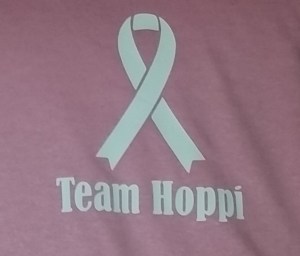
  10. “Team Hoppi!” (TYH!) I had t-shirts made up when Hoppi (Laurie’s nickname) began the journey. I gave them to a few friends. On the day she started chemotherapy, these folks put on the t-shirts, took photos, and texted them to Laurie. Even our local police sergeant posed with colleagues and snapped a photo. She loved it!

team hoppi
These remain a few of the great memories of the healing power of positive thoughts and loving energy. Laurie and I remain deeply indebted to those many, many friends who made this journey as smooth as possible. While no words can make cancer go away, the right words and actions can make the situation much more bearable.

Every situation, patient and family remain unique. My hope is the foregoing may give a bit of guidance to those who struggle with what to say and do.  If you keep your heart open and remember not to deny the patient and family’s story or privacy you will be doing good. You will be a friend indeed.

Video recommendation for the week:  How about a little Carole King and “You’ve Got a Friend”?

Make it an inspiring week as you pursue your authentic “hell, yeah!” goals.—H.T.R.B. as needed.

You can subscribe to my newsletter by clicking here.

You can find my podcast series at Growth and Resilience (http://stevepiscitelli.com/video-media/podcasts). 

Check out my website  (http://www.stevepiscitelli.com/programs.html) for programming information as well as details about upcoming webinars (http://www.stevepiscitelli.com/webinars).

My books Choices for College Success (3rd edition) and Study Skills: Do I Really Need This Stuff?  (3rd edition) are published by Pearson Education.

(c) 2016. Steve Piscitelli. All rights reserved.


Posted in Appropriate Behavior, assumptions, authenticity, awareness, boundaries and limits, Civility, common sense, courage, empathy, Friendship, health, Integrity, intentionality, resilience | Tagged , , , , , , | 10 Comments

(#307) Thank You For Paying Attention To Me


Do you treat those you lead and those you follow with dignity?
Do you do the same for yourself?

One of the things I love about what I do is that even when I’m in speaker/facilitator/keynoter mode I’m learning.  Always learning. The latest evidence came to me this past week.

Before I delivered my keynote address for the IFMA (Jacksonville) Professional Development Forum, I had the opportunity to listen to Dwaine Stevens from Publix address the audience. His overall theme reinforced the importance of providing great customer service in every phase of interaction.  Since I have been a Publix customer for decades, I am familiar with their level of customer commitment.

What caught my attention was a comment from one audience member and, then, one line that was part of the corporation’s mission statement.

As audience members shared their Publix customer experiences with Stevens, one person raised her hand and simply said, “Thank you for paying attention to me.”

This audience member had been relating one of her positive experiences with a Publix employee. I don’t recall what interaction she had in the store; however, it left a lasting impact on that woman.

Thank you for paying attention to me.

What a simple, yet powerful statement.

Stevens said simply that employees know that if their action will not foster the brand and the mission of the company, then don’t do it.  Stay true.

At first, I was quick to write off the talk of “brand” as simply monolithic corporate-speak. But as Lee Corso might’ve said to me, “Not so fast, my friend!”

amenic181@FreeDigitalPhotos.net

amenic181@FreeDigitalPhotos.net

Stevens also shared the Publix mission statement. Again, so many of these can be so many vanilla words strung together. But something caught my attention. One line in fact: “Dedicated to the dignity, value and employment security of associates.” [My emphasis supplied.]

Talk about paying attention!

Coincidentally, I had recent communication with a few higher education colleagues around the nation about career services for their faculty. One colleague shared how her four-year institution went out of its way to provide career counseling for current faculty. It was not seen as a threat—but as an important benefit to help their faculty stay relevant, current and valued. I started asking around the nation to see how common this practice might be.  So far, I have found it isn’t.  Another colleague said that not only did her institution not have such a service, there was a festering atmosphere of mistrust. (I hear this often.)

One university treats the employee with respect. The other with (what seems like from an outsider’s viewpoint) contempt.  For which would you want to work?

Video recommendation for the week:  As this TEDx talk indicates, dignity plays out around the world. It’s not some feel-good word. It means something when it’s present–and definitely means something when it’s absent.

Back to my keynote. My title challenged the audience with What Questions Should I Be Asking?  Questions about the people they served, questions about their calling, and questions about their own well-being and resilience.

More poignantly, let me pose to you a few questions. What is your personal brand (that is, who are you—really?) and do your actions support what you say your personal brand is?  Do you treat those you lead and those you follow with dignity? Do you do the same for yourself?

Your call-to-action for the coming week: (1) What (at least) one thing will you do this week that will add value to someone with whom you work and/or live.  (2) What (at least) one thing will you do this week that will add value to your life?

Make it an inspiring week as you pursue your authentic “hell, yeah!” goals.—H.T.R.B. as needed.

You can subscribe to my newsletter by clicking here.

You can find my podcast series at Growth and Resilience (http://stevepiscitelli.com/video-media/podcasts). 

Check out my website  (http://www.stevepiscitelli.com/programs.html) for programming information as well as details about upcoming webinars (http://www.stevepiscitelli.com/webinars).

My books Choices for College Success (3rd edition) and Study Skills: Do I Really Need This Stuff?  (3rd edition) are published by Pearson Education.

(c) 2016. Steve Piscitelli. All rights reserved.


Posted in branding, dignity, ethics, habits, Life lessons, resilience | Tagged , , , , , , , , , | 3 Comments

(#306) The Power of Empathy For Self


The first person we have to lead and be true to remains ourselves.

On an episode of Super Soul Sunday, Daniel Goleman (Emotional Intelligence) and Oprah Winfrey had a far-ranging conversation about Goleman’s signature subject of emotional intelligence. 

Consider Emotional Intelligence (EQ) a form of “emotional hygiene.”  When we tap into it we have a better chance of tuning into what we feel and what others feel.  We are able to read other people’s emotions and expressions. We can soothe ourselves in times of angst.

Goleman also spoke about three types of empathy. Strong leaders and top performing teams, according to Goleman, have all three.

  1. Cognitive empathy. With this we can say to someone, “I know what you are feeling….I can see things from your perspective.” We communicate and connect.
  2. Emotional empathy. Goleman said that this form of empathic connection allows us to sense what another person is feeling. “I feel your distress.”
  3. Empathic concern. Here we go beyond “feeling” another’s hurt.  We want to help the person navigate the hurt.  It becomes the basis for our concern. Transformational leaders give effective feedback and help people and teams grow.

Video recommendation for the week: In this video, Goleman also tells us each empathy carries with it a potential downside.

“Aha moment.”  The three-pronged empathy juggernaut helps effective leaders grow their teams.  But often we might forget about the person closest to us who needs and can blossom with the same caring leadership.  Ourselves.

When we have difficult times how often do we communicate effectively with ourselves? Do we become our own worst bullies when we make a mistake?  Do we pile on ourselves about “how stupid that was”?

Image: David Castillo Dominici@FreeDigitalPhotos.net

Image: David Castillo Dominici                    @FreeDigitalPhotos.net

Instead of beating ourselves up, why not take time to say, “I feel your distress…I can see things from your perspective…Here is some positive feedback that may help you [me] see the distress differently.” I’m not talking about self-indulgence and moving beyond taking responsibility for actions. Far from that.

I often use the equation “E  +  R  =  O” with audiences. “E” = Event.  “R” = Reaction or Response.  “O” = Outcome.  The event rarely causes the outcome. It definitely has an impact on the outcome. But it is what we do in the middle (React or Respond) that ends up driving the bus. We do have to take responsibility for that.

I would like to add another dimension to the equation: “E  +  C  +  R  +  O.”  The “C” = Choice.  Following the stimulus (the activating Event) we have a Choice on what to do next.

When I feel my blood pressure rise because of some irritant in my life, I can fuss and fume (which, admittedly, I do more than I would like). Or I can call on empathy for myself.  Perhaps you can do the same. Perhaps you already do the same. Treating yourself with kindness and connection makes for effective leadership.

The first person we have to lead and be true to remains ourselves.

This is another example of the stories we tell ourselves and the stories we live. We can talk about the virtues of empathy. But do we practice what we preach for ourselves?  Be mindful of just that. When you have a difficult time, speak kindly to that voice that wants to denigrate your actions. Yes, maybe you did do something that was boneheaded.  OK, acknowledge it and grow from it.  You wouldn’t endlessly beat your best friend up about something she did wrong.

Then why do it to yourself?

Make it an inspiring week as you pursue your authentic “hell, yeah!” goals.—H.T.R.B. as needed.

You can subscribe to my newsletter by clicking here.

You can find my podcast series at Growth and Resilience (http://stevepiscitelli.com/video-media/podcasts). 

Check out my website  (http://www.stevepiscitelli.com/programs.html) for programming information as well as details about upcoming webinars (http://www.stevepiscitelli.com/webinars).

My books Choices for College Success (3rd edition) and Study Skills: Do I Really Need This Stuff?  (3rd edition) are published by Pearson Education.

(c) 2016. Steve Piscitelli. All rights reserved.

 

Posted in acceptance, emotional intelligence, empathy, intentionality, leadership, Mindfulness | Tagged , , , , , | 4 Comments

(#305) Listen. Question. Grow.


“We have two ears and one mouth so that we can
listen twice as much as we speak.”

-Epictetus-
“Question everything.”
-Einstein-

Three things conspired to inspire this week’s blog.

  1. This past week I traveled to Gainesville, Florida to record a podcast about Prader Willi Syndrome. (My host was The Arc of Alachua County and the podcast will go “live” on May 15.) Early on in the conversation, Executive Director Steve Drago said one of the important things The Arc does is to “listen and ask questions. You have to really know what someone wants out of life before you work toward that….”
  2. I am putting together a keynote presentation for a group of facility managers who (typically) have to address difficult situations with internal and external customers. My title: What Important Questions Should I Be Asking—And How Do I Know They Are The Correct Questions?

    DaniloRizzuti/FreeDigitalPhotos.net

    Image: DaniloRizzuti/FreeDigitalPhotos.net

  3. My wife shared a Marilee Adams book that she had just purchased. It’s title: Change Your Questions, Change Your Life. Adams’ parable focuses on the choice we all have when confronted with a situation. Do we move along the Learner Mindset Path (asking questions of ourselves) or follow the Judger Mindset Path (casting blame on others). One leads to growth, the other to a muddled pit.

Too often we may find ourselves, colleagues, supervisors, friends of family members in the Judger role, quickly making assumptions about this or that and then smugly telling someone else what they should or should not do.  (A few years back I wrote and recorded a tongue-in-cheek song titled “I’m Gonna Should On You” aimed at all those who “should on” us.)

The listening part typically goes AWOL.  It seems that people will weigh in on most anything—whether they know about it or not. Rather than say “Can you tell me more” or “Why do you think this or that is so?” they will opine.  And God forbid if they were to utter, “I don’t know about that. Can you tell me more?”

Video recommendation of the week:  In his latest person-on-the-street questioning episodes, Jimmy Kimmel found people willing to proffer opinions about the recent SCOTUS nominee even though they did not know what they were talking about.

This week, how can you more effectively listen to the person in front of you and ask questions? (It really is OK not to know all the answers.)   Help yourself and others learn and grow.

Make it an inspiring week as you pursue your authentic “hell, yeah!” goals.—H.T.R.B. as needed.

You can subscribe to my newsletter by clicking here.

You can find my podcast series at Growth and Resilience (http://stevepiscitelli.com/video-media/podcasts). 

Check out my website  (http://www.stevepiscitelli.com/programs.html) for programming information as well as details about upcoming webinars (http://www.stevepiscitelli.com/webinars).

My books Choices for College Success (3rd edition) and Study Skills: Do I Really Need This Stuff?  (3rd edition) are published by Pearson Education.

(c) 2016. Steve Piscitelli. All rights reserved.
 

Posted in listening, question skills, Reflective practice, soft skills | Tagged , , , | 2 Comments

(#304) Random Thoughts On Overload, Gratitude And Connectedness


But wouldn’t it be a shame if we create such unforgiving filters
that the positive, the joy and the connections never make it through?

Overload.  We hear a lot about information overload. People bemoan social media as a culprit of over stimulation, time wasting, and a privacy invasion. As if we have no control over what we click and view. How much of the overload is self-imposed?  Or have we simply lost the ability or the desire to engage our filters? If we aren’t in touch then, “OMG! FOMO!”

Gratitude.  This past week I celebrated my birthday with the help of my wife, friends, former students, and colleagues across the nation. I was reminded of the gratitude I have for all of these people who have entered my life at many junctures over the past six decades—and who have decided to stay in touch. Yes, some of them may have simply hit a pre=populated “Happy birthday!” message. Nonetheless, they still took the time to hold a positive thought on my behalf. I am grateful for that.

Years ago, I would have received cards in my mailbox, phone calls, and perhaps lunch or dinner with those close by.  The physical cards I receive have dwindled to a small few. Phone calls still come in. But the biggest change comes by way of social media.

Image: pisitphoto@FreeDigitalPhots.com

Image: pisitphoto@FreeDigitalPhots.com

Connectedness.  A few friends dug deep into their treasure trove of old photos and posted old (as in 40+ years ago) of me. A student from more than 30 years ago posted an in-action-classroom photo of me (shot unbeknownst to me in the days when cameras were named Minolta rather than Android).  All were a hoot. A flood of memories came back. We laughed. And more comments were posted. It was fun and added to the happiness of the day.

Clay Shirky’s book Cognitive Surplus (2010) pointed out that one of the great takeaways of social media is that the “motivation to share is the driver; technology is just the enabler.” So often social media is equated with egomaniacal posts, rants, or out-and-out ugliness.  We can lose sight of the power of social media to connect and create positive consequences.

Some studies have shown that social media can help shut-ins achieve a sense of connectedness that they might not have otherwise enjoyed.  Recent research looking at “happy brains” points out that

“Humans have a negativity bias, a tendency to focus on threats.
But this research suggests that people may be able to compensate for it….”

In a small way, the couple hundred or so posts and “likes” I received during my birthday may very well have helped my amygdala to continue searching for the positive, uplifting events and people in my life.

The naysayers of social media will grouse about such postings. Yes, there may be possible downsides. You have to create the filters you are comfortable with. But wouldn’t it be a shame if we create such unforgiving filters that the positive, the joy and the connections never make it through?

Video recommendation of the week: Clay Shirky asks us to consider if we suffer from information overload or filter failure.

Make it an inspiring week as you pursue your authentic “hell, yeah!” goals.—H.T.R.B. as needed.

You can subscribe to my newsletter by clicking here.

You can find my podcast series at Growth and Resilience (http://stevepiscitelli.com/video-media/podcasts). 

Check out my website  (http://www.stevepiscitelli.com/programs.html) for programming information as well as details about upcoming webinars (http://www.stevepiscitelli.com/webinars).

My books Choices for College Success (3rd edition) and Study Skills: Do I Really Need This Stuff?  (3rd edition) are published by Pearson Education.

(c) 2016. Steve Piscitelli. All rights reserved.
 

Posted in Appreciation, assumptions, authenticity, awareness, Connection-Disconnection, Gratitude, information overload, Life lessons, mindset, Motivation, resilience, Social responsibility, technology, wisdom | Tagged , , , , , , , , , | 1 Comment

(#303) Give Your All Stars the Spotlight


Find a way to let your colleagues share what
they are proud of and how they do it.

At times, the execution of appropriate recognition can move from the sublime to the ridiculous.  I remember years ago sitting in a school auditorium during a student awards assembly that dragged on and on and on.  It seemed everyone got an award for something.  I remember a colleague turning to me and wondering when we would start calling people in from the streets for special recognition.

You probably have seen or heard of endless compliments and praise given for even the tiniest deeds (or misdeeds). Everyone is special and everything deserves special recognition.

Social media sites give “badges.”

Ridiculous? Possibly. I don’t think it’s sublime.

On the other extreme we can find the total lack of recognition. There are managers (definitely not leaders) who don’t take the time or don’t see the need to give a shout-out to their people.  Ridiculous—and worse.

Every workplace has All Stars. I don’t mean the egocentric-look-at-me-strut All Stars. I mean those who go about their calling with meaning, authenticity, and caring.  They make a difference in their work space and for the people they work for or with in that space. They lead the way. How do we recognize these folks—and share their strategies and achievements? How do we recognize these folks?

Photo: Steve Piscitelli

Photo: Steve Piscitelli

When I have the chance to work with an audience, I have the fortunate opportunity to stand in front of an auditorium full of people and “show my stuff.” I, also, like to share that opportunity with the audience in front of me. Each time I do it I am amazed (but not surprised) at what happens. Take my recent keynote on reflective practice to the faculty at Wake Technical Community College.

The organizers of the event requested I end my presentation with a fifteen minute Q + A.  I suggested to make it a Q + A + S session. Question + Answer + Sharing. I would gladly entertain any questions the audience had and I would also open the floor to the audience to share how they already incorporate reflective practice strategies in their classes. What occurred was energizing and validating. In the fifteen minutes (that could have easily gone longer), everyone who stood up in the audience shared their bright spots. Proud and full of energy they had the spotlight in front of their colleagues.  Unscripted. Unrehearsed. Unabashed. Proud! They represented the All Stars in that room.

David Castillo Dominici @FreeDigitalPhotos.net

David Castillo Dominici @FreeDigitalPhotos.net

I have done this elsewhere as part of training programs. Department Chairs identified their All Stars. I then incorporated them into a small piece of the program. In an upcoming program for a corporate audience I will facilitate a similar exchange.

Leaders can set aside time for their All Stars to deliver an Ignite Session. Five minutes. Quick. Poignant. Team member affirming. Team building. I saw students do this effectively at a faculty convocation in Virginia.

And if you work for a manager rather than a true leader—someone who does not get the importance of this type of genuine and authentic recognition and professional development-then do it yourself. Hold teaching circles, clearness committees, or Ignite Sessions. Tony Hsieh of Zappos speaks of encouraging collisions to foster innovation.

Video recommendation of the week: Tony Hsieh encourages “collisions” to spark innovation.

Find a way to let your colleagues share what they are proud of and how they do it. They want to hear from you as well. Time for you and your colleagues to shine and grow.

Now, that’s sublime.

Make it an inspiring week as you pursue your authentic “hell, yeah!” goals.—H.T.R.B. as needed.

You can subscribe to my newsletter by clicking here.

You can find my podcast series at Growth and Resilience (http://stevepiscitelli.com/video-media/podcasts). 

Check out my website  (http://www.stevepiscitelli.com/programs.html) for programming information as well as details about upcoming webinars (http://www.stevepiscitelli.com/webinars).

My books Choices for College Success (3rd edition) and Study Skills: Do I Really Need This Stuff?  (3rd edition) are published by Pearson Education.

(c) 2016. Steve Piscitelli. All rights reserved.

Posted in Appreciation, awareness, Being REMARKABLE, branding, Gratitude, Life lessons, Passion, Personal growth, Personal Wellbeing, Reflective practice, retrospective, teamwork, Values and virtues, wisdom | Tagged , , , , , , , , , , , , , , , , , , | 1 Comment