(Issue #493) Mind Enema 


“Tell the negative committee that meets inside your head
to sit down and shut up.” -Ann Bradford

Back in the 1990s, my wife and I discovered the Tucson desert, and we met Herb the wrangler. He led us on horseback rides through the Sonoran Desert and into the foothills of the Rincon Mountains. While Herb had been wrangling for a number of years, Laurie and I were experiencing our first ranch experience.

One day, as we were leaving the coral and heading toward the trail for the day, Herb turned around in his saddle and shared why he liked the desert. For him, sitting in the saddle, walking through the sage brush and prickly pear cacti, with only the sound of the wind and the hooves of the horses in the air, provided solace and a time to be quiet. Or as Herb succinctly put it, this time was like “a mind enema.”

Laurie and I laughed—and we never forgot Herb’s words.

A mind enema.

A time away from distractions. Just person, horse, and nature.  A great time to empty the mind of clutter.  Kind of a walking meditation.  Being in the moment with the surroundings. Allowing our eyes to see, and noses to breathe. Feeling our butts in the saddles, our feet in the stirrups, and our hands with the reigns.

We just returned home yesterday from our latest trip to the ranch. Another opportunity to empty the mind. While Herb has ridden off to the coral in the sky, his words remain.  More so, the reminder in those words.

We totally disconnected from our usual world. No cell phone, no email, no computer, no newspapers, no television news, no business or work-related projects. A total mind enema.

We dedicated the week to ourselves; quiet recharge time.

I don’t know about  you, but when I detach—I mean turn off the digital distractions—I more clearly hear what is bouncing around in my head. Mostly, I hear unhelpful noise in the guise of “helpful words.”  Noise that is encouraged and feed by the endless stream of other people’s words.  For the week, I became more  aware of (reminded of) the power of words—to others and to yourself.  Everything sends a message. And often, we allow ourselves to speak ill thoughts to ourselves—and we let them limit us.

The time away allowed me to take words attributed to Ann Bradford to heart,

“Tell the negative committee that meets inside your head to sit down and shut up.

We have to be mindful of the message we send ourselves and, then, what messages we accept from others. At times, we need to tell those intrusive voices to “sit down and shut up.”

As you navigate the coming week and continue to write your autobiography, think how you can be a choice architect in your life and the lives of others.

And, I remember and thank Herb.


Video Recommendation for the week.

A quick video (115 seconds) juxtaposing some video with some video scenes “Mind Enema.”


Make it a great week and HTRB has needed.

My latest book, Community as a Safe Place to Land (2019), (print and e-book) is available on Amazon.  More information (including seven free podcast episodes that spotlight the seven core values highlighted in the book) at www.stevepiscitelli.com.

Check out my book Stories about Teaching, Learning, and Resilience: No Need to be an Island (2017). It has been adopted for teaching, learning, and coaching purposes.  I conducted (September 2019) a half-day workshop for a community college’s new faculty onboarding program using the scenarios in this book. Contact me if you and your team are interested in doing the same.  The accompanying videos would serve to stimulate community-building conversations at the beginning of a meeting.

My podcasts can be found at The Growth and Resilience Network®.

You will find more about what I do at www.stevepiscitelli.com.

©2019. Steve Piscitelli
The Growth and Resilience Network®
 

Posted in awareness, Balance, fitness, inspiration, meditation, Reflection, Reflective practice, resilience | Tagged , , , , , | 1 Comment

(Issue #492) Using Demonstrations for Teambuilding and Prioritization


Regardless of the topic, demonstrations can drive home a point
that may be lost in a lecture or in a reading.

My decades of teaching, speaking, and facilitating have reinforced that people need to connect with the speaker and the material. I have found that demonstrations drive points home in ways that thirty minutes of talking will not.  A hands-on exercise gets the audience involved—whether as participants or as observers. They engage more of their senses than listening to a lecture. An effective exercise encourages analysis, discussion, a bit of confusion, an ah-ah moment, and movement forward toward a goal

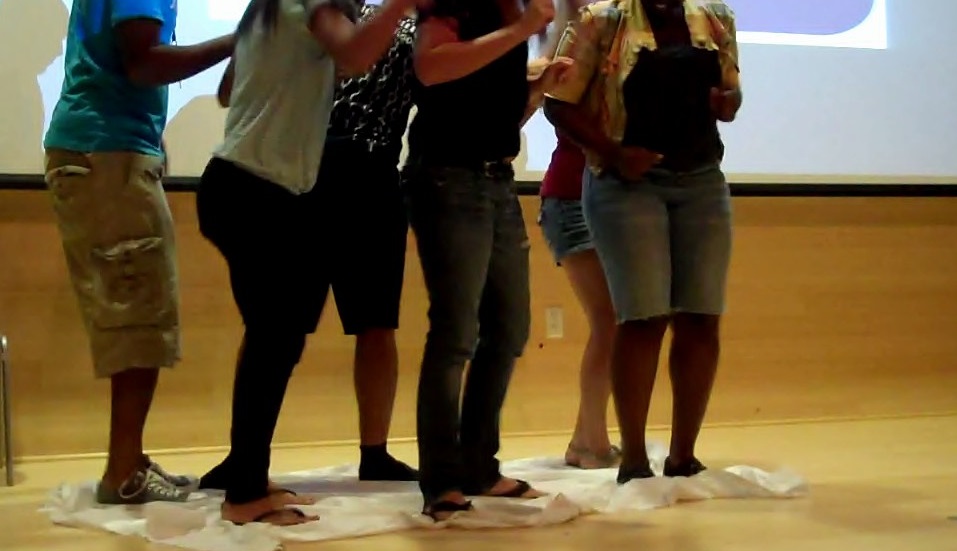
Here is a simple one I did with campus classes and national workshops.  You only need one prop: A bed sheet. I used a bed sheet made for a single bed. Here is what I did:

  1. Spread the sheet on the floor. Place a small “B” on one side and a small letter “T” on the other side.  Standing for “Bottom” and “Top” of sheet.  To start the demonstration, the “T” side should be topside.
  2. Before I sought volunteers, I let them know they would be moving, twisting, and bending. So, if they had back, hip, feet, or knee issues, they may want to sit and observe. (NOTE: In all the times I did this, no one ever fell or got injured.  Best to err on the side of caution and full disclosure, though. Participant beware.)  I asked for six volunteers to come to the front of the room.
  3. One volunteer stood in each of the corners of the sheet. The remaining two people stood on the long side of the sheet between the corner people (one each side). They could be arranged in any position.

4. At times I asked for one more volunteer to come forward. I typically called on the workshop organizer when possible and placed this person in the middle of the sheet. There were now seven people strategically placed along the side of the sheet.

5. All feet HAD to remain totally on the sheet at all times. That is, they could not have one foot on the sheet and one foot totally or partially off the sheet.

6. Their task: Without stepping off the sheet, they must turn the sheet upside down so that the top is on the bottom and the bottom is on the top. The “B” and “T” makes this easy to monitor. And, they must rotate the sheet 180 degrees. So, if the “T” was on the top and pointing to the left side of the room, when they finish the “B” will be on the top and pointing to the right side of the room.

7. I usually had a few spotters to stand around the outside of the sheet in the event someone lost balance as they moved around the sheet.

8. I typically gave the participants two minutes to complete the flip and turn. And, more times than not, they did it in less time.

9. I asked the participants  and the audience for insights. Here are just a few ah-ah moments:

    1. Someone emerges as a leader.
    2. More emerge as the followers.
    3. Collaboration is necessary.
    4. Coordination of movement helps collaboration and results.
    5. Listening is critical.
    6. Initial strategizing can save time.
    7. Move purposefully but not fearfully.
    8. Creativity can help.
    9. Laughter emerges and helps!

10. Once we exhausted observations and insights, the participants drew conclusions and related those to our topic at hand.


Video Recommendation for the week.

Regardless of the topic, demonstrations can drive home a point that may be lost in a lecture or in a reading.

While I do not have a video of me doing the sheet exercise above, watch this video (enjoyed with nearly 20,000 views) of a demonstration I did with my students to drive home the importance of prioritizing the non-negotiables items in their lives.  The visuals provide a powerful lesson that cannot be easily missed or forgotten.


Make it a great week and HTRB has needed.

My latest book, Community as a Safe Place to Land (2019), (print and e-book) is available on Amazon.  More information (including seven free podcast episodes that spotlight the seven core values highlighted in the book) at www.stevepiscitelli.com.

Check out my book Stories about Teaching, Learning, and Resilience: No Need to be an Island (2017). It has been adopted for teaching, learning, and coaching purposes.  I will be conducting (September 2019) a half-day workshop for a community college’s new faculty onboarding program using the scenarios in this book. Contact me if you and your team are interested in doing the same.  The accompanying videos would serve to stimulate community-building conversations at the beginning of a meeting.

My podcasts can be found at The Growth and Resilience Network®

You will find more about what I do at www.stevepiscitelli.com.

©2019. Steve Piscitelli
The Growth and Resilience Network®
Posted in awareness, Being REMARKABLE, effective teaching, public speaking, teaching and learning | Tagged , , , , , | 2 Comments

(Issue #491) Premonitions and Weak Signals


“The point is obvious. There is more than one way to burn a book.
And the world is full of people running about with lit matches….”
-Ray Bradbury-

 Weak signals tell us that what had been best practices are about to end, or, at the least, morph into something transformative.  Think digital revolution as a for instance.

I recently thumbed through my copy of Ray Bradbury’s classic Fahrenheit 451. The book came out in 1953. At that time, our population was trying to understand one of the newest weak signals: the television.  In 1949, about 6,000 homes had TVs.  By the mid-fifties, about half the population was tuning in, and program formats were dramatically changing what had been best practice for broadcasting.

The television provided Bradbury with one opportunity to gaze into the future and guess what might become the newest practice. In fact, as I reread 451, I was taken by the number of technological “advancements” he incorporated into his future-oriented look of society: interactive TV, surround sound TV (mounted on multiple walls in a room), ear buds, ATMs, caller ID, robots, and fast driving cars.


And, he noted disturbing new (“promising”) in human interaction.

  • Book burning (allowed for “a new job of custodians of our peace and mind…official censors, judges, and executors….” p. 59)
  • Apathetic people with surface conversations (found throughout the book)
  • Indiscriminate and senseless killing (drive-bys; p. 128)
  • Limited in-depth reading (“The mind drinks less and less.” p. 57)
  • Distrust people who think (“…the word ‘intellectual,’ of course, became the swear word it deserved to be. You always dread the unfamiliar….” p. 58)
  • Mind numbing fire hosing of information that allows fosters thought control (“Cram them full of noncombustible data, chock them so damned full of ‘facts’ they feel stuffed, but absolutely ‘brilliant’ with information.” p. 61)

In a 2003 interview for the 50th anniversary edition of the book, Bradbury said, “I was interested in more than the political atmosphere. I was considering the whole social atmosphere: the impact of TV and radio and the lack of education. I could see the coming event of school teachers not teaching reading anymore. The less they taught, the more you wouldn’t need books.” (p. 182)

Are these premonitions still pertinent today? What is the role of education?  Have we gone beyond Bradbury’s weak signals to something more dire—or was his fiction just that, fiction?

In the “Coda” of the 2003 release of the book, he speaks about edits and criticisms that had been made to and about some of his works:

The point is obvious. There is more than one way to burn a book.
And the world is full of people running about with lit matches….
(p. 176)


Video Recommendation for the week.

Click on this video for a quick overview of the major themes of the book—and the ponderous questions that arise from those themes.  Were Bradbury’s premonitions accurate?


Make it a great week and HTRB has needed.

My latest book, Community as a Safe Place to Land (2019), (print and e-book) is available on Amazon.  More information (including seven free podcast episodes that spotlight the seven core values highlighted in the book) at www.stevepiscitelli.com.

Check out my book Stories about Teaching, Learning, and Resilience: No Need to be an Island (2017). It has been adopted for teaching, learning, and coaching purposes.  I conducted (September 2019) a half-day workshop for a community college’s new faculty onboarding program using the scenarios in this book. Contact me if you and your team are interested in doing the same.  The accompanying videos would serve to stimulate community-building conversations at the beginning of a meeting.

My podcasts can be found at The Growth and Resilience Network®.

You will find more about what I do at www.stevepiscitelli.com.

©2019. Steve Piscitelli
The Growth and Resilience Network®

Posted in accountability, action, awareness, bullies, bureaucracy | Tagged , , , , , , , , | 4 Comments

(Issue #490) Calling for Deliberative Dialogues. 


Acknowledge common ground
to build a more unified and proactive community.

Every day we find ourselves bombarded by lots of talking.  When fortunate, we get to hear and engage in real conversations. Speaking, listening, questioning, listening, responding, questioning, listening, and so on.  Give and take. Genuine listening. Authentic questioning.

For the past several months, a cadre of people in my community have chosen to develop their conversation skills by engaging in deliberative dialogues. Residents come together to discuss hot-button issues.  As the National Issues Forums Institute describes it, neighbors come together to discuss some of the “thorniest issues” a community confronts.  NIFI works closely with its research partner, the Kettering Foundation, to provide issue guides to nurture open-minded community conversations.

A deliberative dialogue is not a debate.  Rather than a contest to make a point, vanquish a different perspective, and win, it is a gathering designed to dissect, question, and listen to various perspectives. The agreed upon goal is to seek common ground. Deliberative dialogues understand quick change is illusory.  The participants consider and reconsider differing views on an issue.  Again, not win but, rather, to seek understanding—one skill set that is often missing in a call-out pyrotechnic culture.

At its core, a deliberative dialogue promotes civil conversation  Consider these basic ground rules for a deliberative dialogue:

  • Listen carefully to understand.
  • Encourage participation by all participants. No one should dominate.
  • Everyone is encouraged to speak.
  • Consider the options and actions fairly.
  • Disagree out of curiosity, not anger.
  • Move toward understanding.

From my experience with the process (as a participant and as a breakout discussion group moderator), a successful deliberative dialogue promotes civil discord. We need to understand where our differences lie, talk about them, understand why they exist, and what we can do about them.

A two-fold goal emerges when a community comes together for a deliberative dialogue. First, the participants see a need to address a particular “thorny” issue—one that affects quality of life.  In the past six months, the dialogues in our beach communities have addressed issues of toxicity in our societal discourse, mass shootings, mental illness in America, and (to come in November), sea level rise.

Once together, the second goal comes into focus: How do we identify the common ground we share on what can be divisive issues, and how might acknowledging that common ground allow us to build a better community?

I served as a co-moderator in a session earlier this month that addressed “Mental Illness in America: How Do We Address a Growing Problem?” The ground rules provided a pathway to move beyond divisive tribalism to a more productive and unifying conversation about issues. As Kettering shares on its website, such a discussion is “distinctive because it is conducted from the perspective of citizens and focuses on what people can do collectively to address problems affecting their lives, their communities, and their nation.”

The focus is on listening and options. Not collective monologues and political diatribes. In short, what should we do as a community about the problem on the table? What options are available and what opportunity costs come with each option?

As we listen and observe our societal rhetoric amplifying to a level that makes understanding more difficult, one of the strategies of deliberative dialogues stands out above all: It’s OK to disagree, but do so with curiosity, not hostility…and…avoid coming to conclusions until we have deliberated on all the options.

A worthy goal.


Video Recommendation for the week.

As you hear in this brief video, deliberative dialogues build energy with smaller communities to nurture a vibrant larger community.  Dialogues lead to education, understanding, and community mobilization.  In a word, connectedness.


Make it a great week and HTRB has needed.

My latest book, Community as a Safe Place to Land (2019), (print and e-book) is available on Amazon.  More information (including seven free podcast episodes that spotlight the seven core values highlighted in the book) at www.stevepiscitelli.com.

Check out my book Stories about Teaching, Learning, and Resilience: No Need to be an Island (2017). It has been adopted for teaching, learning, and coaching purposes.  I conducted (September 2019) a half-day workshop for a community college’s new faculty onboarding program using the scenarios in this book. Contact me if you and your team are interested in doing the same.  The accompanying videos would serve to stimulate community-building conversations at the beginning of a meeting.

My podcasts can be found at The Growth and Resilience Network®.

You will find more about what I do at www.stevepiscitelli.com.

©2019. Steve Piscitelli
The Growth and Resilience Network®

Posted in accountability, Civility, collaboration, collective monolgues, Community, community development, confirmation bias, consideration, conversation, Critical Thinking, emotional intelligence, Gratitude, growth, habits, Mindfulness, mindset, resilience | Tagged , , , , , , , , | 3 Comments

(Issue #489) Opportunities to Notice


The range of what we think and do
Is limited by what we fail to notice
And because we fail to notice
That we fail to notice
There is little we can do
To change
Until we notice
How failing to notice
Shapes our thoughts and deeds.

~R.D. Lang

If we do not notice, how can we learn or challenge assumptions? One way or another, whether we fail to notice, or do notice,  that will “shape our thoughts and deeds.”

Consider how you onboard new employees or team members.  When you look at the process, what do you notice? Is it all procedural? Like, how to fill out forms, where to pick up mail and duplicating, when to complete leave requests, who to see for technology assistance, and what to do when you need access to a room, building, or website portal?

While those are important, we miss a ripe opportunity for culture creation if we do not help the newly initiated grasp a deep connection to their new positions, colleagues, and team mission.

I had the honor to facilitate a new faculty onboarding workshop at Calhoun Community College last week.  Using actual teaching and learning scenarios, we went beyond procedures. The faculty engaged one another with questions about college resources, promising practices for student engagement, how their current teaching practices (actions) connected to their teaching procedures (words), and how their boundaries and limits affected growth and resilience (for them as well as their students).

One of our exercises asked them to envision their students five years in the future; five years after the students had had their classes. What did they, as a result of the class, hope their students would

  • Value?
  • Remember?
  • Practice?

Then the faculty considered their class syllabi, teaching methods, and assessment strategies.  Did those documents  match what they hoped their students would hold on to five years down the road?

This required them to notice what they do now and continue to notice throughout their teaching careers. Does what they say match what they do?

When we bring new people into our workplace culture, we have a wonderful opportunity to start a conversation that goes beyond where to pick up the office keys.

Keep it practical. Focus on meaningful outcomes. Create opportunities for ongoing deliberative dialogues. Make the orientation/onboarding more than a “one-and-done” opportunity. Maybe, like Calhoun’s new faculty initiative, you create a multi-year process.

Above all, provide opportunities to notice, act, notice, adjust, notice, and grow.


Video Recommendation for the week.

The Critical Incident Review (Stephen D. Brookfield) can guide us as we attempt to notice more of what we do, how we do it, and why we do it.


Make it a great week and HTRB has needed.

My latest book, Community as a Safe Place to Land (2019), (print and e-book) is available on Amazon.  More information (including seven free podcast episodes that spotlight the seven core values highlighted in the book) at www.stevepiscitelli.com.

Check out my book Stories about Teaching, Learning, and Resilience: No Need to be an Island (2017). It has been adopted for teaching, learning, and coaching purposes.  I will be conducting (September 2019) a half-day workshop for a community college’s new faculty onboarding program using the scenarios in this book. Contact me if you and your team are interested in doing the same.  The accompanying videos would serve to stimulate community-building conversations at the beginning of a meeting.

My podcasts can be found at The Growth and Resilience Network®.

You will find more about what I do at www.stevepiscitelli.com.

©2019. Steve Piscitelli
The Growth and Resilience Network®

Posted in assumptions, Being REMARKABLE, boundaries and limits, collaboration, collegiality, faculty development, growth, leadership, Life lessons, resilience | Tagged , , , , , , | 3 Comments

(Issue #488) Read. Reflect. Respond. Repeat.


Reset as needed.

Interesting how Roxie has helped remind me of a basic premise. One that I used again this past week facilitating an onboarding workshop for new faculty. The truism: When we tackle issues or challenges, we do well to slow down and consider what is in front of us before we jump to conclusions. Consider this example I learned as Roxie and I have developed into a working team.

During our daily walks, Roxie and I meet up with old friends and discover new ones.  The comment I often hear when people first meet Roxie is, “What a well-behaved dog, she is!”

As she sits beside me looking at the person and/or canine companion, I am struck by how many people think such a simple task is such a big deal. But then, when we look around at some other dogs and their people, I can see from whence their surprise emanates.

Don’t get me wrong. Roxie can pull at the leash a little harder than she should. Or get focused on something (like breaking news alerts in the pee-mail she reads along the way) and tune me out.  But, generally, she knows what to do. And she does it.  The discipline comes from constant rehearsal of strategies we learned in our puppy obedience and Canine Good Citizen classes.  When Roxie needs a “refresher,” we stop what we are doing and reset.  We make sure we are both on the same page about what we need to do. Then we do it.

At times, workshops (for humans) can be challenging. Especially if the people in front of the room believe they must firehose the audience with every bit of minutiae they know. I have found that interaction is best. Like Roxie and me. While I might lead, I have to remember that if I lose her attention, neither of us is going to go anywhere fast.

At the beginning of the faculty workshop, I set a four-step guide for our day’s journey:

  • READ. They had read assigned classroom scenarios prior to our workshop. These would serve as the focal point for our deliberative conversations.
  • REFLECT. Prior to discussion about a scenario, we took a few moments to review our notes. What did we read? What did we learn? What questions or suggestions did we have?
  • RESPOND. Then we opened the floor for our deliberative discussion. Meaningful give and take about the targeted issues.
  • REPEAT. Once the discussion was concluded, we would reset ourselves, clear the air of any last-minute thoughts or questions, and then we moved on to the next scenario.

Simple process that can have implications beyond an employee workshop or walk with your canine companion.

When appropriate, stop. Reflect on what you are doing and need to do. Reset as needed. Proceed.


Video Recommendation for the week.

In order to reset, we must first recognize the need to do so.  That requires reflection. We have to read the situation at hand and be aware of assumptions we might making and how they might derail us.

This brief video from a stage presentation reminds us of the importance to hit the reset button as needed. Then move forward. Then repeat.


Make it a great week and HTRB has needed.

 Take a moment and read Roxie’s blog (roxiemovingthebiscuithome.wordpress.com). Roxie is my pet therapy partner–a four and one-half year-old rescue dog. On her blog she woofs about life and purpose from the perspective of a dog.  She is quite insightful. It might help you HTRB. (Woof!)

My latest book, Community as a Safe Place to Land (2019), (print and e-book) is available on Amazon.  More information (including seven free podcast episodes that spotlight the seven core values highlighted in the book) at www.stevepiscitelli.com.

Check out my book Stories about Teaching, Learning, and Resilience: No Need to be an Island (2017). It has been adopted for teaching, learning, and coaching purposes.  I will be conducting (September 2019) a half-day workshop for a community college’s new faculty onboarding program using the scenarios in this book. Contact me if you and your team are interested in doing the same.  The accompanying videos would serve to stimulate community-building conversations at the beginning of a meeting.

My podcasts can be found at The Growth and Resilience Network®

You will find more about what I do at www.stevepiscitelli.com.

©2019. Steve Piscitelli
The Growth and Resilience Network®

Posted in Life lessons | 1 Comment

(Issue #487) Community Resilience Through Affordable and Sustainable Home Ownership


We have the know-how in the world to house everyone.
We have the resources in the world to house everyone.
All that is missing is the WILL to do it. -Millard Fuller

Check this out for synchronicity.

  • My most recent book, Community as a Safe Place to Land, has 7 transformational stories that highlight 7 core values for community. For each story, I recorded a podcast episode.
  • During the recording of the podcast episode for the first story (“A Safe Place to Land”), my guests told me about Koinonia Farm outside of Americus, Georgia. It was there that the idea of “partnership housing” took root when Millard Fuller and his wife met Clarence Jordan.
  • That led to the founding of the Habitat for Humanity International in 1976.
  • Fast forward to June of this year. On a visit to Washington, DC, I came across a sidewalk plaque that had an inscription attributed to none other than Millard Fuller: “We have the know-how in the world to house everyone. We have the resources in the world to house everyone. All that is missing is the WILL to do it.”
  • Last week, I sat down with the President/CEO and the Development Director of Beaches Habitat for Humanity to record a podcast. This affiliate program of Habitat for Humanity International, located in Atlantic Beach, Florida, has the WILL that Fuller called for so long ago.

The proverb “It takes a village to raise a child” reminds us of the power of the greater community in raising the children of that community.  As I listened to Curtis Ford and Mary Anne Christensen of Beaches Habitat, I thought of the power that neighbors have to sustain the larger community.

For instance, when a family buys into a Beaches Habitat home, they buy into more than their own space. In some Beaches Habitat areas, like the Ocean Gate neighborhood of some 70 homes, the families become part of a larger homeowners’ association. Ford, the President/CEO, says the journey of the homeowner is more than getting a roof over his or her head.  It is a learning experience that involves collaboration, financial literacy, and giving back to the greater community.

In short, each home helps to create stronger neighborhoods.  The neighborhoods foster communities that add to the strength of the larger community.

Both Ford and Christensen shared (on and off mic) that Beaches Habitat offers a hand up, not a handout.  Sustainable homeownership is the goal when families are selected.  The selected families for Beaches Habitat homes commit to staying in the home—and that requires taking on and meeting financial responsibilities. As Ford stated, “You pay, you stay. You don’t, you won’t.” The houses are not “given away.”  As Fuller envisioned decades ago, the program is about “partnership housing.”

While synchronicity might have led me to the Beaches Habitat podcast recording, I came away understanding that this program is anything but a series of coincidences without causal connections.

Beaches Habitat for Humanity provides deliberative action to help create sustainable housing which in turn fosters community resilience. They help build bridges from neighbor to neighbor.

I have to think Fuller would applaud the WILL as well as the actions of Beaches Habitat for Humanity.


Video Recommendation for the week.

In this brief teaser clip (118 seconds) for Podcast Episode #48, President and CEO Curtis Ford explains how Beaches Habitat goes about providing the foundation for more than a home. This organization helps build communities within communities.

In Episode #48 (in its entirety and with a release date of September 30, 2019 on The Growth and Resilience Network® podcast channel) Beaches Habitat for Humanity President and CEO Curtis Ford and Mary Anne Christensen, Development Director, guide us through the ins and outs of advocating for sustainable housing and its connection to community growth and resilience.


Take a moment and read Roxie’s blog (roxiemovingthebiscuithome.wordpress.com). Roxie is my pet therapy partner–a 4+ year-old rescue dog. On her blog she woofs about life and purpose from the perspective of a dog.  She is quite insightful.


Make it a great week and HTRB has needed.

My latest book, Community as a Safe Place to Land (2019), (print and e-book) is available on Amazon.  More information (including seven free podcast episodes that spotlight the seven core values highlighted in the book) at www.stevepiscitelli.com.

Check out my book Stories about Teaching, Learning, and Resilience: No Need to be an Island (2017). It has been adopted for teaching, learning, and coaching purposes.  I will be conducting (September 2019) a half-day workshop for a community college’s new faculty onboarding program using the scenarios in this book. Contact me if you and your team are interested in doing the same.  The accompanying videos would serve to stimulate community-building conversations at the beginning of a meeting.

My podcasts can be found at The Growth and Resilience Network®

You will find more about what I do at www.stevepiscitelli.com.

©2019. Steve Piscitelli
The Growth and Resilience Network®

Posted in action, collaboration, Community, community development, financial literacy, fortitude, Life lessons, resilience | Tagged , , , , , , | 1 Comment

(#486) A Metaphor for Growth and Resilience


Some will experience a metamorphosis they never dreamed
they could attain. Others will quietly walk away.

I always looked forward to the first day of the semester. As a teacher, that first day came full of anticipation for me and the students. No matter what went well or not so well the previous semester, day number one represented promise.  Every person who walked in that room, including  me, had expectations for the coming months. We were in that room for a variety of reasons.

One of the many challenges a teacher—the leader of the classroom—has is to understand that each student who walks through the door brings a host of abilities and challenges with herself or himself.  Some enter with confidence and a desire to jump in and start the swim. Others, full of trepidation, barely stick a toe in the water.

Photo by Steve Piscitelli

Some will interact with the environment, looking for opportunities to grow. A few, lacking confidence or role models, do not know the questions to ask, let alone the answers to offer.

Some will experience a metamorphosis reaching heights they never dreamed they could attain. Others will quietly walk away.

The same dynamic will happen for any team.  How does the leader respond?  What does the leader do? How will the team members respond? How should they respond?

Your challenge for the week.

Watch the following short (150 seconds) video with your class, team, neighbors, spiritual community, or community action committee. Each cup of water is a metaphor for how any of us may respond (and, probably, have responded) to a challenge, demand, expectation, or a personal dynamic with another.

What lessons do you see?  What is the role of the leader? What are the roles of each individual in the room?


Video and Lesson Recommendation of the Week


My latest book, Community as a Safe Place to Land (2019), (print and e-book) is available on Amazon.  More information (including seven free podcast episodes that spotlight the seven core values highlighted in the book) at www.stevepiscitelli.com.

Check out my book Stories about Teaching, Learning, and Resilience: No Need to be an Island (2017). It has been adopted for teaching, learning, and coaching purposes.  I will be conducting (September 2019) a half-day workshop for a community college’s new faculty onboarding program using the scenarios in this book. Contact me if you and your team are interested in doing the same.  The accompanying videos would serve to stimulate community-building conversations at the beginning of a meeting.

My podcasts can be found at The Growth and Resilience Network®   (http://stevepiscitelli.com/media-broadcast/podcast).

You will find more about what I do at www.stevepiscitelli.com.

©2019. Steve Piscitelli
The Growth and Resilience Network®
Posted in awareness, change, change management, courage, curiosity, emotional intelligence, empathy, Goals, Grit, Life lessons, resilience, tenacity | Tagged , , , , , | 1 Comment

(Issue #485) Human Beings with Human Challenges


Benefiting from human connections.

Effective teachers understand that they never know what questions or dilemmas a student will bring through the door. In addition to academic issues, students (just like the rest of us) always have a bag full of personal and family challenges. And those concerns always have an impact on classroom success.

Photo by Steve Piscitelli.

Corporate managers have the same dynamics with people on their team. Ministers with their congregation. An activist with community residents.

And consider the inverse.  The managers, ministers, and activists have their own baggage. Do the people in the room, stop to consider that perspective as well?

Everyone has a story. We might not (and usually do not) know the nuances of those stories.

What we will discover at the heart of each story plot line, however, are human beings with human challenges who can benefit from human connections.

Video Recommendation of the Week

While this short video (59 seconds) addresses faculty issues, consider a space in your life where the questions pertain to you.  After all, no matter the situation, it always comes down to a teaching and learning moment for the people in the room.  We have to pay attention.


My latest book, Community as a Safe Place to Land (2019), (print and e-book) is available on Amazon.  More information (including seven free podcast episodes that spotlight the seven core values highlighted in the book) at www.stevepiscitelli.com.

Check out my book Stories about Teaching, Learning, and Resilience: No Need to be an Island (2017). It has been adopted for teaching, learning, and coaching purposes.  I will be conducting (September 2019) a half-day workshop for a community college’s new faculty onboarding program using the scenarios in this book. Contact me if you and your team are interested in doing the same.  The accompanying videos would serve to stimulate community-building conversations at the beginning of a meeting.

My podcasts can be found at The Growth and Resilience Network®   (http://stevepiscitelli.com/media-broadcast/podcast).

You will find more about what I do at www.stevepiscitelli.com.

©2019. Steve Piscitelli
The Growth and Resilience Network®

Posted in assumptions, awareness, Communication, Community, Connection-Disconnection, curiosity, empathy, leadership, Life lessons, problem solving, Reflection, resilience | Tagged , , , , , , , | 1 Comment

(Issue #484) Nutritious People and Purpose


The key is to understand the story and the associated people, because
there can be a danger if community devolves into tribalism.

 I have written of energy vampires. I’ve even recorded a song about these dastardly beings who “suck the air right out of the room.”

In his book The Power of Purpose Richard J. Leider delineates the attributes of the people who help us discover our best talents and skills. They can provide, if you will, an antidote to energy vampires.  He encourages us to surround ourselves with “people [who] have three primary characteristics: their face lights up when you come in the room, they listen to you, and they have few (i.e., no) plans for your improvement!”

These souls help us grow and find ourselves. We become the best of our capabilities.  Leider found in his research that nutritious people can help us “align our energies around our true priorities.” They help us connect to our purpose. In fact, when we have a community of nutritious people, the entire group can lift itself up.

As David Brooks said in The Second Mountain, “A community is, in part, a group of people organized around a common story.”  The key is to understand that story and the associated people, because there can be a danger if community devolves into tribalism. As Brooks found in his work, “Tribalism is community for lonely narcissists.”

Pause for a moment today and think of the nutritious people in your life who help you and your community grow in a purpose that embraces and fosters virtue. For whom are you a nutritious person? How do you know?


Video Recommendation of the Week

Richard Leider found three themes related to purpose when he asked people what they would do differently if they could live their lives over.  Perhaps your nutritious people can help you identify and commit/recommit to your purpose.


My latest book, Community as a Safe Place to Land (2019), (print and e-book) is available on Amazon.  More information (including seven free podcast episodes that spotlight the seven core values highlighted in the book) at www.stevepiscitelli.com.

Check out my book Stories about Teaching, Learning, and Resilience: No Need to be an Island (2017). It has been adopted for teaching, learning, and coaching purposes.  I will be conducting (September 2019) a half-day workshop for a community college’s new faculty onboarding program using the scenarios in this book. Contact me if you and your team are interested in doing the same.  The accompanying videos would serve to stimulate community-building conversations at the beginning of a meeting.

My podcasts can be found at The Growth and Resilience Network®  (http://stevepiscitelli.com/media-broadcast/podcast).

You will find more about what I do at www.stevepiscitelli.com.

©2019. Steve Piscitelli
The Growth and Resilience Network®

Posted in amplifying, authenticity, awareness, Being REMARKABLE, coaching, collaboration, Connection-Disconnection, Energy Vampires, nutritious people | Tagged , , , , | 4 Comments