(#292) A Blogger’s Retrospective: 2015 in Review


May your 2016 goals lead to your actions and your actions lead to your dreams.

While sitting in an Austin hotel room at the end of May 2010, I wrote my first post for this blog. I had 3 goals:

  • Experience a new (for me) aspect of social media
  • Develop and flesh out new ideas
  • Provide something of value—not just another cyber rant.

I believe I have accomplished the first and the second. It is up to you whether I have accomplished the third. My blog posts contain videos, book recommendations and summaries, questions to ponder, and always a takeaway to apply immediately to life.  I have remained true to my commitment to publish one blog post per week. This post marks the 292nd consecutive week.

Thank you for reading, commenting, and sharing.  I would love to hear what you found of value on this blog. And, please feel free to share any ideas you have for future posts.  One of my goals for 2016 is to add another 1,000 followers to this blog. With your help, I will reach that goal. Thank you!

As has now become tradition for me, this last-of-the-year offering lists each of the previous 51 posts I have made to this blog this year. Along with each title you will find a descriptive statement. Perhaps a nugget or two will provide inspiration. I have linked each title to the actual blog should you want to read it, re-read it, or share it. Thank you for your continued support and comments.

And I have included a new “TOP FIVE” feature for this end-of-the-year post: (1) the top (by number of views/visits) blog posts for 2015; and (2) top five blog posts since I started this journey.

*Top Five 2015 Posts on this Blog*

1.  (#257) Sunsets and Sunrises
2. (#260) An Evening in the Gratitude Café
3. (#262) Resilience: What’s Your Story?
4. (#241) What If?
5.  (#249) A Life Well-Lived

*Top Five All-Time Posts on this Blog*

1. (#86) A Model for Critical Thinking
2. (#194) Honor the Past. Celebrate the Present. Embrace the Future.
3. (#219) The First Day of Class: People Before Paper!
4. (#18) Crab Pot Mentality!
5. (#93) SQ4R: Strategic Reading Strategies for the Classroom and Beyond
(My video that accompanies this post is my most watched YouTube video.)

All the best to you and your family and your friends as you create and enjoy your 2016 journey. May your 2016 goals lead to your actions and your actions lead to your dreams.

2015 in Review

  1. What If? * Rather than setting a list of “me-too” goals, why not imagine the “what if” of our future selves?Think of your future and fill in the blank: “What if _____?
  2. Reflecting on a Significant Event * The power of this reflective practice exercise lies in its ability to help us discover not only what we do but why we do it.
  3. Failure is an Option * How will I stretch myself in the coming week? Even if I might fail, what will I do to continue my learning and growth?
  4. Do You Have Your Own Board of Directors? * I remain focused on surrounding myself with knowledgeable and skillful people who will have my back—and kick me in the butt when needed. Who do you have on your Board?
  5. Courage * What we do in these situations defines our characters and our destiny.
  6. Are You Bitching or Are You Pitching? * Do you work (or live) with someone who endlessly pontificates, grouses, grumbles, moans and laments?
  7. Applications and Reflections * Just consider the hourly wage of each person tied up in a workshop.  Is the R.O.I. worth the lost wages and service?
  8. Loopers Add Texture to Life * We all add layers and texture to life.
  9. A Life Well-Lived * We have to remember that Buddy touched us as he did so many others he met on his journey.  He leaves lessons and a life well-lived.
  10. Motivating the Motivators * Beyond the paycheck and benefits, what is being done
    to motivate those who are charged with motivating our students?
  11. Transformational Leadership * These leaders literally transform our workplaces
    and our lives into empowerment zones. How many have you had?
  12. If Politicians Had to Live the Educational Policies They Create * Let’s make the policy makers have to face, and work with, our students and teachers day in and day out. The same ones their legislation impacts.
  13. Bridging the Gap: The Stories We Tell Ourselves and the Stories We Live * Stories we tell ourselves vs. stories we actually live. What stories are you telling yourself?

    Image: pisitphoto@FreeDigitalPhots.com

    Image: pisitphoto@FreeDigitalPhots.net

  14. The Five P’s of New Employee Mentoring * Does your organization effectively “on-board” new team members?
  15. Did You Make a Difference? How Do You Know? * While this blog post speaks specifically to my teaching colleagues, we can all draw inspiration and clarification
    when we stop and examine what we do.
  16. Don’t Blame the Bureaucracy, Point to the People * If you can’t or won’t help, just step aside for someone who will do a competent and humane job.
  17. Sunsets and Sunrises * “You are where I was. And I am where you will be.”
  18. The Power of Guy Fieri: Five Life Lessons * In our do-everything-a-little-bit-faster-each-day world, how often do we take time to be curious, to learn, to listen, to laugh and be positive?
  19. Is HOPE a Meaningless Sentiment? * Is hope just a word that will soon be washed away by  an incoming tide? Or does it send a message of resilience?
  20. An Evening in the Gratitude Café * So many great things, places and people surround us. Appreciate them…embrace them.
  21. Mixing it Up with Your Audience * So, go ahead. Mix it up. It will not only energize your audience, it will keep you fresh.
  22. What’s Your Story? * What autobiography have you created? Time for a revision?
  23. Retreat or Stay-Treat? Treat Yourself! * What can you do if you want a retreat but can’t quite swing getting away from your daily routines for three or four days?
  24. Manage Your Energy. Maximize Your Productivity. * What small step can you take this week to set your agenda, manage your energy, and accomplish the most important thing on your radar?
  25. That’s Not Teaching. That’s Talking. * Teaching and learning need to remain inextricably connected.
  26. Challenging the Status Quo * We have to remember what we learned in our formative years:
    “Know what battles to pick.” Great advice unless you never seem to choose a battle.
  27. You Get to Create the Path. * We are all artists painting our own lives.

    Arvind Balaraman@FreeDigitalPhotos.net

    Arvind Balaraman
        @FreeDigitalPhotos.net

  28. P.R.I.D.E. for Student and Life Success * Choose well, my friend.
  29. Yes AND * It is interesting that we can point to others as being intransigent in their thinking while we pat ourselves on the back as possessing true critical thinking skills.
  30. Have You Spent Time with Ida Ownly? * A relationship with Ida Ownly has no future
    other than one of contrition, remorse, disappointment, and heartbreak
    .
  31. Comfort Zone * “Life begins at the end of your comfort zone.” -Neale Donald Walsch-
  32. GRIT: What Keeps You Moving Toward Your Goals? * “If at first you don’t succeed try, try again. Then quit. There’s no point being a damn fool about it.” -W.C. Fields-
  33. You Got Mail! *Is email “so yesterday”?
  34. Igniting Passion: Seven Superlative Student Stars * They spoke directly to the power of teaching and the importance of relationships in life. 
  35. What Do You Carry in Your Backpack? * It’s one thing to know we need to shed the extra baggage but it is quite another thing to actually do
  36. Mistakes, Disappointment, Curiosity and Growth. * When we choose not to dare because we might “risk feeling disappointed” we end up “choosing to live disappointed.”
  37. Thriving in the Thin Place: Becoming Our Essential Selves.  * Thin places represent those spaces that help construct (or maybe deconstruct) meaning in life.
  38. Common Goal-Achieving Challenges. *  Treat yourself with respect on the way to your goals.
  39. Do You Have the Wisdom of a 5th Grader?  * If we pay attention we often can find real nuggets of wisdom from the young people around us.
  40. Trigger Warnings. * If we keep our students in protective bubble wrap while in college, what have we prepared them for as they move into the workforce and the rest of their lives?
  41. Collisions for Collaboration or Crashes for Confusion? * Whether talking about the college classroom or the corporate boardroom, conscientious nurturing of authentic relationships improves the chances for effective communication, meaningful connections and powerful creation.
  42. The Story of the Lavender Farmer * It has been a saga, but I am determined to be successful, and continue to learn from each chapter. Thank heaven they come one at a time.
  43. Inspiration and the Potential to Make a Difference * While the interactions may “just happen,” turning them into meaningful moments takes mindfulness.
  44. Gaining Clarity * We would do well to surround ourselves with people who care about us—but won’t allow us to skate by with minimal reflection and action.
  45. Are You Relevant * “The trap we fall into is trying to tell people how life-changing our widget is. If it changes their lives, we won’t have to tell them.”–Bernadette Jiwa

    amenic181@FreeDigitalPhotos.net

    amenic181@FreeDigitalPhotos.net

  46. Seeking Passion? Embrace Curiosity * Be curious about your inspiration…curiosity will lead to your passion.
  47. It Could be Worse. Comparatory Suffering? * For me, comparatory suffering creates its own issues. My suffering is mine. Yours is yours. Does it really help to compare it to someone or something else—while denying the feelings in front of you?
  48. Advice from an Owl * This week, thanks to an owl, I will leave you with many more questions than answers.
  49. On Making Mistakes, Being Ordinary, and Embracing Growth * Accepting mistakes does not mean we condone sloppy work. Acknowledge, take ownership of, and grow from your mistakes and you will definitely not be ordinary.
  50. Life Fitness and Mental Discipline * “How do you walk around in something you were born with and not know anything about it or not be aware of what affects it?”-Charles Bailey
  51. Befriending Ourselves * Think of your favorite novels.  More than likely the protagonists
    did not follow a straight line from the beginning to the end of the story. Your life journey is the same. You are the hero of your story.

Make it a wonderful week—H.T.R.B. as needed.

You can subscribe to my newsletter by clicking here.

You can find my podcast series at Growth and Resilience (http://stevepiscitelli.com/video-media/podcasts). 

Check out my website  (http://www.stevepiscitelli.com/programs.html) for programming information as well as details about upcoming webinars (http://www.stevepiscitelli.com/webinars).

My books Choices for College Success (3rd edition) and Study Skills: Do I Really Need This Stuff?  (3rd edition) are published by Pearson Education.

(c) 2015. Steve Piscitelli. All rights reserved.

 

Posted in Life lessons | Tagged | Leave a comment

(#291) Befriending Ourselves


Think of your favorite novels.  More than likely the protagonists
did not follow a straight line from the beginning to the end of the story.
Your life journey is the same. You are the hero of your story.

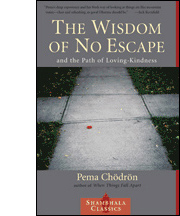
This past week, I reacquainted myself with a classic work by Pema Chodron. Nearly twenty years after its publication, The Wisdom of No Escape and the Path of Loving-Kindness still provides a timely reminder to “make friends with ourselves.”

Not in a self-indulging, selfie-stick kind of way.  Rather, in a healthy and mindful manner.

If you are one of those folks who can easily fall into the trap of beating yourself up ask yourself, “Why am I so hard on myself?”  “Is this helping me—and those around me?”

Give yourself a break.

chodron

Consider this.  Chodron maintains thatas soon as you begin to believe in something, then you can no longer see anything else. The truth you believe in and cling to makes you unavailable to hear anything new.” Take someone who is angry. She knows she is angry. She doesn’t like that she’s angry. She has been told by others that she needs to stop it. She sees it as a detriment. And she wants to suppress the anger. Chodron suggests a different perspective.

Someone who is very angry also has a lot of energy;
that energy is what’s so juicy about him or her…
The idea isn’t to try to get rid of your anger, but to make friends with it,
to see it clearly with precision and honesty, and also to see it with gentleness.
That means not judging yourself as a bad person,
but also not bolstering yourself up by saying,
“It’s good that I’m this way, it’s right that I’m this way. Other people are terrible,
and I’m right to be so angry at them all the time.”

Her words suggest a different mindset.

Note that she is not saying anger is good. Rather, the angry one needs to acknowledge the uncomfortable emotion, do what she can to understand it and confront it, and see how the energy attached that emotion can create (has created) positives in her life. We have to be willing to make friends with ourselves, Chodron urges. That includes all the parts—not just the parts we like.  All of our characteristics and traits have “a lot to teach us.”

We have to be willing to listen. Staying with the anger example, “making friends” with it involves “coming to know the anger and coming to know the self-deprecation” attached to it.

Video recommendation of the week:

Are we willing to turn our obstacles into bliss?

Think of your favorite novels.  More than likely the protagonists did not follow a straight line from the beginning to the end of the story. Their journeys probably looked more like a “W” with the downward sloping lines indicating barriers, obstacles, manipulations, catastrophes and challenges.  That’s what holds your interest in the story.  That’s what makes your hero, well, the hero!

And our own life journey is the same. We constantly face challenges—the downward sloping lines of our own “W.”  And we have encouraging times and high points of elation, too.

Chodron believes that

 Life is a whole journey of meeting your edge again and again.
That’s where you’re challenged; that’s where, if you’re a person who wants to live,
you start to ask yourself questions like, “Now, why am I so scared?
What is it that I don’t want to see? Why can’t I go any further than this?”

Individuals who are willing to wake up and make friends with themselves
are going to be very beneficial, because they can work with others,
they can hear what people are saying to them,
and they can come from the heart and be of use.

 We would help a friend or family member come to terms with a challenge be it with anger, self-esteem, or confidence. So why don’t we use our own Board of Directors to help us sort through things. Find mentors and wise counsel to assist as needed; to grow from the adversity; to become a better version of ourselves.

And why not befriend ourselves along the way, as well?

Make it a wonderful week—H.T.R.B. as needed.

You can subscribe to my newsletter by clicking here.

You can find my podcast series at Growth and Resilience (http://stevepiscitelli.com/video-media/podcasts). 

Check out my website  (http://www.stevepiscitelli.com/programs.html) for programming information as well as details about upcoming webinars (http://www.stevepiscitelli.com/webinars).

My books Choices for College Success (3rd edition) and Study Skills: Do I Really Need This Stuff?  (3rd edition) are published by Pearson Education.

(c) 2015. Steve Piscitelli. All rights reserved.


Posted in Appreciation, awareness, Balance, Choice, Critical Thinking, curiosity, Discipline, fitness, listening, Mindfulness, mindset, Reflection, self-efficacy, self-regulatory behavior, wisdom | Tagged , , , , , , , , , | 1 Comment

(#290) Life Fitness and Mental Discipline


How do you walk around in something you were born with and
not know anything about it or not be aware of what affects it?
Charles Bailey

With December invariably come thoughts of New Year’s Resolutions—and just as inevitably, the breaking of those resolutions. Many of us will start with the desire to be in good shape, better shape, or best shape.  But something happens on the way to that better version of ourselves. Many will give up. Two of the perennially broken resolutions are to lose weight and get fit.

The reasons vary from unrealistic expectations (we overwhelm ourselves) to lack of action (we underwhelm ourselves). I call it “Big Intentions—Minimal Action.”  As I wrote on this blog three years ago:

If you lack discipline and the work ethic to make your dreams come true…
the lack of action will create its own reality.
But there are a number of strategies that we can all use to help us identify our goals,
take action, and enjoy the reality we want to create.

[Photo provided by Charles Bailey]

[Photo provided by Charles Bailey]

If physical fitness is part of life fitness, why do many of us “fall off the fitness wagon”? On Tuesday of this coming week (December 15, 2015), I will explore this further during Episode #9 of my podcast series on growth and resilience.  My guest, personal trainer and competitive power lifter Charles Bailey, will provide insights from nearly 30 years working with people on their life fitness goals. He reminds us that we all live multi-dimensional lives and for that reason it’s difficult to consider “physical” conditioning without also considering other dimensions like the emotional, social, and occupational components of our lives.  And that requires awareness and discipline.

But how many of us stop and think about these fitness components? As Charles said during the recording of our session, “How do you walk around in something you were born with and not know anything about it or not be aware of what affects it?”

steve and charles

Below you will find a few nuggets from my time with Charles. We dig down on each of these (and more) in our lively and thought-provoking conversation.

  • Don’t overwhelm yourself. Be realistic with your goals and timing.
  • If you use a trainer, “audition” him or her before engaging him or her for your fitness regimen. Charles provides a few key characteristics and qualities to look for in a trainer. (BTW: Charles is my current trainer in the gym. No, I’m not going to be a power lifter. I just want to be a fit version of myself.)
  • A trainer needs to pay attention to the client—and the client needs to pay attention to the trainer. Do you know what to look for during the first session and beyond?
  • Know your current fitness level and where you want to go. Consult your doctor/healthcare professional as needed to make sure you embark on and stay on a healthy and safe fitness program.  Take in as much accurate and appropriate information as you can. Do you have an awareness about your current fitness; understand the assumptions behind your fitness goals; and map out and carry out a smart action plan?
  • How big is your “need” to be in better shape? This will be part of your drive—and may well determine if you stay true to your fitness goals.
  • Proper nutrition is a major part of one’s overall fitness level.
  • If you have started a fitness program in the past, and then fell off the wagon, do you know how to minimize that from occurring again? How can your goals remain sustainable?

Fitness depends on mental discipline.  It’s not so much about how we measure up to the person next to us in the weight room.  It is more about understanding our goals, smartly planning to reach those goals, and then taking wise and consistent action.

I developed a five-component model for success that I used with my students and with audiences around the nation: P.R.I.D.E. ™ It fits our discussion about your fitness level.


[You also can access the video by clicking here.]

In short, when and if you consider a fitness program, understand why you are doing it; surround yourself with appropriate and healthy resources; stay focused and disciplined; and strengthen your resilience along the way.

Please click into the free podcast (again, it goes live on December 15, 2015).  Whether you work with a trainer or not, and whether you agree with Charles’ philosophy or not, you will hear information worth considering and evaluating to help you make the best choices for your growth and resilience.

Make it a wonderful week—H.T.R.B. as needed.

You can subscribe to my newsletter by clicking here.

You can find my podcast series at Growth and Resilience (http://stevepiscitelli.com/video-media/podcasts). 

Check out my website  (http://www.stevepiscitelli.com/programs.html) for programming information as well as details about upcoming webinars (http://www.stevepiscitelli.com/webinars).

My books Choices for College Success (3rd edition) and Study Skills: Do I Really Need This Stuff?  (3rd edition) are published by Pearson Education.

(c) 2015. Steve Piscitelli. All rights reserved.

 

Posted in assumptions, awareness, Balance, Discipline, fitness, fortitude, Goals, Grit, habits, health, information literacy, mindset, Motivation, Personal growth, Personal Wellbeing, Physcial health, resilience, self-efficacy | Tagged , , , , , , , , | 5 Comments

(#289) On Making Mistakes, Being Ordinary, and Embracing Growth


Accepting mistakes does not mean we condone sloppy work.
Acknowledge, take ownership of, and grow from your mistakes
and you will definitely not be ordinary.

Back in 2008, I selected five of my previously recorded songs, had them burned to a “best of” disc for marketing purposes and then sent copies to selected colleges and corporations.  I titled the CD “Be Brief, Be Bright, Be Gone. Energize Your Next Meeting.

Feeling very proud, I showed my musical marketing tool to a colleague. She smiled and then asked, “What’s Engergize?”

“Oh,” I said a bit confused, “you mean Energize.

“No, right here, it says Engergize,” as she pointed to the CD cover.

engergize

My heart sank. Sure enough, there was a spelling error. In the title of the CD. That I had already sent out to about thirty university and corporate leaders.

The CD had been reviewed by three sets of eyeballs—and still the mistake reared its ugly misspelled head.

Are you kidding me?

Fast forward to last week when I sent out my latest newsletter. Again, this was reviewed probably four or five times.  Once it “went live” I saw it—the error. In the first line of the newsletter.

Are you freaking kidding me? 

I immediately started to beat myself up about it. My bride did what she could to calm me done—but I persisted in the self-flagellation.  Finally, I took a walk with my dog, Roxie.

“Look,” Roxie said to me with those big brown eyes, “you made a mistake. Look at the big picture. You just sent out a newsletter with twenty free resources relating to growth and resilience. If someone gets whacked about a small error—and does not even see the good stuff you provided, then maybe you don’t need that unforgiving person on your list.”

Point well-taken. There are people who live to tell everyone else what they did wrong—while they remain in their safely-constructed cocoon.

Brené Brown writes about the power of shame and vulnerability. Seth Godin reminds us that we can make a mistake as we attempt to “invent our future” or mistakenly stay safely within the status quo—afraid of what might happen. Don’t send out that CD or newsletter; something bad might happen; you might look foolish.

Accepting mistakes does not mean we condone sloppy work.  And certainly some mistakes can be deadly, literally.  My guess is that what most of us engage in each day would not fall into the “deadly” category. Unless, of course, by deadly you mean embarrassing, awkward, or humbling.

Accepting and learning from mistakes leads to growth. Avoiding ever making a mistake is a fool-hardy and growth limiting endeavor.

A recent Psychology Today article, reported that

“Students are afraid to fail; they do not take risks;
they need to be certain about things. For many of them,
failure is seen as catastrophic and unacceptable.
External measures of success are more important than learning and autonomous development.”

The author further noted that decreasing levels of student resilience is “thwarting the emotional and personal development of students.”

That is sad and concerning.  If pervasive (and, anecdotally, I saw it with regularity in my classes) what does it mean for our students and our workplaces after graduation?

And it’s not just the students. There are plenty of so-called leaders who will not accept anything that may smack of weakness. In their view a mistake is equated with deficiency, failing, and ineptitude.  The transformational leaders encourage their followers to fail, learn, and grow. They understand.

Selfies scream look at how unique I am. Have we moved to a space that “fears being ordinary”? Acknowledge, take ownership of, and grow from your mistakes and you will definitely not be ordinary.

Video recommendation of the week:

A not-so unusual response to a mistake is to blame someone else.

As I’ve stated on this blog before, don’t let “perfection” and “disappointment” rule.  Don’t let fear of being wrong, making a misstep or committing (shutter!) a mistake keep you from your destiny.

You have so much more to offer yourself and those around you.

Make it a wonderful week—H.T.R.B. as needed.

You can subscribe to my (mostly) error-free newsletter by clicking here.

You can find my podcast series at Growth and Resilience (http://stevepiscitelli.com/video-media/podcasts). 

Check out my website  (http://www.stevepiscitelli.com/programs.html) for programming information as well as details about upcoming webinars (http://www.stevepiscitelli.com/webinars).

My books Choices for College Success (3rd edition) and Study Skills: Do I Really Need This Stuff?  (3rd edition) are published by Pearson Education.

(c) 2015. Steve Piscitelli. All rights reserved.
 

Posted in accountability, blame, growth, lessons reaffirmed, Mindfulness, Motivation, Personal growth, resilience | Tagged , , , , , , | 4 Comments

(#288) Advice from an Owl


This week, thanks to an owl, I will leave you
with many more questions than answers.

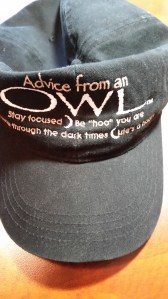
In our garage, I keep a shelf of baseball caps.  While my favorite and often-worn choice is my New York Yankees hat, I often times grab for a different one when I head out the door for my beach walk.  Many sport the names of cities, towns, or colleges I’ve visited. This past week I grabbed one from the bottom of the stack—and smiled as I read the embroidered words of inspiration above the bill.

Advice from an Owl

*Stay focused

*Be ‘hoo’ you are

*Glide through the dark times

*Life’s a hoot!

2015-11-27 11.47.40

I have shared “advice” and lessons of life on a few occasions that I have gleaned from our dogs over the years. And now, I gotta pass along these practical reminders from this wise Strigiform.

  • Stay focused
    • Our goals and dreams may be easy to articulate—but sometimes the difficulty comes in consistent action.
    • What do you do to stay focused and to regain focus on a day-to-day basis?
  • Be ‘hoo’ you are
    • There are times when our lives get sidetracked by what others think we should do or be. Often called “group think,” we end up going against our instincts and, instead, follow what others tell us we should do.  My friend and colleague, Ann Pearson, ably captured this dynamic in her novel Taken by Storm: Galveston 1900.
    • What do you do to maintain the clarity of who you really are? How do you stay true to the person who lurks deep within but, who may be afraid to show itself because of risk or disappointment?
  • Glide through the dark times
    • We’ve all experienced these times. They range from mild despair to outright angst and anguish. Illness, relationship troubles, financial challenges, and environmental disasters can pose situations that seem insurmountable. Regardless of the situation, many (most? all?) of us eventually not only move through the crisis, we come out the other side a better/stronger/more resilient person.
    • Perhaps you or a close friend have been experiencing a dark time. What actions have you taken in the past that helped you glide through (or muddle through) such times? Who can you lean you in these times?
  • Life’s a hoot!
    • I was recently reminded of a book I read some six or seven years ago by Norman Cousins. He spoke to the power of humor—and how that power can multiple over time.
    • What do you do to keep humor and levity in your life? No, they probably might not erase the difficult times (but, according to Cousins, they just might do that!). Maybe, though,  the light moments take the sting out of the not-so-bright moments.  How do you bring humor into your life? When was the last time you had a real belly-bring-tears-to-your-eyes laugh? Sometimes it may help to recognize that kid inside of us.  Go ahead, shut your office door…I’ll wait.  Now sing along with the owl in the clip below.

Video recommendation of the week:

Sometimes we just need to listen.

There are owls who live in the park across the street from our house. At times they grace one of the trees in our front yard.  I listen to them I bit more closely now. Both for what they say and don’t say.

Make it a wonderful week—H.T.R.B. as needed.

You can find my podcast series at Growth and Resilience (http://stevepiscitelli.com/video-media/podcasts). 

Check out my website  (http://www.stevepiscitelli.com/programs.html) for programming information as well as details about upcoming webinars (http://www.stevepiscitelli.com/webinars).

My books Choices for College Success (3rd edition) and Study Skills: Do I Really Need This Stuff?  (3rd edition) are published by Pearson Education.

(c) 2015. Steve Piscitelli. All rights reserved.


Posted in childlike, Dreams, Goals, humor, laughter, Motivation | Tagged , , , , , | 1 Comment

(#287) It Could Be Worse. Comparatory Suffering?


For me, comparatory suffering creates its own issues.
My suffering is mine. Yours is yours.
Does it really help to compare it
to someone or something else—
while denying the feelings in front of you?

You’ve heard them. Probably have used them. I’ve used them. Four little words.

It could be worse!

Some time we use the phrase to help us cope with a disappointing (or even devastating) situation.

It could be worse!

Young Frankenstein reminded us it could be raining.

The sentiment, for some, helps make sense of otherwise confusing circumstances.

You’re diagnosed with an illness “A” and say, “It could be worse. I could have illness ‘B’.”

You lose your job and say, “It could be worse. My neighbor has illness ‘B’.”

You have a large car repair bill and say, “It could be worse. My buddy just lost her job.”

You end up with a new supervisor—whom you do not like.  “It could be worse. My colleague just got diagnosed with illness “A.”

I am not making light of this.  It almost seems to be clichéd resignation to accepting what lies before us. Or a way to not validate someone’s grief or angst.  “Yes, you are suffering—but the person over there suffers worse. You know, you could be in a lot worse situation.”

For me, comparatory suffering creates its own issues. My suffering is mine. Yours is yours. Does it really help to compare it to someone or something else—while denying the feelings in front of you?

It could be worse!

Lately, for me, though, the phrase “It could be worse” lacks passion or drive. Somehow it seems almost perfunctory, like someone mindlessly saying “God bless you” after a sneeze. Or, something we can say when confronted with a troubling situation that has happened to someone else—and we don’t know what to say.  So, out come those four little words.

Video recommendation of the week:

I guess, anything can be worse than something in front us. Still, words are powerful—and they matter.  A change of a phrase or a word may have a powerful effect on perception, outlook, and action.

Decades ago I remember telling a mentor about some issue that was bothering me.  I had been carping about the unfairness of my fate. I then heard myself complaining, stopped myself, and said to my colleague (something to the effect of), “But isn’t there some scripture verse about the person with no shoes who was upset until he saw the person with no feet? Am I just being a crybaby?” (A scriptural “It could be worse.”)

My mentor looked at me and advised that I not diminish my suffering.  He said something to the effect of “Yes, you may have your feet—but it is still you without shoes on your feet.”

The person with illness “A” can certainly take solace that at least it’s not illness “B.” If that works for that person, then it works. And, perhaps, this is merely semantics.

2nd video recommendation of the week:

And, just maybe, the tweaking of the words will help us better see the positive (“this will give me strength”) as opposed to hearing ourselves speak an alternative (“well, it could be worse”).

Make it a wonderful week—H.T.R.B. as needed.

You can find my podcast series at Growth and Resilience (http://stevepiscitelli.com/video-media/podcasts). 

Check out my website  (http://www.stevepiscitelli.com/programs.html) for programming information as well as details about upcoming webinars (http://www.stevepiscitelli.com/webinars).

My books Choices for College Success (3rd edition) and Study Skills: Do I Really Need This Stuff?  (3rd edition) are published by Pearson Education.

(c) 2015. Steve Piscitelli. All rights reserved.


Posted in acceptance, assumptions, Communication, Friendship, Words | Tagged , , , , , , | 6 Comments

(#286) Seeking Passion? Embrace Curiosity!


Be curious about your inspiration…curiosity will lead to your passion.

In June of this year, I treated myself to a four-day solo retreat.  I spent those days reacquainting myself with a manuscript I had written fifteen years ago. Fifteen years!

As I read, highlighted, annotated and plotted (pun intended) my next moves with the novel, I felt energized by my reunion with my creation.  I was excited to make this project a regular part of my life and move it to the next level (wherever that might be).  I felt inspired.

Then, I let life intrude.  Over the course of the next five months, I spent a total of three hours (probably) working on the manuscript. Three hours! I found every reason to talk myself out of doing the work. My biggest and most relied upon excuse:  “Well, if I can’t devote at least a couple of hours a day, there is no use getting into it.” Guess what? I never found the two hours. Ergo, I never wrote another sentence in my novel. I had become, on this project, one of those people who does not finish things.

It bothered me. But not enough to do anything, mind you. Guess it really didn’t bother me that much.

I was guilty of what Steven Pressfield refers to as The Resistance. Seth Godin speaks of the failure to ship. I got bogged down doing little but wallowing in what ifs and not-good-enoughs.

Enter Elizabeth Gilbert and her new book Big Magic: Creative Living Beyond Fear. 

big magic

Gilbert maintains that often what keeps us from creative living is our self-absorption (our self-doubt, our self-disgust, our self-judgment, our crushing sense of self-protection).”

Creative living—whether that be as an artist, writer, office worker, teacher, nurse, leader, parent or what have you—is, according to Gilbert, “…living a life that is driven more strongly by curiosity than by fear.”

As I read Big Magic, I felt like Gilbert spoke to directly to me.  She spoke of inspiration: “If inspiration is allowed to unexpectedly enter you, it is also allowed to unexpectedly exit you.”

Be curious about your inspiration, she told me. (Well, not really me…but, geez, it did resonate! I know she had to be looking at me from somewhere.)  Curiosity will lead to your passion.

2015-10-23 11.57.11

I never had the intention of writing a novel. Never have had any such training.  No creative writing classes (that I can remember). No nurturing family growing up urging me to be creative.

In 1997, Laurie and I moved to Atlantic Beach and I became thoroughly immersed in our new community.  I wanted to know about its history. I was curious.

That led me to a community committee to put together a book about our beachside community.  I started interviewing long-time residents.  Each conversation raised more questions; more curiosity.

Image: chaloemphan @ FreeDigitalPhotos

Image: chaloemphan @ FreeDigitalPhotos.net

A year or so passed and the committee never really got far; no product (that I remember) came from it.  What did happen, though, was my building curiosity about a hotel built in Atlantic Beach by Henry Flagler in 1901.

I kept asking questions. Who were the guests? Why did they come? What was happening in their lives, the community, and the nation? I became more and more curious about this long-ago venue that no longer existed but for a few folks’ memories.

What emerged was my 360+ page manuscript.  My initial passion drove me to learn about my community—not do research for a novel. My curiosity, however, complemented my initial passion and led me to a new passion. If I had not been curious, I would have missed that inspiration.

Elizabeth Gilbert reminded me that when I find reasons (excuses) to not do what I want to do/need to do, I am cheating myself and my inspiration.  She reminded me of something I know—we all know. The best way to start a project that seems intimidating is to begin with one small step and build from there. Heck, I even developed an activity for my students called “The Two-Minute Drill.”

The result: I told myself I could find 15 to 30 minutes per day to work with the novel.  And over the course of the past week, I’ve not missed a day. A simple reminder. A simpler step. Action. Commitment. Still a long way to go. But what is the saying about the long journey and the single step?

Are you feeling frustrated and blocked by a project that mocks you from across the room? Does it dare you to roll up your sleeves and start working-someplace?  Gilbert says that “Frustration is not an interruption of your process; frustration is the process.”   Remember that. Passion is great—but are you committed to the passion? That is the real question.

Image: Stuart Miles @ FreeDigitalPhotos.net

Image: Stuart Miles @ FreeDigitalPhotos.net

If the passion wanes or leaves you…then be curious.  What are you interested in—even in the slightest? What clues reside within that curiosity? What new passions await?

Video recommendation for the week:

It might not be a novel. In fact, it probably is not a novel.  Makes no matter.  The point: Embrace the curiosity, get on board, and be open to a wonderful ride.

Make it a wonderful week—H.T.R.B. as needed.

You can find my podcast series at Growth and Resilience (http://stevepiscitelli.com/video-media/podcasts). 

Check out my website  (http://www.stevepiscitelli.com/programs.html) for programming information as well as details about upcoming webinars (http://www.stevepiscitelli.com/webinars).

My books Choices for College Success (3rd edition) and Study Skills: Do I Really Need This Stuff?  (3rd edition) are published by Pearson Education.

(c) 2015. Steve Piscitelli. All rights reserved.


Posted in Being REMARKABLE, Communication, Dreams, focus, fortitude, Life lessons, mindset, productivity, resilience | Tagged , , , , , , , | 8 Comments

(#285) Are You Relevant?


“The trap we fall into is trying to tell people
how life-changing our widget is.
If it changes their lives, we won’t have to tell them.”
–Bernadette Jiwa

Prior to working with any audience, I invest a number of hours in emails and phone conferences with the contracting institution or organization.  I ask a lot of questions about their expectations and needs. Having sat through my fair share of irrelevant speakers and inconsequential programs, I make it my responsibility to understand what my audience needs. Yes, I have certain programs, messages and themes that I am known for and that I “market,” but in order to be relevant to my audiences I have to be meaningful to the audience in front of me.  My appearance on stage has to be about the audience not about me. That means tailoring the message to their situation as best I can.

In her book  Meaningful: A Story of Ideas that Fly, Bernadette Jiwa drives home one main point.Start the innovation journey with the customer’s story and allow our customers to become not just our target, but our muse.”

Tydings Auditorium Hobbs, New Mexico

Whomever sits in our “audiences,” we would do well to consider Jiwa’s advice. What is the purpose of our talk (or service or product)? Is it to be relevant to us or the people we serve? If it is not relevant to them, are we truly serving them?

What comes first, the marketing or the audience needs?  Is your programming or product developed and then marketed to people? Or do you get the pulse of your audience and then develop what they need?

Video recommendation of the week:

Again from Jiwa: “What companies and entrepreneurs sometimes forget is that the purpose of innovation is not simply to make new, improved products and services; it is to make things that are meaningful to the people who use them.” It taps into a feeling.

The first day of the semester (in my student success classes) I started with my students’ dreams and went from there.  Yes, there was a course outline and the textbook—but the approach to the material had to resonate with and connect to the people in front of me.  I had to make an attempt to understand their story rather than force feed my story. I attempted to tap into their feelings and emotions. To them college was not simply about a degree. It was about a better life for them and their families.

My history students received my promise that each day they would be able to apply the assigned readings and class discussions to their lives beyond campus. If they could not, then why waste their time? To be certain, the students had responsibilities in this dance; they needed to pay attention to guidance provided.  However, as Jiwa pointedly proves with various case studies, “The best way to get attention is to give it unconditionally first.”

Relevance. Meaning. Connection.

Do we take time to experience what our customer, client, or student is experiencing?  Stephen Brookfield puts forth a simple reminder in his book Becoming a Critically Reflective Teacher.  Teachers need to remember what it is like to be a learner in a “foreign” (read: unknown; difficult; demanding; uninteresting to them) field. One way for those of us in “front of the class” to stay in touch with our inner learner is to take a course in a “foreign” field. Perhaps a history instructor enrolls in a chemistry class or the English teacher signs up for Algebra.  I did this sort of learning when I learned to play guitar, wrote and recorded songs, began blogging, participated in an 8-week improv workshop, and, most recently, started a podcast channel.

Each experience helped me understand not only how I learned (and how that has been tweaked over the years) but also what I expected of my “teachers” and myself in each new and challenging situation. This exercise puts us in the seat as the student, client or consumer.

Jiwa’s book reminded and reinforced for me that success is not what we make but, rather, the difference we make with our product or our service in people’s lives.  She challenges us to consider the following:

Before you/your product/your service came on the scene,
what did people do?
After you/your product/your service came on the scene,
what did people do?

“The trap we fall into is trying to tell people how life-changing our widget is. If it changes their lives, we won’t have to tell them,” Jiwa says.

Make it a wonderful week—H.T.R.B. as needed.

You can find my podcast series at Growth and Resilience (http://stevepiscitelli.com/video-media/podcasts).

Check out my website  (http://www.stevepiscitelli.com/programs.html) for programming information as well as details about upcoming webinars (http://www.stevepiscitelli.com/webinars).

My books Choices for College Success (3rd edition) and Study Skills: Do I Really Need This Stuff?  (3rd edition) are published by Pearson Education.

(c) 2015. Steve Piscitelli. All rights reserved.


Posted in Communication, relevance | Tagged , , , , , , | 3 Comments

(#284) Gaining Clarity


We would do well to surround ourselves
with people who care about us—
but won’t allow us to skate by with minimal reflection and action.

I first read about the Clearness Committee  (Quaker tradition) in Parker Palmer’s works. This powerful tool allows the “focus person,” along with a selected group of people,  to tap into his/her inner truth to gain clarity on a vexing personal or professional challenge. No advice is allowed. No leading questions. No pontificating. Only genuine, honest, and clarifying inquiries may be presented by the group.

I’ve attempted to model this in reflective practice sessions I have facilitated—and it is extremely difficult to do.  In our fast-food-give-me-a-quick-fix society, allowing someone space (within a group) for reflective deliberation may be viewed as a waste of valuable time. Silence can be awkward.  Advice and here’s-what-worked-for-me-so-you-should-use-it-too-so-we-can-get-back-to-work strategies seem to be the default position.

Image by: Steve Piscitelli

Image by: Steve Piscitelli

One of the functional, yet challenging, structural components of the Clearness Committee is it’s two-hour meeting length.  All members commit their undivided (read: no texting, emailing, technology) attention to what the group is saying and doing for 120 minutes.

Last week I had the opportunity to address the opening session of the Florida Developmental Education Association annual conference. Our topics during the keynote were resilience and passion. As a follow-up , I facilitated a session on the power of reflective practice for a professional community. Throughout the day I often thought about the Clearness Committee concept. What a wonderful way to gain insight and clarity about one’s direction. Participants readily listened to one another about their respective journeys.

If given the chance, who would you place on your clearness committee to help you gain clarity about a personal or professional challenge? In the spirit of the Clearness Committee, allow me to pose a few questions:

  • Who do you trust with information about your challenge?
  • Who would you not trust to be on your committee? (The Clearness Committee process allows the focus person to name those she would like on the committee—and those she would not want.)
  • Can you clearly and succinctly describe your challenge?
  • What steps have you already taken to address the challenge?
  • Are you willing to accept (possible)long periods of silence during the group meeting? (Silence, as Palmer states, “… does not mean that nothing is happening or that the process has broken down. It may well mean that the most important thing of all is happening: new insights are emerging from within people, from their deepest sources of guidance.”)
  • When will you implement your Clearness Committee?

Video recommendation for the week:

Listen to Parker Palmer‘s explanation of what a clearness committee is and does.

I’ve written here before about No B.S. Friends and a personal Board of Directors. The Clearness Committee is one more alternative to help one gain clarity and focus. One commonality that I see is that each possibility depends heavily on choosing your surrounding people with care.

As I mentioned to the conference participants, we would do well to surround ourselves with people who care about us—but won’t allow us to skate by with minimal reflection and action.  While they don’t tell us what we should do (in the true sense of the Clearness Committee), they will hold up a mirror and allow us to come to grips (sometimes emotionally kicking and screaming) with what our inner self knows and is struggling with at the moment.  Some might call it tough love.

I  like to think of it as having people around me who will have my back and be ready to kick my butt when needed with hard honest questions.

Choose well, my friend.

Make it a wonderful week—H.T.R.B. as needed.

You can find my podcast series at Growth and Resilience (http://stevepiscitelli.com/video-media/podcasts). 

Check out my website  (http://www.stevepiscitelli.com/programs.html) for programming information as well as details about upcoming webinars (http://www.stevepiscitelli.com/webinars).

My books Choices for College Success (3rd edition) and Study Skills: Do I Really Need This Stuff?  (3rd edition) are published by Pearson Education.

(c) 2015. Steve Piscitelli. All rights reserved.


Posted in assumptions, Balance, collaboration, focus, growth, Integrity, life success, mindset, teaching and learning, tenacity, wisdom | Tagged , , , , , , , , , | 4 Comments

(#283) Inspiration and the Potential to Make a Difference


While the interactions may “just happen,”
turning them into meaningful moments takes mindfulness.

This past week I had the opportunity to sit down with reporter Matt Soergel of The Florida Times Union to record an episode for the Growth and Resilience Network (GRN) podcast channel. Using his journalistic experience as our starting point, we examined the strategies that have kept him “stay fresh” for more than 30 years on the job.  How has he continually come up with a diversity of positive features for his readers?

Matt Soergel and Steve Piscitelli

Matt and Steve

While you will have to listen to the podcast (to be released on November 15) to hear his expert articulation based on his evaluated experiences, I wanted to share with you the most powerful takeaway (in my words) from my time with Matt:

Every interaction we have each day (on or off the job) has the potential to make a positive difference.  Think about that.  Each “hello,” nod of the head in the hallway, or encounter at the coffee shop holds the opportunity to leave a positive mark on someone.  And these human connections also have the potential to inspire us to new levels of growth and resilience.  Why wait for our boss or a job assignment to inspire us? We can do that for ourselves each day.

While the interactions may “just happen,” turning them into meaningful moments takes mindfulness. It requires curiosity—are we curious enough to open the lines of communication with someone we meet, even if for a brief moment to explore our commonalities and differences? Do we pay attention to the ideas and opportunities that surround us? Do we trust that there is potential for growth in each interaction?  And do we treat each opportunity with respect—do we treat the other people with integrity.

Think of your workspace. What did you do last week to make a positive difference? Where is your spot this week for making a difference in someone else’s life?

Video recommendation for the week:

Leo Buscaglia says it well.

Enter this week with your eyes wide open for the inspiration you may receive—and the inspiration you may present to someone else. Don’t wait. Act today.

[Video link: https://youtu.be/4Tth7BSQgt8]

Make it a wonderful week—H.T.R.B. as needed.

You can find my podcast series at Growth and Resilience (http://stevepiscitelli.com/video-media/podcasts). 

Check out my website  (http://www.stevepiscitelli.com/programs.html) for programming information as well as details about upcoming webinars (http://www.stevepiscitelli.com/webinars).

My books Choices for College Success (3rd edition) and Study Skills: Do I Really Need This Stuff?  (3rd edition) are published by Pearson Education.

(c) 2015. Steve Piscitelli. All rights reserved.


Posted in awareness, collaboration, collegiality, courage, curiosity, inspiration, Integrity, Life lessons, resilience | Tagged , , , , , , | Leave a comment