(#452) Cognitive Distortions


Can you say, “fake news”? Or “leading statements”?
Or “inferences based on limited information or examples”?

In their book The Coddling of the American Mind: How Good Intentions and Bad Ideas are Setting Up a Generation for Failure, Greg Lukianoff and Jonathan Haidt examine nine cognitive distortions that “interfere with realistic and adaptive interpretations” of events and situations. The nine challenges are (with the authors’ explanations beneath each; see page 38 of their book):

  • Emotional Reasoning

o   Feelings guide interpretation of reality

  • Catastrophizing

o   Focusing on the worst possible outcome and seeing it as most likely

  • Overgeneralizing

o   Perceiving a pattern based on a single incident

  • Dichotomous Thinking

o   Viewing events in all-or-nothing terms; binary thinking

  • Mind Reading

o   Assuming you know what people think without having enough evidence

  • Labeling

o   Assigning global negative traits to yourself or others

  • Negative Filtering

o   Focus almost exclusively on the negatives and seldom notice the positives

  • Discounting Positives

o   Claiming that the positive things you or others do are trivial

  • Blaming

o   Focusing on the other person as the source of your negative feelings

While Lukianoff and Haidt examine how these distortions can and do have a chilling effect on higher education, it is easy to see  how they play out daily in current events and reactions to those events. Can you say, “fake news”? Or “leading statements”? Or “inferences based on limited information or examples”?

We can see this with ideologues. Whatever “those” ideologues do (according to “these” ideologues on the “other” side of the spectrum) will lead to utter destruction (catastrophizing), because “those people” never listen to the correct sources (mind reading, labeling), and because they clearly are not one of us (dichotomous thinking), they will lead to nothing but the worst consequences for our society (blaming, negative filtering, overgeneralizing).

I’d venture to say that we all engage in these distortions from time to time.  Think about the different tone our political debates would have if we checked these distortions at the door. Heck, the so-called debates might turn from yelling and screaming matches to actual debates—give and take with a whole lot of listening and authentic questioning.

This week be alert for the above cognitive distortions in others and yourself. As Lukianoff and Haidt posit, “Wouldn’t our relationships be better if we all did a little less blaming and dichotomous thinking, and recognized that we usually share responsibility for conflicts?”


Video Recommendation of the Week:

In this CBS interview, the two authors address the great “untruths” that help set the context for cognitive distortions.


My book,
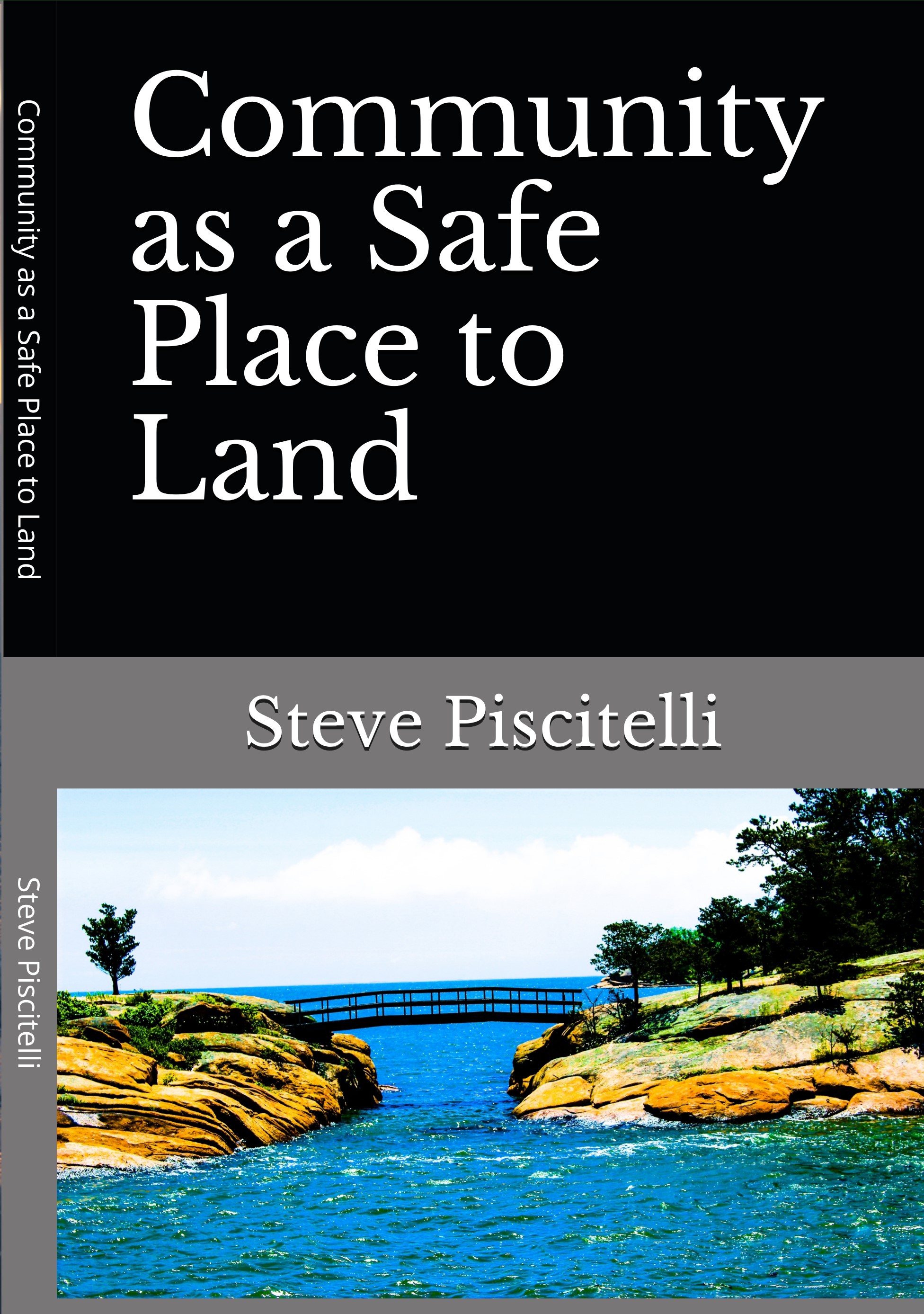
Community as a Safe Place to Land,

has been released!  At this point, you can purchase it on Amazon.  More purchasing options coming. More information at www.stevepiscitelli.com.

Make it an inspiring and grateful week and H.T.R.B. as needed.

For information about and to order my book, Stories about Teaching, Learning, and Resilience: No Need to be an Island, click here. A few colleges and one state-wide agency have adopted it for training and coaching purposes. Contact me if you and your team are interested in doing the same.

The paperback price on Amazon is now $12.00 and the Kindle version stands at $3.99. Consider it for a faculty orientation or a mentoring program. The accompanying videos would serve to stimulate community-building conversations at the beginning of a meeting.

My podcasts: The Growth and Resilience Network® (http://stevepiscitelli.com/media-broadcast/podcast).

My programs and webinars: website (http://stevepiscitelli.com/programs/what-i-do) and (http://stevepiscitelli.com/programs/webinars).

©2019. Steve Piscitelli
The Growth and Resilience Network®



Posted in assumptions, awareness, blame, Critical Thinking | Tagged , , , , , , , , , | 2 Comments

(#451) The Conversation Starter


There are no strangers; only friends she has yet to meet.

It was a chance encounter on a pet therapy round. As Roxie and I exited a hospital office area, a woman stopped in the hallway and looked at us.

“I need to pet a dog at this moment,” she said.  She reached down as we approached. Roxie stood beside her and gently leaned into her. The woman stroked Roxie’s back with a soft hand.

In the other hand I noticed she had a clump of papers.  She looked up at me and said she just learned she had a brain tumor. She continued to move her fingers up and down Roxie’s back.

We continued to talk. Mostly, Roxie and I listened. It sounded like she was doing an initial sorting of her thoughts and emotions.

And her hand never left Roxie’s back. Roxie patiently stood.

A few minutes later, the woman excused herself for the restroom. Before she left, she raised her eyes from Roxie to me and said that she believed the universe brought Roxie to her at that point in time.

That moment—more than any other I’ve had with Roxie—reminded me of the potential an animal holds for people.  Roxie, like other pet therapy dogs I have seen, serves as the conversation starter.

There are no strangers; only friends she has yet to meet.

At the airport last week, Roxie met many new friends. And I think about the lessons she teaches.

It generally starts with someone looking at, and then, smiling as we walk by. We approach. There is a paw shake or body language welcoming an interaction.

No barking. No jumping. No rudeness. No showboating. No ugliness. No put-downs.

Just an “I’m-glad-to-meet-you-and-spend-some-time-with-you” experience.

Roxie’s new “friends” invariably talk about their pets, family, home, and travels. Roxie is the conversation starter. She does not interrupt. She does not tell them they are wrong. She does not mind what language they speak (as exhibited last week when one international couple hand-gestured to me, with huge smiles, that they would like to take photos of Roxie). Her language is love and patience.  Other than seeing a gentle stroke in her future, Roxie carries no prejudgment.

She waits.

A conversation begins.

A bond is forged. Perhaps a small piece of healing takes root. Even if for a few minutes.

Smiles linger. Moods brighten.

Roxie teaches us another lesson in civility, kindness, and community. In some ways, it is a brighter day.


Video Recommendation of the Week:

Last year I had the opportunity to record a podcast with the Reverend Elizabeth Teal. We discussed animal-assisted interventions. You can hear the entire episode on The Growth and Resilience Network® podcast channel.  In this short clip (86 seconds) we hear about facilitating a little bit of healing.


For more about community building and sustainability,
look for my new book,
Community as a Safe Place to Land.

The paperback edition is due out this week.
The Kindle version can be purchased here.
More information at www.stevepiscitelli.com.


Make it an inspiring and grateful week and H.T.R.B. as needed.

For information about and to order my most recent book, Stories about Teaching, Learning, and Resilience: No Need to be an Island, click here. A few colleges and one state-wide agency have adopted it for training and coaching purposes. Contact me if you and your team are interested in doing the same.

The paperback price on Amazon is now $14.99 and the Kindle version stands at $5.99. Consider it for a faculty orientation or a mentoring program. The accompanying videos would serve to stimulate community-building conversations at the beginning of a meeting.

My podcasts: The Growth and Resilience Network® (http://stevepiscitelli.com/media-broadcast/podcast).

My programs and webinars: website (http://stevepiscitelli.com/programs/what-i-do) and (http://stevepiscitelli.com/programs/webinars).

©2019. Steve Piscitelli
The Growth and Resilience Network®
Posted in awareness, Civility, collaboration, compassion, empathy, intentionality, kindness, pet therapy | Tagged , , , , , , | 1 Comment

(#450) Respectful Relationships


Respectful relationships help build lasting, meaningful,
accepting, loving, nurturing, and sustaining communities.

As I wrote Community as a Safe Place to Land, I had the opportunity to speak with transformational people in communities from Savannah, Georgia to Celebration, Florida.  Each story spoke to the interrelated importance of The Seven Rs—the seven core values for purpose and growth.

This past week I reviewed the author’s proof copy of the book (the last step before release of the work).  I thumbed through the seven transformational stories and once again was struck by the common themes from different parts of the region. Different stories with a connecting principle.  Consider the following quotes from the book:

  • “That congregation of loving and accepting people tied a knot at the end of my rope so that I could hang on.” (2)
  • “Everyone has a story, and our job is to listen.” (32)
  • “The program manager kept coming back to the program each day because ‘It’s about the people.’” (60)
  • “A young songwriter sings for her community, ‘You’re my friend and I love you.’” (87)
  • “People must have a say-so about what is going on in their community if change is to take root.” (117) 
  • “Remember that kindness is always better than righteousness.” (117)
  • “Friendships were born, and they helped grow resilience…In hearing other people’s stories, they began to hear the ‘echo of a voice’ of their story. They would not be denied and would not give up.” (173)

Respectful relationships help build lasting, meaningful, accepting, loving, nurturing, and sustaining communities.


You will be able to read more later this month when the book is released.  In the meantime, you can read more about the book and the accompanying podcast transformational community episodes at https://stevepiscitelli.com/media-written/community-as-a-safe-place-to-land.


Podcast Clip Recommendation of the Week:

Listen to Executive Director George Maxey of the New Town Success Zone speak about the importance of listening to people. Listening + Accountability = Movement.


For more about community building and sustainability,
look for my new book,
Community as a Safe Place to Land,

due out later this month. More information at www.stevepiscitelli.com.


Make it an inspiring and grateful week and H.T.R.B. as needed.

For information about and to order my most recent book, Stories about Teaching, Learning, and Resilience: No Need to be an Island, click here. A few colleges and one state-wide agency have adopted it for training and coaching purposes. Contact me if you and your team are interested in doing the same.

The paperback price on Amazon is now $14.99 and the Kindle version stands at $5.99. Consider it for a faculty orientation or a mentoring program. The accompanying videos would serve to stimulate community-building conversations at the beginning of a meeting.

My podcasts: The Growth and Resilience Network® (http://stevepiscitelli.com/media-broadcast/podcast).
My books: www.stevepiscitelli.com/media-written/books

Posted in acceptance, accountability, action, amplifying, Appreciation, Communication, Community, community development, Life lessons, resilience, respect, responsibility | Tagged , , , , | 1 Comment

(#449) A Blogger’s Retrospective for 2018


May you create, share, and savor powerful moments
in the coming year and beyond.
[Watch this week’s recommended video toward the end of this post!]


While sitting in an Austin hotel room at the end of May 2010, I wrote my first post for this blog. At that time, I had three goals:

  • Experience a new (for me) aspect of social media
  • Develop and flesh out new ideas
  • Provide something of value—not just another cyber rant.

I believe I have accomplished the first and the second. It is up to you whether I have accomplished the third. My blog posts contain videos, book recommendations and summaries, questions to ponder, and always a takeaway to apply immediately to life.  I have remained true to my commitment to publish one blog post per week. This post marks the 449th consecutive week.  And I know that I am #alwayslearning!


Since that first post, this blog has had more than 75,000 visits and evolved into www.thegrowthandresiliencenetwork.net. Thank you!

Thank you for reading, commenting, and sharing.  I would love to hear what you find of value on this blog. And, please feel free to share any ideas you have for future posts.


As has now become tradition for this blog, this last-of-the-year offering lists each of the previous week’s posts I added this year. Along with each title, you will find a teaser about each. Perhaps a nugget or two will provide inspiration. I have linked each title to the actual blog should you want to read it, re-read it, or share it. Thank you for your continued support and comments.

I also have included (1) top five blog posts (by number of views/visits) since I started this journey in 2010; and (2) the top five blog posts for 2018.

*Top Five All-Time Posts on this Blog (Since 2010)* 

  1. (#194) Honor the Past. Celebrate the Present. Embrace the Future.
  2. (#86) A Model for Critical Thinking
  3. (#18) Crab Pot Mentality
  4. (#93) SQ4R: Strategic Reading Strategies for the Classroom and Beyond
  5. (#219) The First Day of Class: People Before Paper!


*Top Five 2018 Posts on this Blog*

  1. (#194) Honor the Past. Celebrate the Present. Embrace the Future.
  2. (#86) A Model for Critical Thinking
  3. (#416) A Safe Place to Land
  4. (#18) Crab Pot Mentality
  5. (#426) It’s Easy to be Left Behind

*2018 in Review*

  1. We Are Where We Are * “We are where we are, however we got here. What matters is where we go next.”—Isaac Marion
  2. Inappropriate or Authentic * Feedback is powerful. Evaluated feedback carries more weight.
  3. Do We Live In A Post-Fact World? * Perhaps we live in a time when the question to ponder becomes, “If a fact is offered and it is not ‘liked,’ is it a fact?”
  4. Improv Leadership * Incompetent and fear-based managers rely on rigid scripts.
  5. Over Your Head * The exceptional leaders take their moments of vulnerability and build on them.
  6. Create Your Own Story Or Someone Else Will * It may be too late.
  7. Risk, Empty Spaces, and Self: Lessons from the Stage. * There is no failure in result; there is only failure in process.
  8. Communication or Statement? * Are we listening to others—and ourselves?
  9. Purpose and Authenticity * Mortality salience often leads you to ask questions about the meaning in your life.
  10. Are You Just Doing Stuff? * We can easily get caught up in the “noise” around us if we allow that to happen. The wrong things end up pushing the right things to the side.
  11. Self-Evaluation * Narrow the focus and help yourself understand what does or does not serve and nourish your soul.
  12. More with Less or Less with More? * If the “more-with-less crisis” is followed by another “more-with-less crisis” and yet another, simple arithmetic indicates with each “more” there is a lot “less.” And then that becomes the norm.  
  13. Your Backstory * Who are two people who have had the biggest impact on your life?
  14. Perhaps, A Human Good Citizenship Test? * If only we treated our fellow human beings (citizens of the world) with the same dignity as the CGC expects of its participants.

  15. Choices: Where Do You Choose To Be? * Once we choose who we want to be, people grow “to the way in which they have been exercised.”
  16. Don’t Figure It Out * Leave room…develop the concept…be free…listen.
  17. Come Together: Food, Friends, and Family * The food might have brought us together; the bonding kept us coming back.
  18. Does the Disturbance Disturb You? * We limit our own growth and spiritual development.
  19. A Safe Place to Land * I kept hearing about the connections between congregants and neighborhood, congregants and congregants, as well as congregants and their own souls.
  20. Gratitude * Simple acts of gratitude offered, received, and witnessed.
  21. Helping a Village Find Its Voice * Listen and respect one another. Find your voice. Use your voice. Pursue your rainbows.
  22. What if It Were All Gone * We allow ourselves to get overwhelmed by the “stuff” of life. We end up taking a lot for granted. We may even have GDD.  Gratitude Deficit Disorder.
  23. Trust as a Core Value * Everyone has a story and our job is to listen.
  24. Step Out, Stretch, and Experience * You make your partner look good. The scene is never about you….
  25. Ask. Listen. Act. * Noise abounds as people tell us what we should and should not. Perhaps we do the same to others.
  26. Poverty * When communities build walls to separate their people (due to a poverty of understanding or compassion), the lack can seem insurmountable.
  27. Connections * How often do we stop to remember the grace others have added to our lives?
  28. A Community of Mentors for Music, Hope, and Rainbows * Neighbors entertaining neighbors while enjoying the company of other neighbors.
  29. It’s Easy to be Left Behind * “Aging in place” may describe what the residents were doing but not who they wanted to be.
  30. Someone Must be the Grown Up in the Room * The leader helps us see what is possible, especially when we do not have that vision in our experience.
  31. What Does Success Look Like to You? * Is success a noun? A verb? An adjective? Does it have to be connected to the common good?
  32. Everything Is Up for Revision * Considered evaluation can alter, broaden, and strengthen our belief system.
  33. Reality? Question the Buddha * Everyone talking or interrupting and not much listening. People speaking what they want to hear. Ignoring all else.
  34. Pay Attention to the 360° View * If we gaze in one direction, toward the subject and the toward the subject only, we miss the full spectrum.
  35. Compassion * “That which is hateful to you, do not do to another. That is the whole Law. The rest is commentary. Now go and learn.” -Rabbi Hillel

  36. Verifying the Truth * You won’t find a step that says evaluate a source based on what “my group believes” or “who tweeted the most” or “how much I dislike a source.”
  37. Wisdom * The opportunities to appreciate wisdom exist all around us. Are we mindful? Are we paying attention?
  38. Community Requires Respectful Communication * You better think.
  39. Facing the Worst. Preparing for the Best. * Once the conversation started, no one was going to stop it.
  40. Your Meeting Deserves a K.I.S.S. * Keep It Simple and Short.
  41. You May Not be the Gift in the Room * Effective collaboration rests on the ability to share the stage.
  42. Are You Paying Attention to the People in Front of You? * Collaboration does not come from telling, yelling, or selling people. It comes from considered conversation.
  43. What Matters Now? * When you set your goals you said to yourself, “These matter to me.” As you review where you have been and where you want to go, ask yourself, “What matters now?”  And then act on it.
  44. It Means Something to Somebody * It got me thinking about those missed moments when we think something isn’t “worth it.”
  45. Community Building: Beyond Why to How * The question, in my mind, moves beyond why we need community to how we go about building and sustaining it.
  46. Why Did We Form This Band? * There are some things that really matter, like a shared vision. If the singer wants to be a star, the guitarist wants to play a different style and the bassist and drummer are in it to smoke weed and jam…might not work out.—Crucial Eddy Cotton
  47. Mouths and Ears * Discourse. Dialogue. Debate. Diminished?
  48. Endings. Beginnings. Beginnings. Endings * How will the ending affect your beginning?
  49. What Serves as Your Fuel? * W.A.Y.D.T.G.W.Y.W?
  50. Resistance Bubbles * How do we get the two groups to the table to capitalize on
    the 10% they agree on—to start a conversation and maybe educate one another to each resistance bubble’s beliefs and core values? Is this a worthy goal—and, is it possible?
  51. Flexibility * “The age of a person is not determined by his years but by his flexibility.”~ Attributed to Yogi Bhajan
  52. A Blogger’s Retrospective: 2018 in Review *


Video Recommendation for the Week.

This video still has legs. I filmed it on New Year’s Eve seven years ago.  Who and what do we allow into our lives? Why do we allow people, thoughts, issues, and events into our minds that we would never invite into our homes? Feed your mind. Create your life.  Happy New Year!


For more about community building and sustainability,
look for my new book,
Community as a Safe Place to Land,

due out the beginning of 2019. More information to come.


<b>Make it an inspiring and grateful week and <a style=”color: #0066cc;” href=”http://stevepiscitelli.com/programs/htrb&#8221; target=”_blank” rel=”noopener”>H.T.R.B.</a> as needed.</b>

F<i style=”background-color: transparent; border-image-outset: 0; border-image-repeat: stretch; border-image-slice: 100%; border-image-source: none; border-image-width: 1; color: #444444; font-family: Georgia, &font-size:16px; font-style: italic; font-variant: normal; font-weight: 400; letter-spacing: normal; orphans: 2; text-align: left; text-decoration: none; text-indent: 0; text-transform: none; white-space: normal; word-spacing: 0; border: 0 none #444444;”>or information about and to order my most recent book, Stories about Teaching, Learning, and Resilience: No Need to be an Island, click here. A few colleges and one state-wide agency have adopted it for training and coaching purposes. Contact me if you and your team are interested in doing the same.

<strong>The paperback price on Amazon is now $14.99 and the Kindle version stands at $5.99. Consider it for a faculty orientation or a mentoring program. The accompanying videos would serve to stimulate community-building conversations at the beginning of a meeting.</strong>

My podcasts: <a href=”http://stevepiscitelli.com/media-broadcast/podcast&#8221; target=”_blank” rel=”noopener”>The Growth and Resilience Network®</a> (<a href=”http://stevepiscitelli.com/media-broadcast/podcast&#8221; target=”_blank” rel=”noopener”>http://stevepiscitelli.com/media-broadcast/podcast</a&gt;).

My programs and webinars: <a href=”http://stevepiscitelli.com/programs/what-i-do&#8221; target=”_blank” rel=”noopener”>website </a> (<a href=”http://stevepiscitelli.com/programs/what-i-do”>http://stevepiscitelli.com/programs/what-i-do</a&gt;) and (<a href=”http://stevepiscitelli.com/programs/webinars”>http://stevepiscitelli.com/programs/webinars</a&gt;).

Posted in Annual blog statistics, Appreciation, Appropriate Behavior, assumptions, awareness, Gratitude, resilience | Tagged , , , , , , , , | Leave a comment

(#448) Flexibility


NOTE to my followers.  This will be my last post for 2018.  Next week in this space you will find my annual end-of-year retrospective.  Thank you for following, commenting, and sharing my posts.  I appreciate you. May you end your year creating, sharing, and savoring wonderful moments for yourself and those you love.  See you in 2019. Now, for this week’s offering….


“The age of a person is not determined by his years but by his flexibility.”
~ Attributed to Yogi Bhajan

Flexibility has helped us survive. Dr. Friedemann Schaub writes that our evolutionary past is a reminder that “survival of the fittest” can easily be labeled as “survival of the most flexible.”  Look at a young child learning to walk. She stands, falls, stands, teeters, falls, stands, moves forward a few steps, stumbles, and walks.

Imagine what the consequence would be if she decided it would be better to just remain seated. Lost opportunities. No growth. Limited stretching and exploration. Rigid boundaries of a not-so-expansive world.

The same inflexibility can happen cognitively and emotionally.  Schaub says when we stop wondering about the world,

We can gradually become entangled in rather rigid internal and
external framework of pressures, obligations, and conditional acceptance of ourselves.
The imposed reality can become our reality and leave us little room
to think or act in a flexible, self-empowered manner.

We get comfortable. Feel safe. And we limit our options and beliefs about ourselves and those around us. Growth (physical, emotional, spiritual, intellectual) is a casualty. Anxiety and fear take hold.

Same with decision making. Lack of flexibility (read: ability to look at various sides and sources of an issue) can lead to entrenched beliefs, fear, and ill-advised action.

Flexibility increases options and empowers us to find possibilities and revise our beliefs and biases.

But to be flexible we must stretch ourselves beyond our comfort zones.  We must be willing to learn from opposing views.

Jonathan Haidt speaks about “openness to experiences.” People who have this openness crave newness and want a deeper life. (See TED Talk below.)  They are more apt to become engaged in their world and hold a passionate commitment to the truth.

Which requires flexibility.

Yoga reminds us, “The age of a person is not determined by his years but by his flexibility.”

No one group has the corner on morality or openness. We can learn from each other. That requires flexibility.

Namaste.


Podcast Recommendation of the Week:

Jonathan Hait’s TED Talk on “The Moral Roots of Liberals and Conservatives.”


For more about community building and sustainability,
look for my new book,
Community as a Safe Place to Land,

due out the beginning of 2019. More information to come.


Make it an inspiring and grateful week and H.T.R.B. as needed.

For information about and to order my most recent book, Stories about Teaching, Learning, and Resilience: No Need to be an Island, click here. A few colleges and one state-wide agency have adopted it for training and coaching purposes. Contact me if you and your team are interested in doing the same.

The paperback price on Amazon is now $14.99 and the Kindle version stands at $5.99. Consider it for a faculty orientation or a mentoring program. The accompanying videos would serve to stimulate community-building conversations at the beginning of a meeting.

My podcasts: The Growth and Resilience Network® (http://stevepiscitelli.com/media-broadcast/podcast).
My programs and webinars: website (http://stevepiscitelli.com/programs/what-i-do) and (http://stevepiscitelli.com/programs/webinars).

Posted in assumptions, awareness, bias, boundaries and limits, change, Choice, collaboration, curiosity, Life lessons, resilience | Tagged , , , , , , , , | 1 Comment

(#447) Resistance Bubbles


How do we get the two groups to the table to capitalize on
the 10% they agree on—to start a conversation and maybe educate one another to each resistance bubble’s beliefs and core values?
Is this a worthy goal—and, is it possible?

In my book, Community as a Safe Place to Land (scheduled for release in January 2019), I pose the following:

If we surround ourselves with a community of people who believe as we do (politically, socially, nutritionally, economically, or religiously) can it be inclusive?  Or, because we live in a diverse community (politically, socially, nutritionally, economically, or religiously) does that make it inclusive? And if it is inclusive, can it be a gathering of like-minded individuals? Or do we, within a community, still segregate ourselves into smaller like-minded groupings—smaller like-minded sub-communities? Is inclusiveness an idealized goal within a diverse community?

Or as one reviewer of this book offered, “Inclusivity is the practice of including people beyond comfort or like-ness. The only like-mindedness of inclusive folks is to be open to others.”

A recent podcast episode (November 20, 2018) of Insights at the Edge introduced me to the concept name of “Resistance Bubbles.” Vann Jones, the guest, challenged the listeners to get out of their resistance bubbles—those like-minded groupings where all comes down to “us, good” and “them, bad.”  Jones puts it this way,

Rather than me  living in a world where every time I go on my social media feed and it’s all just offering reinforcement of me by people who think my way and giving me that sense of righteousness, a cheap sugar rush…I see how all sides respond….Over time, you develop a tolerance and better understanding of the range of responses….We have to build up the capacity to hold a lot of different kinds of views…It’s a discipline.

If we stay with like-minded folks only, Jones argues, we then wakeup in a resistance bubble [go to the 7:55 mark for the introduction of the concept name]. Surrounded by all that makes us comfortable; all that agrees with us.

Saying we are inclusive and diverse and living it can be two different sides of the coin.

How do we break out of—or at least venture a little way from—our own resistance bubbles? Is it possible for us learn from those housed in other resistance bubbles? Is there any common ground? Or are the lines so rigid there is no crossing? If the lines are that rigid, do we then become entrapped within our own bubble?

Let’s say with have two community groups (two resistance bubbles) who disagree on most issues. In fact, ask their opinions and you will find that 90% of the time they are on polar extremes of the issue. Rather than considered conversation, we hear cacophonous diatribes. But there is that 10% of the time that they can find common ground. The decibel level decreases and they (almost) listen to one another.

I would appreciate your considered insights to this:  

How do we get the two groups to the table to capitalize on the 10% they agree on—to start a conversation and maybe educate one another to each resistance bubble’s beliefs and core values? Is this a worthy goal—and, is it possible?


Podcast Recommendation of the Week:

Click here to listen to the podcast “Breaking Out of Our Resistance Bubble.”


For more about community building and sustainability,
look for my new book,
Community as a Safe Place to Land,

due out the beginning of 2019. More information to come.


Make it an inspiring and grateful week and H.T.R.B. as needed.

For information about and to order my most recent book, Stories about Teaching, Learning, and Resilience: No Need to be an Island, click here. A few colleges and one state-wide agency have adopted it for training and coaching purposes. Contact me if you and your team are interested in doing the same.

The paperback price on Amazon is now $14.99 and the Kindle version stands at $5.99. Consider it for a faculty orientation or a mentoring program. The accompanying videos would serve to stimulate community-building conversations at the beginning of a meeting.

My podcasts: The Growth and Resilience Network® (http://stevepiscitelli.com/media-broadcast/podcast).

My programs and webinars: website (http://stevepiscitelli.com/programs/what-i-do) and (http://stevepiscitelli.com/programs/webinars).

Posted in acceptance, Appreciation, Appropriate Behavior, assumptions, awareness, change management, Civility, collaboration, collegiality, community development, consideration, conversation, curiosity | Tagged , , , , , , , , , , | 9 Comments

(#446) What Serves As Your Fuel?


W.A.Y.D.T.G.W.Y.W?

Clean out an overstuffed desk drawer or dig into the rear of the hall closet and you might say, “Darn, where did that come from?” Or, a slight smile might crease your lips, “Yeah, that brings back memories!”

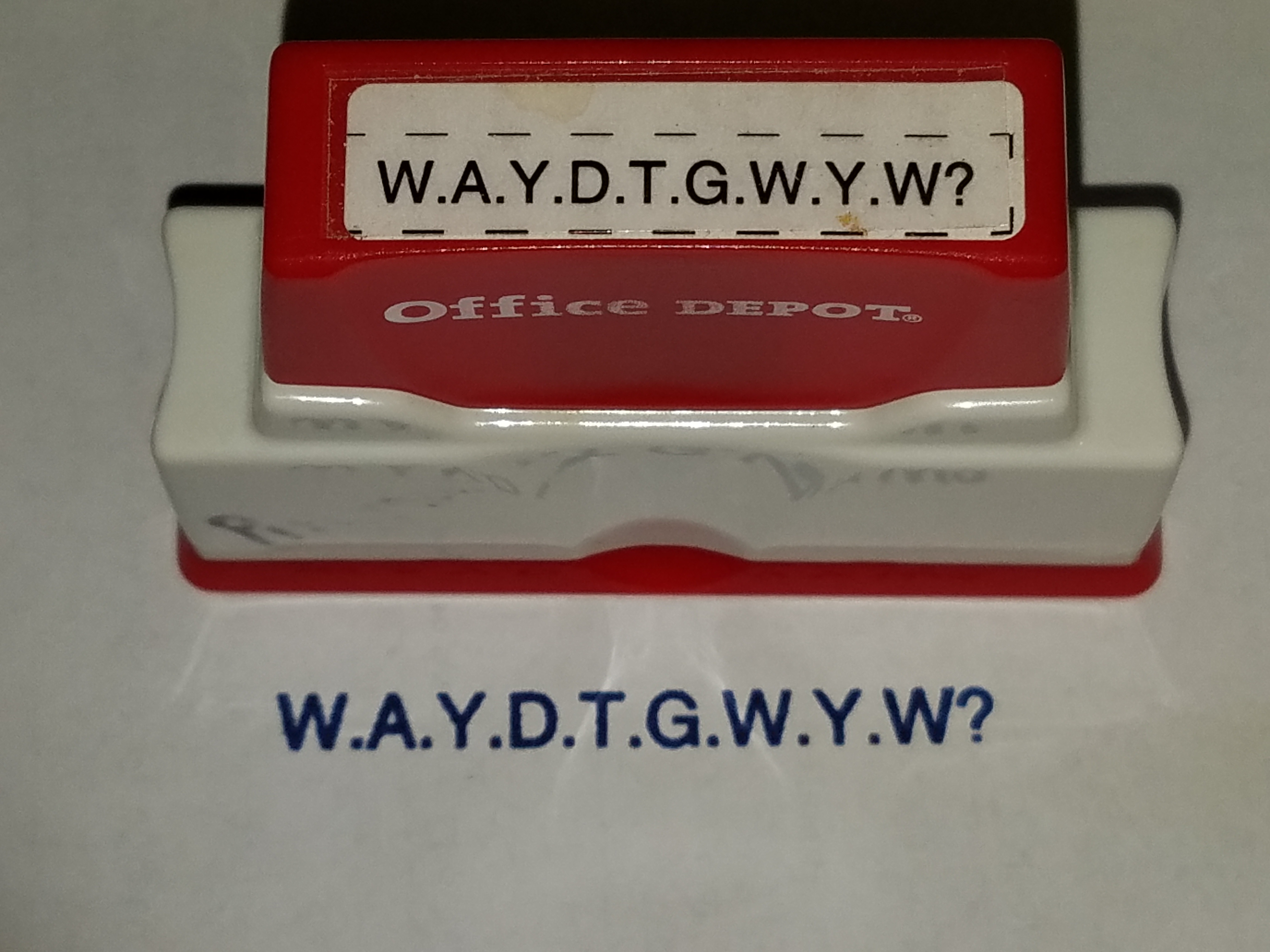
Last week I found a stamp in my office. You know, the self-inking type that you might have for a return address or to mark a check for deposit.

My stamp had “W.A.Y.D.T.G.W.Y.W?”

I had it made one semester for my students. More specifically, for their papers.  After readying their initial assignment of the term, in addition to my written, long-hand comments, I would stamp “W.A.Y.D.T.G.W.Y.W?” on the bottom of the page.  Occasionally, I would share the message again at midterm and end of term.

“W.A.Y.D.T.G.W.Y.W?”

“What Are You Doing To Get What You Want?”

Each student came to campus with dreams. Some laser-focused; others a bit scattered. I challenged them to add action to their dreams.  Without initiative, all the potential and ambition in the world can come up short.

As you review your goals for this past year, you will find times of progress, stumbles, misdirection, success, learning, and growth. Take a moment and dig deeper. What happened because of your consistency and inconsistency?  Did you take your eye off your dream? Did you get tired?  Did you get sidetracked because you paid attention to distractions and detractors? Did you find you needed assistance? Did you seek that assistance?

What served as your fuel and what depleted your reserves?

“W.A.Y.D.T.G.W.Y.W?” is more than a clever technique. It reminds us that our dreams need attention, assumption-checking, alacrity, and action.

As you review 2018 and move into 2019, perhaps “W.A.Y.D.T.G.W.Y.W?” can provide the little push you need—we all need—to stay true to our core values.


Video Recommendation of the Week:

This 60-second video reminds us of the importance of establishing, recognizing, and honoring boundaries and limits.  If we fail to do this, we risk sabotaging our journey. Consider, as part of your “W.A.Y.D.T.G.W.Y.W?”, how boundaries and limits fit into your action plan.


For more about community building and sustainability,
look for my new book,
Community as a Safe Place to Land,

due out the beginning of 2019. More information to come.


Make it an inspiring and grateful week and H.T.R.B. as needed.

For information about and to order my most recent book, Stories about Teaching, Learning, and Resilience: No Need to be an Island, click here. A few colleges and one state-wide agency have adopted it for training and coaching purposes. Contact me if you and your team are interested in doing the same.

The paperback price on Amazon is now $14.99 and the Kindle version stands at $5.99. Consider it for a faculty orientation or a mentoring program. The accompanying videos would serve to stimulate community-building conversations at the beginning of a meeting.

My podcasts: The Growth and Resilience Network® (http://stevepiscitelli.com/media-broadcast/podcast).

My programs and webinars: website (http://stevepiscitelli.com/programs/what-i-do) and (http://stevepiscitelli.com/programs/webinars).

Pearson Education publishes my student textbooks for life success—Choices for College Success (3rd edition) and Study Skills: Do I Really Need This Stuff? (3rd edition).

(c) 2018. Steve Piscitelli. All rights reserved.

Posted in amplifying, assumptions, authenticity, awareness, boundaries and limits, emotional intelligence, Failure, growth, resilience | Tagged , , , , , , | Leave a comment

(#445) Endings. Beginnings. Beginnings. Endings.


How will the ending affect your beginning?

Sunset. Moonrise.

Moonset. Sunrise.

December 31. January 1.

High school graduation. College first-year experience.

Diagnosis. Recovery.

Digital detachment. Digital detachment.

Relationships. Relationships.

Death. Birth.

Winter. Spring.

Rainbow bridge. Puppy adoption.

Open door. Closed door.

Letting go. Moving forward.

[You fill in the ending.  You fill in the beginning.]

Endings. Beginnings. Beginnings. Endings.

Once a month, Roxie and I can witness a full moon descending over the beach dunes while the sun peaks over the ocean waves. At once we can see the ending of the preceding day and the beginning of the new.

The past yields to the present. We build on our progress and learn from our stumbles. We can move forward or curl up.

In 30 days, the calendar turns. What matters to you before the year ends? How will the ending affect your beginning?

Video Recommendation of the Week:

A poem (with Native American flute accompaniment) reminds us that
“For sometimes things must end. Try not to cling tightly.
Fearing what is around the bend. Endings and beginnings.”


For more about community building and sustainability,
look for my new book,
Community as a Safe Place to Land,

due out the beginning of 2019. More information to come.


Make it an inspiring and grateful week and H.T.R.B. as needed.

For information about and to order my most recent book, Stories about Teaching, Learning, and Resilience: No Need to be an Island, click here. A few colleges and one state-wide agency have adopted it for training and coaching purposes. Contact me if you and your team are interested in doing the same.

The paperback price on Amazon is now $14.99 and the Kindle version stands at $5.99. Consider it for a faculty orientation or a mentoring program. The accompanying videos would serve to stimulate community-building conversations at the beginning of a meeting.

My podcasts: The Growth and Resilience Network® (http://stevepiscitelli.com/media-broadcast/podcast).

My programs and webinars: website (http://stevepiscitelli.com/programs/what-i-do) and (http://stevepiscitelli.com/programs/webinars).

Pearson Education publishes my student textbooks for life success—Choices for College Success (3rd edition) and Study Skills: Do I Really Need This Stuff? (3rd edition).

(c) 2018. Steve Piscitelli. All rights reserved.

Posted in amplifying, assumptions, authenticity, awareness, change management, Choice, confidence, core values | Tagged , , , , , , , | 1 Comment

(#444) Mouths and Ears


Discourse. Dialogue. Debate. Diminished?

In an interview with Bill Moyers, writer and political analyst Sam Tanenhaus addressed the challenge with current-day discourse or dialogue or debate.

The people around the table “have many mouths but they don’t have many ears…
The sign of a true statesman is the capacity to listen…
to try to inhabit the thoughts and ideas of the other side.”
(p. 261)

A lot people talking. Not many listening.

When these collective monologues turn to gossip and insults, the mouths without ears end up killing people’s dignity and assaulting their souls according to psychologist Brenda Shoshanna.

From the lack of listening to the talking over one another, one would think that to even consider meaningful discourse somehow diminishes one’s self. Shoshanna blames it on ego domination. We diminish conversation, others, and ourselves. She states,

One way for the ego to protect itself from being insulted is to enjoy insulting others.
This is the basis of gossip and slander…
However, what we do not realize is that engaging in these
practices not only harms others but also harms us.
We keep ourselves thinking negatively; we keep upset alive within.
(p. 62)

Before we can collaborate, we must converse. Before we can do that, we need to consider the subject before us. Consideration (that is, careful thought over time) requires work; listening; questioning; listening some more. Bridge building–or at least authentic efforts to construct a connection. No short cuts.


Video Recommendation of the Week:

In his 1960 hit, Joe Jones, sings “you talk about people you don’t know….you talk about people wherever you go.” You just talk too much!


For more about community building and sustainability,
look for my new book,
Community as a Safe Place to Land,
due out the beginning of 2019. More information to come.


Make it an inspiring and grateful week and H.T.R.B. as needed.

For information about and to order my most recent book, Stories about Teaching, Learning, and Resilience: No Need to be an Island, click here. A few colleges and one state-wide agency have adopted it for training and coaching purposes. Contact me if you and your team are interested in doing the same.

The paperback price on Amazon is now $14.99 and the Kindle version stands at $5.99. Consider it for a faculty orientation or a mentoring program. The accompanying videos would serve to stimulate community-building conversations at the beginning of a meeting.

My podcasts: The Growth and Resilience Network® (http://stevepiscitelli.com/media-broadcast/podcast).
My programs and webinars: website (http://stevepiscitelli.com/programs/what-i-do) and (http://stevepiscitelli.com/programs/webinars).

Pearson Education publishes my student textbooks for life success—Choices for College Success (3rd edition) and Study Skills: Do I Really Need This Stuff? (3rd edition).

(c) 2018. Steve Piscitelli. All rights reserved.

Posted in Appreciation, Appropriate Behavior, awareness, boundaries and limits, Civility, collaboration, collective monolgues, Communication, Community, conversation, ethics, growth | Tagged , , , , , , | 1 Comment

(#443) Why Did We Form This Band?


There are some things that really matter, like a shared vision.
If the singer wants to be a star, the guitarist wants to play a different style and the bassist and drummer are in it to smoke weed and jam…
might not work out.—Crucial Eddy Cotton

Last week, I crafted a musical metaphor for a community group. I wanted to address the challenge of establishing a shared vision for our group.

A few days later, I asked musician friends to share what they have found makes for a successful band.

The parallels between what makes for meaningful community activism and a successful band struck me as poignant.  Lessons right in front of us.

First, the metaphor I shared with the community group:

Consider a group of talented and accomplished musicians forming a band. For the band to be successful, several components must fall in place. Among them:

  1. Determining what the band’s genre will be. Blues? R and B? Classic? Jazz? Pop? Rap? Something else.

o   I liken this to the band’s core value. Why does it exist?

o   Metaphor for a community group: You have come together. You are the musicians, if you will.  What “music” do you want to play as a GROUP?

  1. The band must figure out its purpose beyond style of music.

o   Is to be a dance band? Concert band? Club band? Background music? Is it to record and sell CDs?

o   Metaphor: What is your purpose for forming your community “band”—your group?

  1. The band needs musicians that believe in the band’s reason for being—and each member must understand and live this. See #1 and #2 above.

o   If the band says it is a Blues Band and the bassist plays ¾ time jazz, the guitar player performs a 4/4 country slide lead, while the drummer pounds out a Reggae beat, and the keyboardist decides that the audience really needs to hear Bach, well we got a lot of talented people—but no one is playing together.  No music. Just cacophony.

o   Metaphor: Your group may have lots of ideas and actual programs moving forward.  Are they all connected to a common purpose? See #1.

  1. The band talks about a promoter or record producer. It wants to be HUGE!

o   If the band has not considered carefully the above (and much more) it can end up going with a promoter because the band believes he/she has experience and will make them big.  Unfortunately, if the band does not have a handle on what it wants to do, why it wants to do it, and how to do it….the band can lose the ability to direct its destiny.

o   Metaphor: Maybe your group has spoken about having a main driver/key donor to help make it big.  But, what do you approach them with? A bunch of parts and pieces of an amorphous being? A clear vision?

Now, for my question to the musicians:

What is the “IT” that makes a band work? If we were to move beyond the (obvious?) expectations for instrument and/or vocal talent, what keeps the band moving forward? What keeps the band together, playing, reaching goals, enjoying, making a difference for the members and the audience? Is there an “IT” that make the band work/click/gel?

Every musician’s post reminded me of the power of finding and loving what we do.  And recognizing those who help us make our “music” whether it’s on stage, in a classroom, serving in a restaurant, working in an office, or organizing a group of people.

Here were four of the many posts to my Facebook query. The bold emphasis is my emphasis of their words.

o   “The best music happens when the people making it respect and care about each other and the music.” – John Mortensen

o   “I’ve been in many bands and the best ones were always the ones where the band members liked and respected each other and worked together to create great music. I know, this may sound corny, but it’s true.”—Roy Peak

o   “To me, bands mirror the same dynamics of personal relationships. It’s easy to fall in love; they take work to sustain; they require clear alignment on goals. I believe that’s why so few live very long.”—Alan Gross

o   “There are some things that really matter, like a shared vision. If the singer wants to be a star, the guitarist wants to play a different style and the bassist and drummer are in it to smoke weed and jam…might not work out.”—Crucial Eddy Cotton

This week consider a community with which you work. Whether it concerns itself with political action, elimination of  a food desert, connections for shut-ins, or literacy training, does a clear vision exist—or just a bunch of pieces and parts of an amorphous being?


Video Recommendation of the Week:

While I have referenced this video in a few past blog posts, its musical message connects to this week’s post. As my friends above reminded us, we need vision and respectful relationships to get to that vision.  People supporting and standing by one another for the greater good of the group’s purpose.


For more about community building and sustainability, look for my new book Community as a Safe Place to Land
due out the beginning of 2019. More information to come.


Make it an inspiring and grateful week and H.T.R.B. as needed.

For information about and to order my most recent book, Stories about Teaching, Learning, and Resilience: No Need to be an Island, click here. A few colleges and one state-wide agency have adopted it for training and coaching purposes. Contact me if you and your team are interested in doing the same.

The paperback price on Amazon is now $14.99 and the Kindle version stands at $5.99. Consider it for a faculty orientation or a mentoring program. The accompanying videos would serve to stimulate community-building conversations at the beginning of a meeting.

My podcasts: The Growth and Resilience Network® (http://stevepiscitelli.com/media-broadcast/podcast).

My programs and webinars: website (http://stevepiscitelli.com/programs/what-i-do) and (http://stevepiscitelli.com/programs/webinars).

Pearson Education publishes my student textbooks for life success—Choices for College Success (3rd edition) and Study Skills: Do I Really Need This Stuff? (3rd edition).

(c) 2018. Steve Piscitelli. All rights reserved.

Posted in authenticity, awareness, Being REMARKABLE, change management, Choice, Civility, collaboration, collegiality, Communication, Community, community development, consideration, conversation, core values, resilience | Tagged , , , , , , , , | 1 Comment