
(#261) Mixing it Up with Your Audience


So, go ahead. Mix it up. It will not only energize your
audience, 
it will keep you fresh.

A note to my blog followers: This week’s post marks the fifth anniversary for this blog. Thank you for following and sharing my weekly posts. It all began in an Austin, Texas hotel room on May 31, 2010.  I had just completed facilitating a session at the NISOD annual conference and decided it was time I dove in to the blogosphere.   Ironically, as I start year #6, I am sitting in Austin once again. (Love this city! And NISOD!). Please let me know if you have ideas for future topics.


Tomorrow I will facilitate a session on student success strategies at the annual NISOD conference.  As is the case so often, strategies for success in school can be broadly (and at times, specifically) applied beyond the classroom.  Hence the inspiration for this week’s blog post.

Whether you orchestrate a staff meeting, call to order a community action group, or lead a classroom, consider mixing it up with your audience.  Especially if it is a repeat audience.

Image: renjith krishnan/FreeDigitalPhotos.net

Image: renjith krishnan/FreeDigitalPhotos.net

Educational psychologist Lee Shulman developed a simple non-linear model for engagement in the classroom. It allows for a teacher/leader/organizer to start a lesson/meeting/session from any one of six entry points.   The six points are:

  • Engagement
  • Understanding
  • Performance
  • Reflection
  • Judgment
  • Commitment

I have found this one model a simple reminder that I never have to begin two sessions in the same manner. Nor do I have to stay in the same gear for an entire presentation. It switches things up for me, keeps the students “guessing” (what will he do today?), and helps make the material relevant.

There are times it is appropriate to deliver a lecture when the audience needs to have a quick grasp of knowledge. For instance, if students needed to know the safety precautions in a science lab, it would probably be best to provide a mini lecture for understanding.  Safety is probably not the area for experimentation. The same might hold true before sending a group of volunteers into a local river to pick up debris.

Or maybe you want to get the thought processes flowing with an opportunity to reflect on a significant event from the news headlines.  Speakers often begin with a story to engage the audience’s thinking. This requires that they also reflect on the words of the speaker and the meaning of those words to their lives (judgment).

Many times I had my history students begin a lesson by forming small groups (engagement), reading a primary source document (reflection) and then evaluate (judgment) how it supported an historical perspective.

Have you ever conducted the Marshmallow Challenge? This immediately places your participants in a performance mode. Engagement, reflection, judgment, and commitment soon follow.

Or maybe, after evaluating a particular issue from different points of view, your students/audience can commit to one position or another.

Video recommendation of the week:

As you can see, it is possible to use all of these in one session. They are not linear. You don’t need to do a certain one first and another one at the end.  You can enter at any point and mix and match as serves the needs of the people in front of you.

So, go ahead. Mix it up. It will not only energize your audience, it will keep you fresh.

Make it a wonderful week—H.T.R.B. as needed.

Check out my website (http://www.stevepiscitelli.com/programs.html) for programming information as well as details about upcoming webinars  (http://www.stevepiscitelli.com/webinars).

Information on my newest book, Choices for College Success (3rd ed.), can be found at Pearson Education.

(c) 2015. Steve Piscitelli. All rights reserved.

 

Posted in engagement, Learning Styles, public speaking, Teaching, teaching and learning | Tagged , , , , , , | 3 Comments

(#260) An Evening in the Gratitude Café


So many great things, places and people surround us. Appreciate them…embrace them.

This past week I had the opportunity to participate in a celebration of life for a friend who left us far too soon.  Kent Lindsey will be remembered as an entertainer, musician, TV personality, actor, teacher, husband, father, friend and community-minded citizen.  All who met him, found inspiration.

But there was more to this man. And while most of my blog followers never met or knew of Kent, I want to share one piece of his legacy that we would all do well to remember and practice regularly.

Photo by Steve Piscitelli. Taken at Kent's celebration.

Photo taken at Kent’s celebration.

Kent named his porch the Gratitude Café. Here he could enjoy peace, solitude, reflection and, yes, gratitude for the bounty in his life.  As the story is related, he so appreciated this space.

As he battled cancer and the slow but steady loss of all that was dear to him, he never lost his appreciation for life.  Even when he was undergoing chemotherapy and things just did not look good, Kent was thankful.  Filled with gratitude for all that he had the good fortune to experience in life.

Someone once asked Kent if the Gratitude Café was a place or an attitude. His response (with his inimitable laugh) was simply, “Yes.”

Kent’s lesson is simple yet often overlooked.  So many great things, places and people surround us. Appreciate them…embrace them.  Why would we let the not-so positive rob us of the joy around us? Yes, we can focus on who “did us wrong” today or we can think about all those good people in our lives. Why let the energy vampires (or toxic situations in life) take control?

Video recommendation of the week:

One of the celebration event singers performed the classic James Taylor song, “You’ve Got a Friend.” One line was particularly appropriate: “People will take your soul if you let them but don’t you let them.”

All star band at the grande finale

All star band at the grande finale

You would have been hard pressed to find a person in that room last Thursday night who would disagree. But what often happens after such events? When we find ourselves confronted with the dramas of life, we can easily let ourselves get distracted from all that is good.

A few years ago a colleague shared the wisdom of a wise old man with me.  In short, “I can wake up and count all that hurts me and is wrong with me or the world. Or I can give thanks for all that works and is right.”

It is truly our choice.  Thanks to Kent for reminding me of that. Reminding all of us.

May you spend more time in your Gratitude Café this week.

Make it a wonderful week—H.T.R.B. as needed.

Check out my website (http://www.stevepiscitelli.com/programs.html) for programming information as well as details about upcoming webinars  (http://www.stevepiscitelli.com/webinars).

Information on my newest book, Choices for College Success (3rd ed.), can be found at Pearson Education.

(c) 2015. Steve Piscitelli. All rights reserved.

Posted in Community, Gratitude, Life lessons, Reflection, Relationship, resilience, respect | Tagged , | 1 Comment

(#259) Is “Hope” a Meaningless Sentiment?


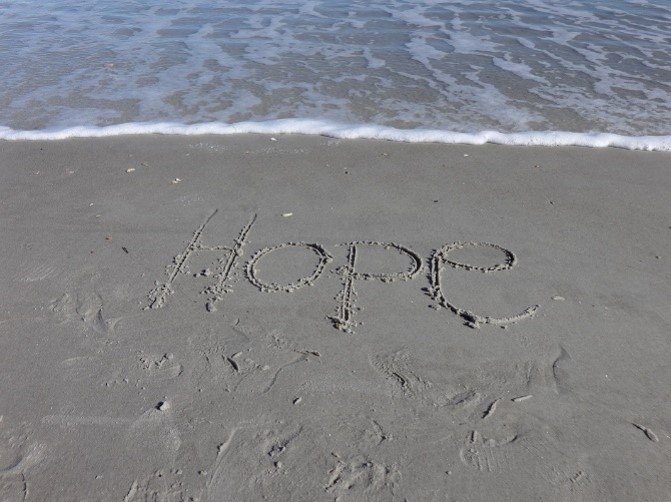
Is hope just a word that will soon be washed away by
an incoming tide? 
Or does it send a message of resilience?

What is the worth of “hope”?  As in, “don’t lose hope.”  Or, “I hope tomorrow is better than today.”  And, “I hope the boss likes my report.”

I have gone around the block with hope.  Like many of us, I have used the word without real thought any time I wished for something either to happen or not to happen.  It became a cliché word without much thought.  (A lot like the word “try” that is bandied about all the time. You know, “It didn’t work but I tried!“)

I then went 180 degrees and embraced the thought that “hope is not a strategy” and is not conducive to progress. It can be, I thought, a comfortable rationalization for inaction.

This past week I had a conversation with a colleague who is grappling with some professional challenges.  We both had recently heard a speaker focus on the power of hope. Hope for the future. Hope for improvement. Hope for a meaningful life. Hope for a good job. Hope, hope, hope.

My friend said that was nice—but he needed a plan to move through and beyond his challenges. “Hope” would not do the job.

Image: Laurie Piscitelli

Image: Laurie Piscitelli

A little over a year ago, a dear friend battled a disease that would in short order kill her.  While walking on the beach, my wife wrote the word hope in the sand and took the above photo.  So many ways to look at that.

Is hope just a word that will soon be washed away by an incoming tide? Or does it send a message of resilience?

I’ve come to believe that hope can be a powerful source of inspiration. In some cases, it might be the last thing separating a person from desperation and just giving up.

BUT for hope to have any chance of a lasting impact there must be more. Consider the equation:

H  +  P  +  A  =  D

HOPE can be the fuel that keeps our head up in times when we are confused, angry, and/or tired. Nice.  But to that we must add a PLAN. What do we need to put in place in order to move out of the (desperate) situation we find ourselves? Again, the plan (or goal) represents a start but it must be accompanied by ACTION.  What will you actually do to move your goal from words to your desired DESTINATION?

So to answer my question in the title above: Hope can be a meaningful sentiment as long as it is accompanied by a well-thought-out plan that is put into action to move toward the destination.  Hope, to me, can be a powerful fuel. But like the fuel in your car, it will not move you forward unless you put yourself in gear, step on the gas, and navigate down the road.

Video recommendation of the week:

This week, keep hope in front of you.

Make it a wonderful week—H.T.R.B. as needed.

Check out my website (http://www.stevepiscitelli.com/programs.html) for programming information as well as details about upcoming webinars  (http://www.stevepiscitelli.com/webinars).

Information on my newest book, Choices for College Success (3rd ed.), can be found at Pearson Education.

(c) 2015. Steve Piscitelli. All rights reserved.


Posted in courage, hope, life success, Passion, Personal growth, Personal Wellbeing, resilience | Tagged , , , , , , | 1 Comment

(#258) The Power of Guy Fieri: Five Life Lessons


In our do-everything-a-little-bit-faster-each-day world,
how often do we take time to be curious, to learn,
to listen, to laugh and be positive?

I don’t watch a lot of television.  When I do, though, one program my wife and I enjoy is Diners, Drive-Ins and Dives. The host and star, Guy Fieri, takes to the road in his ’68 Camaro each episode to find the “most off the hook joints in this great country.”

He’s been to our part of the world here in Atlantic Beach visiting Culhane’s Irish Pub and Singleton’s Seafood Shack (in nearby Mayport Village).  In Jacksonville he visited the Metro Diner.

Besides the gastronomic delights Fieri discovers and shares, I love his attitude.  His infectious laugh combined with his clever sense of humor make for an educational and entertaining thirty minutes.  And, most importantly, I have never seen an episode where he belittled anyone. He always portrays a positive outlook on every place he visits.

I’m not sure if Guy knows it, but beyond the recipes and destinations, Triple D offers powerful lessons (really, reminders) for a more fulfilled life. Here are five that I have distilled from viewing.

  • Remain Curious. In spite of his culinary background and expertise, he remains willing to learn a new twist on an old dish or chow down on a new menu discovery.
    • Takeaway. In the rush of daily life, it can become easy (and “safe”) to grind out the same-ole-same-ole stuff. Walt Disney reminded us to “keep moving forward, opening new doors, and doing new things…curiosity keeps leading us down new paths.”
  • Learn from Others. Curiosity leads to learning. He gets tips and suggestions from his viewers to visit out-of-the-way restaurants. He focuses on discovery.
    • Takeaway. If we don’t remain open to change, we risk becoming redundant, boring, and obsolete. Coaching great Lou Holtz said, “I never learn anything talking. I only learn things when I ask questions.” Which leads to the next point….
  • Listen. He listens to the chefs he visits. He does not tell them how it should be done. And he certainly does not rant, rave and vote someone out of the kitchen. He wants to learn (see point above), appreciate, and enjoy.
    • Takeaway. In our do-everything-a-little-bit-faster-each-day world, how often do we really listen to other people? And, more pointedly, how often do we listen to people who hold an opposing opinion or belief. Stop and listen (truly listen) to someone who differs from you.   “Courage is what it takes to stand up and speak; courage is also what it takes to sit down and listen,” stated Winston Churchill.
  • Laugh. Fieri laughs, jokes with others, and pokes fun at himself. He appears to be passionate and enjoying what he is doing. He seems to take his calling seriously—but takes time to belly laugh.
    • Takeaway. We’ve all heard that “laughter is the best medicine.” I can’t speak to any medical “evidence” but I do know, that I promised myself and my students that we would laugh each and every class session.  Even when the days were tough or the material dry, we laughed. I’m not a comedian but students have often thanked me for my sense of humor in class. It helped them in tough times. It often transports me.

Video recommendation for the week: In a moving speech, the late great coach Jimmy “V” Valvano told his audience “If you laugh, you think, and you cry, that’s a full day. That’s a heck of a day. You do that seven days a week, you’re going to have something special.”

  • Accentuate the Positive. After he watches a chef make a creation (see the first two points above),Fierisamplesandsavors.  He accentuates the positive for each and everydishhetastes.
    • Takeaway. We certainly can find enough Debbie Downers and Nasty Newtons out there. But rather than be an energy vampire, why not focus on being a nutritious person. Not in the sense of food—but from the perspective of soul nurturing.    Willie Nelson reportedly said, “Once you replace negative thoughts with positive ones, you’ll start having positive results.”  Sing it, Willie!

Make it a wonderful week—H.T.R.B. as needed.

Check out my website (http://www.stevepiscitelli.com/programs.html) for programming information as well as details about upcoming webinars  (http://www.stevepiscitelli.com/webinars).

Information on my newest book, Choices for College Success (3rd ed.), can be found at Pearson Education.

(c) 2015. Steve Piscitelli. All rights reserved.
Posted in Appreciation, awareness, Find Your Happy Place, Gratitude, Integrity, Mindfulness, Motivation, Passion, Purpose | Tagged , , , , , | Leave a comment

(#257) Sunsets and Sunrises


“You are where I was. And I am where you will be.”

This week represents a major life demarcation for me.  After 33 years of classroom teaching, I will be retiring from my college. I am not retiring, however, from my calling to education.

For me, so-called retirement represents a time of re-purposing, renewing, re-calibrating, re-energizing and resilience.

I will still provide targeted facilitation programs nationwide (I am working on engagements for 2016) and work on a diversity of writing projects (textbook development, two novels, and one screenplay).  I will be even more involved in higher education than I had been—just on a different level and schedule.

Video recommendation for the week:

As I get ready to lock up my office door and head down the hallway for one final time this coming week, I want to say thank you to all of my colleagues for the years of camaraderie, friendship, and mentoring.  And I want to share a few parting thoughts.

  • When Derek Jeter announced his retirement from the New York Yankees last year, he said, “I have gotten the very most out of my life playing baseball, and I have absolutely no regrets. Now it is time for the next chapter. I have new dreams and aspirations, and I want new challenges.”
  • I feel the same way. Now is my time to move to the next chapter.  I have gotten so much from teaching students for the last three-plus decades.  I have learned even more from those same students and my colleagues.  And it is time to dig deeper in other parts of life.
  • I was told a few years back by someone in the publishing industry that if I were not in the classroom that I would lose credibility in the publishing or educational world.  I do NOT believe that for a moment.  With reflection and application, those 33 years of experience will geometrically expand.
  • A dear mentor many years ago reminded me that our lives can be roughly divided into three parts. The first third is about knowing. The second third about doing. And the last third is about being.  I am looking forward to taking much more time to reflect on what I have accomplished—and what I still can do for students and my colleagues across this nation.

   Rather than a time of sunset, the sun is most definitely rising.

Image by: Steve Piscitelli

Image by: Steve Piscitelli

  • A long time ago I read that the three important components in life are people, place, and purpose.  When we are with people we love, in a place we love, pursuing a purpose we love, we have a better chance of leading a fulfilled and contented life.  I found that purpose in the classrooms, in the hallways, and around the campus.  Even the trying times–especially the trying times–helped make me who I am.
  • What I have really loved about teaching was that it allowed me to take and make the opportunities to constantly re-discover myself. Rediscover my purpose. I urge my colleagues to do the same; constantly rediscover.  Forget about flying under the radar. Forget about perfection. Just go out and do it.  Do it and make sure you are living the life and the purpose you are intended to live.  Continue to make a difference for your students and your community.
  • And finally, I remember what an octogenarian shared with me one morning as he was—interestingly enough—going through his morning workout at the gym.  “You are where I was. And I am where you will be.”

We all travel the journey. The sun rises and sets each day. And then rises again.

We can learn from one another. Thank you for allowing me to learn from you.

Until we meet online or somewhere around this great nation, may your sunsets be beautiful and your sunrises glorious.

Make it a great life. And H.T.R.B. as needed.

Thank you for taking the time to read my blog post. Please share it (and any of the archived posts on this site) with friends and colleagues. You also can follow me on Twitter, LinkedIn, and Facebook. If you get a chance, visit my Facebook page and join in–or start–a conversation (www.facebook.com/stevepiscitelli).  If you have suggestions for future posts, leave a comment.

Check out my website (http://www.stevepiscitelli.com/programs.html) for programming information as well as details about upcoming webinars  (http://www.stevepiscitelli.com/webinars).

Information on my book, Choices for College Success (3rd ed.), can be found at Pearson Education.

(c) 2015. Steve Piscitelli. All rights reserved.


Posted in Appreciation, assumptions, awareness, Balance, Being REMARKABLE, change, collegiality, effective teaching, Goals, Gratitude, happiness, Integrity, Life's purpose, Mindfulness, Reflection, resilience, retrospective, Success, Teaching | Tagged , , , , , , , , | 6 Comments

(#256) Don’t Blame the Bureaucracy, Point to the People


If you can’t or won’t help,
just step aside for someone who will do a competent and humane job.

When something goes wrong in a big organization, the easy thing to do is blame it on the bureaucracy.  Blame the structure; blame the bigness; blame some nameless, faceless, and soulless entity.

And it can even help us rationalize why we don’t do anything about the problem.  If something is that big and that unresponsive, then there is nothing that can be done.  It becomes easy to shrug shoulders, throw up hands, and walk away.

However, there is something we can do.  I suggest that a better approach is to point out and call out (civilly) the people creating the bottleneck.  The people, after all have created, staffed, and carried out (or not carried out) the functions of the bureaucracy.   It’s the people who decide not to smile or who say “it’s not my job” or who opt for inefficiencies and paper over people.  The organizational chart might tell the people where they fit in as a cog in the structure.  But the people give life to the chart.

Image: David Castillo Dominici @FreeDigitalPhotos.net

Image: David Castillo Dominici @FreeDigitalPhotos.net

I was reminded of that this week as I dealt with two bureaucracies. One on the state level and the other on a local level.  Interestingly, the bigger one at the state level actually proved to be easy, efficient, and effective with which to work.  Why? Because of the bureaucrat—the person—with whom I spoke. She was polite. She asked appropriate questions. She listened. And then….she made the choice to take appropriate action to rectify a glitch.  The person made the difference.

At the local level, not so much. Well, there was a difference made—but not necessarily a positive difference. That bureaucracy created obstacles and wasted time.  But really, who created the challenges? The bureaucrats making (or not making) decisions.

It reminded me how our students often feel; especially first-year and first-generation college and university students.  Those of us who have been in this calling for a while tend to see a lot of what we do as self-explanatory.  We’ve done it for so long, it must be obvious to the students, right?  Well, again, not so much.

Students can get overwhelmed by the syllabus or the exam schedule or the financial aid process or even how to get a parking space. Same for health care. Or the Department of Motor Vehicles. Or…. That’s why, for students, office hours and one-on-one meetings can be critical to success.

When the people of a bureaucracy fail to remember that a person has to navigate what is to them a foreign system, disconnections or worse will arise. The people staffing the bureaucracy know their system/product/service/stuff and must assume the user/customer/client does not have the same working knowledge of that stuff.  If the service provider does not know its stuff or is hiding behind mindless rules, the problem lies with the people who allow that to happen.

Image: sheelamohan/ FreeDigitalPhotos.net

Image: sheelamohan/
FreeDigitalPhotos.net

So this week, in whatever space you inhabit, remember that you are the expert in that space and people depend on you to help them through that space. Step up and be a hero for them.  Don’t be an obstacle. Don’t be a mindless bureaucrat who knows how to say “no” but little else.

If you can’t or won’t help, just step aside for someone who will do a competent and humane job.

Make it a great week. And H.T.R.B. as needed.

Thank you for taking the time to read my blog post. Please share it (and any of the archived posts on this site) with friends and colleagues. You also can follow me on Twitter, LinkedIn, and Facebook. If you get a chance, visit my Facebook page and join in–or start–a conversation (www.facebook.com/stevepiscitelli).  If you have suggestions for future posts, leave a comment.

Check out my website (http://www.stevepiscitelli.com/programs.html) for programming information as well as details about upcoming webinars  (http://www.stevepiscitelli.com/webinars).

Information on my book, Choices for College Success (3rd ed.), can be found at Pearson Education.

(c) 2015. Steve Piscitelli. All rights reserved.

 

Posted in bureaucracy, customer service | Tagged , , , | 2 Comments

(#255) Did You Make A Difference? How Do You Know?


While this blog post speaks specifically to my teaching colleagues,
we can all draw inspiration and clarification
when we stop and examine what we do.

On my campus, we have two weeks of classes and a week of final exams in front of us.  The semester is quickly winding down.  Some of my colleagues are laser focused on finishing the course material. Others prepare their final assessments.  And still others, may simply be limping to the finish line, tired after a semester of grading, committee work, mandates, and student challenges.

Image: StuartMiles/ FreeDigitalPhotos.net

Image: StuartMiles/
FreeDigitalPhotos.net

While the natural tendency might be to rush to the end of the semester and the beginning of the summer,  this time of year affords a wonderful time to reflect on where we have been and, more importantly, where we would like to go with the next semester.  Toward that end, my blog readers who are teachers may find the following three exercises compelling.  If you are NOT a teacher, pass this along to one you know.

  1. Your Syllabus. For this reflective exercise, have a copy of your most recent syllabus in front of you. A typical review could include a look at your pacing (did you stay on target?) and your assignments/assessments (did they do what you had thought they would?). For this exercise, dig a bit deeper.Flip through the pages of your syllabus. Pause and observe the structure, the emphases, the length, recurring themes, the detail, and the appearance. Answer the following questions.
  • What theme(s) resonated throughout your syllabus?
  • What does your syllabus say about you as a teacher?
  • If this is the only thing a student had to form an opinion about you, what would that opinion be?
  • How do you know your syllabus is effective?
  • How could it be more effective?
  • How do you know?
  • What will you definitely keep for the next time around—and what will you consider revising or eliminating?
  1. Your Calling. The exercise above (Your Syllabus) focuses on a specific tool of your profession.  This exercise asks you to take a 30,000 foot view.  Think of your calling (teaching) from when you entered it until now. Reflect on the ideas and conceptions you brought to your calling.  Consider how you have grown into (or out of) the calling. Think about the significant people you have mentored or who have mentored you.
  • Based on your experiences what and who have been instructive and meaningful in your calling?
  • How have you come to know this? That is, what are you using for game film?
  • Who/What has helped you to come to this conclusion?
  • Is your passion as stronger, stronger, or weaker, than when you entered your calling?
  • Add anything else you believe would be helpful to your reflection.
  1. Difference Maker. Describe a situation in which you made a difference as a teacher—a real difference in someone’s life. It could be a student or a colleague.
  • Again, start with identifying your game film. What did you use to gather your reflections?
  • Describe the circumstances of this difference making situation.
  • What did you do?
  • Why did you do it?
  • What specific difference did you make?
  • Why do you consider this a difference maker in the person’s life?
  • How does this connect with your reasons for choosing your calling?

Video recommendation for the week:

Socrates is said to have reminded us that the unexamined life is not worth living.  Take time to day and make Socrates proud—and do yourself and those around you the service of quiet reflection.

While this blog post speaks specifically to my teaching colleagues, we can all draw inspiration and clarification when we stop and examine what we do.

Make it a great week. And H.T.R.B. as needed.

Thank you for taking the time to read my blog post. Please share it (and any of the archived posts on this site) with friends and colleagues. You also can follow me on Twitter, LinkedIn, and Facebook. If you get a chance, visit my Facebook page and join in–or start–a conversation (www.facebook.com/stevepiscitelli).  If you have suggestions for future posts, leave a comment.

Check out my website (http://www.stevepiscitelli.com/programs.html) for programming information as well as details about upcoming webinars  (http://www.stevepiscitelli.com/webinars).

Information on my book, Choices for College Success (3rd ed.), can be found at Pearson Education.

(c) 2015. Steve Piscitelli. All rights reserved.

 

Posted in awareness, Reflection, Reflective practice, resilience, Teaching, Values and virtues, wisdom, Year in review | Tagged , , , , , , | Leave a comment

(#254) The “Five Ps” of New Employee Mentoring


Does your organization effectively “on-board” new team members?

This semester I had a wonderful opportunity to mentor a first-year full-time professor on our campus. And since our campus does not have a formal new faculty mentoring program, we kind of “made up” our own “program” along the way.  It proved to be an enriching opportunity for both of us.  As always, I became the student.

This relationship gave me the extended opportunity to reflect on how we (our campus, college, and calling) go about and could go about “on-boarding” new faculty in an effective and validating manner.  And, going beyond faculty, I thought about how we could help any new employee transition to the culture of her/his calling.

Image: David Castillo Dominici/ FreeDigitalPhotos.net

Image: David Castillo Dominici/
FreeDigitalPhotos.net

Toward that end, I developed a brief (one typed page) case study of my semester-long mentor-mentee relationship. I am simply calling it the “FIVE Ps.” Perhaps you can incorporate it with your new employee mentoring program as a post-mentoring review of the relationship.  Here are the five categories with a brief description of what you could include.

Video recommendation for the week:

  1. Preview. In this section, briefly explain who the mentee is and what she/he brings to the new employment position. This could include specific skills or talents.
  2. Problem. Focus on any specific challenge the mentee might face in the new position. This could be a skill-set or personal dynamics issues. Perhaps, issues evolved as the relationship evolved.
  3. Process. Who is the mentor and why was she/he chosen for the role? When, where and how often did the mentor and mentee meet? List any significant particulars about the relationship and goals.
  4. Product. In this section, list what was accomplished. What were the bright spots and what were the not-so bright spots? What were specific topics of conversation and mentoring? What “tools” were used? Anything in particular stand out? Suggestions for future action?
  5. Planning. In this situation, I used this section to pose questions for the future of mentoring relationships at our campus. While these are specific to my space, use them as a model for your organization. I have included five of the planning points I developed.
  • Should there be a formalized mentoring pre-assessment and post-assessment?
  • What percentage of the mentoring emphasis should be functional/procedural, cultural/political, and skills development?
  • How will the mentoring relationship be monitored—and by whom? Should it be monitored?
  • How long should the “formal” mentoring relationship last?
  • Will there be incentives (money; recognition; other) for participation in the program for the mentor? Should there be?

How does your organization effectively “on-board” new hires?

Make it a great week. And H.T.R.B. as needed.

Thank you for taking the time to read my blog post. Please share it (and any of the archived posts on this site) with friends and colleagues. You also can follow me on Twitter, LinkedIn, and Facebook. If you get a chance, visit my Facebook page and join in–or start–a conversation (www.facebook.com/stevepiscitelli).  If you have suggestions for future posts, leave a comment.

Check out my website (http://www.stevepiscitelli.com/programs.html) for programming information as well as details about upcoming webinars  (http://www.stevepiscitelli.com/webinars).

Information on my book, Choices for College Success (3rd ed.), can be found at Pearson Education.

(c) 2015. Steve Piscitelli. All rights reserved.

Posted in collaboration, collegiality, faculty development, growth, mentoring, Personal Wellbeing, Reflection, Reflective practice, resilience | Tagged , , , , , , | Leave a comment

(#253) Bridging the Gap: The Stories We Tell Ourselves and the Stories We Live


Stories we tell ourselves vs. stories we actually live.
What stories are you telling yourself?

For years I’ve been using a professional and personal growth exercises with my students and audiences.

  • Start with one piece of paper and a pen or pencil.
  • Draw a line down the center of the page.
  • At the top of the left column write the word “VALUE” and at the top of the right column write the word “TIME.”
  • In the VALUE column list the three things that are the most valuable/the biggest priorities in your life right now. (You could do this with 5, 10 or more items.)
  • In the TIME column list the three things that take most of your time each week—not counting sleep.
  • The final step ends up being the eye-opener as I pose this question: When you look at what you say you value and how/where you actually use your time, do you see any disconnections?

I think you see the point of the exercise.  All of us can talk about what is important but when it comes to walking our talk, do our actions match what we say?

Image: tiverylucky/FreeDigitalPhotos.net

Image: tiverylucky/FreeDigitalPhotos.net

The VALUE column represents our intentions; the stories we tell ourselves about what is important.

The TIME column indicates the stories we actually live.

Inspired by Tony Schwartz’s book The Way We Are Working Isn’t Working, I have added a third column to the exercise. (I rolled this out in a reflective practice session with my faculty colleagues this week.)

Video recommendation for the week:

Go back to the two-column page and do the following:

  • In the VALUE column, rate how important in your life each item is. Use the scale of 1 (not particularly important) to 10 (extremely important).
  • In the TIME column, rate how much of week is devoted to this stated value/intention. Again, use the scale of 1 (nearly no time) to 10 (a great deal of time).
  • Label the third column THE GAP.
  • Subtract the number you wrote in column 2 from the number you wrote in column 1. This is your gap between intention and reality.

The bigger the gap, the more work you need to do.  The “work” could be a re-evaluation of what you actually value (as opposed to what you say you value). Or it could be a re-commitment to your stated priorities by re-arranging the way you spend your time. (Personally, I’d rather invest my time than spend it.)

One final note.  About six or seven years ago I did this exercise with a group of students.  One young woman became quite perturbed with the exercise.  When I talked with her, she announced to the class, “I don’t like your activity!”

When pressed as to why, she said her job took most of her time each week—and she hated her job. “According to you,” she said, “I should value my job.”

I said, “Then why don’t you quit.”

She informed me that was not possible as she was a single mother and needed the money for necessities of life.

After careful thought I offered that it appeared the job was indeed very valuable to her.  The exercise did not ask what she liked—but what she valued.  She was telling herself one story while living another story.

What stories are you telling yourself?

Make it a great week. And H.T.R.B. as needed.

Thank you for taking the time to read my blog post. Please share it (and any of the archived posts on this site) with friends and colleagues. You also can follow me on Twitter, LinkedIn, and Facebook. If you get a chance, visit my Facebook page and join in–or start–a conversation (www.facebook.com/stevepiscitelli).  If you have suggestions for future posts, leave a comment.

Check out my website (http://www.stevepiscitelli.com/programs.html) for programming information as well as details about upcoming webinars  (http://www.stevepiscitelli.com/webinars).

Information on my book, Choices for College Success (3rd ed.), can be found at Pearson Education.

(c) 2015. Steve Piscitelli. All rights reserved.


Posted in assumptions, awareness, Balance, boundaries and limits, core values, creating your future, Integrity, Life's purpose, Mindfulness, self-efficacy, Words and Action | Tagged , , , , , | 2 Comments

(#252) If Politicians Had to Live the Educational Policies They Create


Let’s make the policy makers have to face, and work with, our students and teachers
day in and day out. The same ones their legislation impacts.

________________

 A note the reader: I have written before about (a former student) Lt. Col. Michael Waltz’s book.  As I continue to read the book, the student has become the teacher.  I am drawing lessons–that go beyond the politics and realities of war. His words are poignant on multiple levels. For this week’s blog, I take a look at the problems created when policy makers have little to no connection with implementation.

I am in NO way equating my thoughts below (about teaching) to Waltz’s experiences. Totally different circumstances. BUT I do believe we can find a lesson beyond the war zone.

________________

 In the Preface of his book WARRIOR DIPLOMAT Michael Waltz states “…how few people have a hand in crafting U.S. policy for a war and then have to go to the war zone to personally execute the strategies they advocated.” That is exactly what he had to/chose to do.  He worked in policy formation in a Washington, D.C. office, and then served on the front lines to execute the policy.

warrior diplomat

In riveting detail he writes about the frustrations of fighting to make a difference in the war effort and the lives of the Afghan people, only to be stymied by a lack of resources and/or coordinated oversight/implementation.

While Waltz’s writes about the serious issues of life, death, and survival, I could not help but draw a few parallels from his accounts to my more than three decades in the classroom.

Wouldn’t it be great if our state legislators had to carry out the policies they dictate to our teachers and students? Just think about what they would need to do because of THEIR actions in the state house. For instance, they would be:

  • shackled by testing mandates
  • hampered by the elimination of (or at the least, curtailing of) programs to help their struggling students (read: developmental education programs in higher education)
  • forced to wonder (if the 2015 Florida state legislature passes legislation currently being discussed) who is packing a gun in class and when it might come out during a discussion about a controversial issue.
  • placed in a position like some of our elementary, middle school and high school teachers, to spend from their own pockets to purchase supplies for their students.

 (www.buttonsonline.com)

(www.buttonsonline.com)

Yes, let’s make the policy makers have to face and work with our students day in and day out. Not just a photo shoot that has a politician “being” a teacher “for a day.”  No, let’s make them teach under their restrictions for a year.  (If we really want to make it interesting, make sure they ONLY get a beginning teacher’s paycheck.)

Let the policy makers have to work with the human dimensions that each student brings into the classroom. Let them look each student in the eye–and then have to figure out how to work with that person as a person—not as a data point on an excel spreadsheet or a tagline in a political speech.

Let them handle a parent-teacher conference.

And it is not just the politicians. Business folks who think they can (should?) influence decision makers simply because they have held a focus group or two need to be placed in the position of explaining and carrying out these policies as well. On a daily basis.

We could make the same arguments as well for other callings. Healthcare professionals come to mind. They have to deal with their patients’ needs–yet have to meet political mandates that may or may not be the most effective or efficient to follow.

Waltz advocates for the soldiers having flexibility. They are on the ground seeing the day-to-day realities. Our warriors need to be able to respond on their instincts and professional training rather than waiting for a bureaucratic review process (that may take far too long for appropriate implementation to occur).

Our teachers also need to be nimble in how to best meet the educational needs of our students.  They are the professionals on the ground in our classrooms.

Video recommendation for the week:

Let’s finish with an impassioned defense for teachers by Taylor Mali.]

Make it a great week. And H.T.R.B. as needed.

Thank you for taking the time to read my blog post. Please share it (and any of the archived posts on this site) with friends and colleagues. You also can follow me on Twitter, LinkedIn, and Facebook. If you get a chance, visit my Facebook page and join in–or start–a conversation (www.facebook.com/stevepiscitelli).  If you have suggestions for future posts, leave a comment.

Check out my website (http://www.stevepiscitelli.com/programs.html) for programming information as well as details about upcoming webinars  (http://www.stevepiscitelli.com/webinars).

Information on my book, Choices for College Success (3rd ed.), can be found at Pearson Education.

(c) 2015. Steve Piscitelli. All rights reserved.


Posted in learning, Life lessons, Reflection, resilience, teaching and learning | Tagged , , , | Leave a comment