The power of this reflective practice exercise lies in its ability to help us discover not only what we do but why we do it.
Regardless of our calling, we can all point to those critical (or significant) events that have had an impact on us and those around us. Scholar, researcher, and author Stephen Brookfield defines a critical incident as a “vividly remembered event which is unplanned and unanticipated.”
A critical incident can reflect a particularly positive or pleasant experience—or it can reveal a challenging situation, person, or issue.
Whether you are a classroom teacher or the CEO of a large corporation set aside some time today (or in the very near future) to complete the following exercise. It can help you examine and gain clarity about what you are doing in any given space—and why.
Image by: Steve Piscitelli
For the example below, I am referencing a campus-based situation. For the corporate world, substitute “office” or “Boardroom” or “staff meeting” or “client’s office” to make the exercise meaningful.
For this reflection, consider a recent situation in your classroom, on the campus-at-large, or somewhere else. Write your thoughts to the following prompts. Don’t edit yourself. Write what comes to your mind.
What method(s) of game film did you use to gather your recollections?
That is, how did you gather your information about the incident?
What took place?
As completely as you can remember, write about the incident. What actually happened?
From your point of view, was this a positive or challenging experience?
Does your game film support this assessment?
What factors contributed to the success or challenge of this critical incident? Explain as best helps you to understand fully what happened.
You?
The students?
A colleague?
Campus resources?
Community resources?
A colleague coach/friend/mentor?
Once you have a clear understanding of the “what” of your critical incident, do the following.
How do you know your above account is accurate?
What methods did you use to gather your information about what happened?
What worked really well—and/or not so well in the above described situation?
How do you know your assessment is accurate?
What assumptions were you carrying with you (then and now) about the situation?
That is, why did you react or respond like you did to the situation?
How can this situation/issue be improved?
How can you build on this (even if the situation went well)?
The power of this reflective practice exercise lies in its ability to help us discover not only what we do but why we do it. Done with frequency, this practice can help us identify patterns in our behavior and which of our “buttons” seem to be pushed in certain situations.
We may even discover “buttons” we never knew we had.
Thank you for taking the time to read my blog post. Please share it (and any of the archived posts on this site) with friends and colleagues. You also can follow me on Twitter, LinkedIn, and Facebook. If you get a chance, visit my Facebook page and join in–or start–a conversation (www.facebook.com/stevepiscitelli). If you have suggestions for future posts, leave a comment.
Rather than setting a list of “me-too” goals, why not imagine the “what if” of our future selves? Think of your future and fill in the blank: “What if _____?
In a recent TED talk, psychologist Dan Gilbert examined the tension between the “ease of remembering vs. the difficulty of imagining.” In short, we can remember who we were but have difficulty imagining who we will be.
The New Year always brings with it the promise of a new calendar and the hopes for something better. The “better” can be occupational (locate a new job), physical (maintain a healthy weight), spiritual (find meaning and connection), or social (nurture nutritious relationships).
You probably have read or heard about the research concerning the short life span of most New Year’s resolutions. For whatever reason, the dreams turn to fantasies and fade away in disappointment or rationalization. Some people simply set unrealistic goals. Others have difficulty breaking down their meaningful goals into small manageable steps. Some lack discipline (stick-to-itiveness!).
Image: Ideago/ FreeDigitalPhotos.net
Perhaps a challenge lies in the initial imagining. Maybe they don’t ask the right questions of themselves. In his book, A More Beautiful Question: The Power of Inquiry to Spark Breakthrough Ideas, Warren Berger suggests we ask ourselves three questions to help move us to levels we may not be imagining:
Why?
What if?
How?
Which got me to thinking. Rather than setting a list of “me-too” goals, why not imagine the what if of our future selves? Fill in the blank: “What if _______? If you are having a little difficulty imagining what could be, use the following questions to jump-start your imagination:
What if I surrounded myself with my own Board of Directors (corporations and colleges have one; why not me)?
What if I saw the world through the eyes of a child?
What if I take more time to step back and view my life from a 30,000 foot perspective?
What if I get off the train of knowledge and board the train of wonder?
What if I could identify and eliminate those habits that slow me down?
What if I surrounded myself with as many nutritious people as possible (and, conversely, what if minimize my time with energy vampires)?
What if I became more nutritious for those around me?
What if I begin/complete the project I have been thinking about for years?
What if I focused more on strengths and possibilities and less on challenges and obstacles?
What if I got more involved with my community?
What if I risked more and feared less?
Video recommendation for the week:
Every day, every year, every encounter is full of possibilities. Listen to Dan Gilbert speak about the psychology of the future.
What if 2015 is the year you start turning more of your possibilities into realities?
Thank you for taking the time to read my blog post. Please share it (and any of the archived posts on this site) with friends and colleagues. You also can follow me on Twitter, LinkedIn, and Facebook. If you get a chance, visit my Facebook page and join in–or start–a conversation (www.facebook.com/stevepiscitelli). If you have suggestions for future posts, leave a comment.
May your 2015 goals lead to your actions and your actions lead to your dreams.
In May of 2010 I made the decision to begin my first blog. I had 3 goals:
Experience a new (for me) aspect of social media
Develop and flesh out new ideas
Provide something of value—not just another cyber rant.
I believe I have accomplished the first and the second. It is up to you whether I have accomplished the third. My blog posts contain videos, book recommendations and summaries, questions to ponder, and always a takeaway to apply immediately to life. I have remained true to my commitment to publish one blog post per week. This post marks the 240th consecutive week.
Thank you for reading, commenting, and sharing. I would love to hear what you found of value on this blog. And, please feel free to share any ideas you have for future posts.
Image: dan/ FreeDigitalPhotos.net
For this last-of-the-year post, I have returned to each of the previous 51 posts I have made to this blog in 2014—and provided a statement about each. I have linked each title to the actual blog should you want to read it, re-read it or share it.
Perhaps a nugget or two will provide inspiration. Thank you for your continued support and comments.
All the best to you and your family and your friends as you enjoy a wonderful 2015! May you experience all this wonderful world has to offer in 2015—and beyond.
May your 2015 goals lead to your actions and your actions lead to your dreams.
192. Be Brave and Go There! * If I have learned anything over the years, playing it safe is usually the biggest risk…We could well find ourselves in an unacceptable environment that we quietly let grow around us.
193. Matching Words to Action * For the coming week, challenge yourself and someone you care about to take specific action and develop one of the six characteristics ….If we all do it, think of the change we can generate.
197. Significance and Passion* So, what single project or task do you consider to be your most significant career accomplishment?
198. Appreciation * It was a reminder to appreciate my obligations and continue to find and embrace ways to meet them head on.
199. Retirement? Let’s Rename It * Whenever “retirement” comes for me, I know it will not be a work stoppage or a forgetting of the past but rather a grand anticipation and embrace of what the future holds.
202. Obstacles to Goal Achievement* Stating or writing a goal is the easy part. The work is found in making a plan, executing that plan, and re-calibrating along the way.
203. I Don’t Have Time To Grow Old! * Complete the following: “If you don’t have time to ______ then when will you ____?
204. College Ready?* I think, more poignantly, the question for our colleges and universities comes down to “Once the students (college-ready or not) are admitted, what do we do to best serve them?”
205. What? Why? How? * This exercise can help with major life decisions.
207. Building a Transcript—or Building a Life? * Just like the dashboards of social media that measure “likes,” “friends,” “followers,” and “connections,” we have to examine if the numbers by themselves have any real meaning.
208. Community* What do you see as the primary characteristic of a community? What greater purpose does it serve?
210. Keeping the Hands Raised* I’m thinking we should hire these young folks to help our so-called “leaders” understand the basics of human dynamics and collaboration.
211. The Power of the Crowd* Well-constructed and delivered staff training/development programs represent a “value-added” investment in an organization.
213. Your Drama Ain’t My Drama * When you come face-to-face with a drama queen/king, what do you do?
214. Check Your Baggage at the Door * Rather than living by the creed of F.O.M.O (Fear Of Missing Out), why not embrace J.O.M.O (Joy Of Missing Out)?
215. Consistent Talk or Consistent Action * What goal will you focus on this week? What action do you need to take to reach the goal? How will you maintain your consistency of action?
217. What We Think We Become * Until she made the decision to start focusing on how her now created her later, she lived a life of unfulfilled expectations.
236. Hometown Appreciation: A Different Perspective * Sometimes we can be overwhelmed by daily events. Still, there are people, businesses, locations, and memories in our hometown that add immeasurably to our lives.
237. Core Values * What guides your personal and professional life?
238. Practicality Over Bean Counting * If all we do is look for the “research to inform our actions” we will drown in an ever-rising sea of mind-numbing numbers, tables, graphs, and pontifications for more research.
239. Reflecting On Meaningful Professional Development *Professional growth benefits the organization and the people it serves. Just as importantly, the growth can stimulate and sustain personal resilience.
240. A Blogger’s Retrospective: 2014 in Review * A listing of the previous 51 blogs for 2014.
Thank you for the conversation, positive light, and the difference you make in the world.
Choose well. Live well. Be well—and H.T.R.B. as needed!
Thank you for taking the time to read my blog post. Please share it (and any of the archived posts on this site) with friends and colleagues. You also can follow me on Twitter, LinkedIn, and Facebook. If you get a chance, visit my Facebook page and join in–or start–a conversation (www.facebook.com/stevepiscitelli). If you have suggestions for future posts, leave a comment.
Professional growth benefits the organization and the people it serves. Just as importantly, the growth can stimulate and sustain personal resilience.
The end of every semester brings with it a balance sheet of sorts. What went well? What could have been better?
For the last 18 months, I’ve had the opportunity to work intimately with professional development (more specifically, faculty development) on my campus. Thanks to my forward-looking dean and supportive campus president, we have slowly and steadily gained traction. Bridges continue to be built and strengthened across our campus. Faculty have responded with questions, suggestions, actions, and support. The journey has been a wonderful learning and professionally reaffirming experience on so many levels. It has reminded me of how critical a coherent professional development program can be to an organization. When organized and supported appropriately and with passion, PD creates power and vision.
Image: StuartMiles/ FreeDigitalPhotos.net
Back in June of this year, I wrote:
The evolution of a team or organization depends on continuous growth. Forward looking leaders understand the importance of continuous professional development opportunitiesfor their followers. PD should not be hit or miss—and it should never be considered a “luxury.” The leader must have a plan….and that plan must take into account the needs of the team members as well as the team itself.
And, it takes work. Disciplined work. Balanced work. In short, meaningful professional development requires and provides a sense of:
If all we do is look for the “research to inform our actions” we will drown in an ever-rising sea of mind-numbing numbers, tables, graphs, and pontifications for more research.
A few weeks ago, a colleague mentioned in passing that he needed to “see the research” that backed up what an international speaker had said. He wanted data. He needed statistical information.
While I have never been a pure researcher (per se), I do respect those who toil for, gather and crunch numbers. Evidence helps direct movement in a proper way (or away from an inappropriate direction). And there is something powerful about evidentiary testimony that backs up a proposed initiative.
I get that.
But….
Image: koratmember/ FreeDigitalPhotos.net
Sometimes we get lost in the bean counting. If all we do is look for the “research to inform our actions” we will drown in an ever-rising sea of mind-numbing numbers, tables, graphs, and pontifications for more research. And sometimes I have found the pontificators to be suspect themselves as they have not bothered to share how to practically and powerfully apply the research.
As I read some time ago, are you “data informed or data driven?” Do you live with the arcane or the actuality?
Consider this: As we tread water surrounded by the gathering data, we need to become more effective critical thinkers. Don’t mindlessly accept the latest research. Some of the research adds nothing to the conversation. As the Heath brothers offer in their book Switch: How to Change Things When Change is Hard, some data is T.B.U.—True But Useless.
Video recommendation for the week:
If we don’t use our critical thinking skills, data may even create additional challenges.
What we need is more practicality. Anecdotal evidence can be powerful. And yes, it can even be worth generalizing the anecdotal information for future implementation. If a colleague has had success with a particular strategy, do we really need to study it, gather data, and create benchmarks before we draw conclusions and pass along the methodology?
A few years ago a college brought me in to do two days of faculty training. I was specifically advised to stay away from the research. This school, the previous year, had completed two days of training in the same topic area on which I was to speak. Unfortunately, while the researchers were noted and had great material, the faculty walked away with “that’s great…but how do I use it in my classroom?” Telling us the metrics behind the making of a tool or how many times someone used a particular tool may be of interest. But unless those metrics can “inform” us how to move from theory to practicality, what good does the information do for us?
Image: kookkai_naki/ FreeDigitalPhotos.net
A coach or a teacher can teach you technique based on the best research. But has the coach been a regular practitioner of the skill she is teaching you? How many paid engagements has the speech coach landed in the last five years? The writing instructor–when was the last publication? When was the last time the music instructor performed?
The above is not meant as a slap. I have worked with all of the above–and they proved invaluable to my development. Their coaching and my trial and error in the practical (read: non-theoretical) environment brought results.
Many times in the past three plus decades of classroom experience I successfully went down a path with a student based on the circumstances in front of me—not the data in the research. My effective colleagues constantly move to the edges of the box—and beyond—to bring meaning to their lessons. They rely, many times, on their instincts; not data. And while their successes are anecdotal, they are no less noteworthy.
Again, the research plays an important role—but without practical suggestions for implementation what good does it do for our students, institutions, and community? As always, balance is needed.
Demanding to see data before moving forward can become a wonderful excuse for more of the same, or worse, it becomes an excuse to poo-poo those who want to stretch and move beyond platitudes and bean counting.
This week’s blog post challenges us to examine what guides our actions.
For the past several years I have become a lot more intentional about my direction. I have always been goal directed—but I have become aware that I can be a bit “fuzzy” on my journey. It really does not matter if I have admirable intentions. Those intentions need to be clearly stated and clearly connected to who I am and what I desire to accomplish.
Image: StuartMiles/ FreeDigitalPhotos.net
I am constantly seeking input and game film to help me with my movement toward improvement. In the next few days I will be meeting with a trusted mentor and advisor to chart the coming year’s professional activities.
The first thing on our agenda: Core values.
I have always had these—but I have never committed them to paper. As I started the process, I first started by listing my broad goals for the coming year. It dawned on me, though, that the first step had to be for me to identify what I hold dear and important. Without a clear awareness of that, how could I chart goals and direction for the future? The values provide the “whys” for my “whats” (goals).
We all need to be aware of what guides our actions? Is it the chase for financial wealth and security? Meaningful relationships? Intimacy? Health? Significance? Legacy?
What guides your personal and professional life?
Set aside some time this week to write your top ten core values. There is something about seeing them in print that makes them very real. For me, the process quickly led to self-examination about how true I am to these. Where do I excel and where am I a major work in progress.
One last note. I tussled with whether I should use (above) the singular “life” or plural “lives.” While I believe there need to be clear boundaries and limits in our professional and personal lives, I also have come to understand that they are inextricably connected. One constantly affects the other. Do your core values reflect that connection?
Video recommendation of the week:
Consider the message from Tony Hsieh of Zappos in this video.
Sometimes we can be overwhelmed by daily events. Still, there are people, businesses, locations, and memories in our hometown that add immeasurably to our lives.
Take a look at your list of people, things, and conditions for which you are grateful in your life. Does your hometown make the list? Your neighbors? Your local businesses? Your recreational areas?
My wife and I are fortunate to live in the wonderful community of Atlantic Beach, Florida. We love it here. And while we give thanks each day for where we live, this Thanksgiving we decided to experience our hometown from a different perspective. We walked up the beach, checked into a hotel and enjoyed our hometown from a different perspective.
We have been enjoying virtual vacations for a couple of decades. Back in 1998 I wrote a newspaper article about the virtues of a staycation. What we did this past week continued to build on that concept. In one 24-hour period this Thanksgiving we:
Got an early check in at the beachfront hotel. Room with a balcony overlooking the ocean.
Photo by Steve Piscitelli
Participated (with discretion!) in the annual Bloody Mary Thanksgiving morning block party here at the beach.
Savored an evening meal (room service) overlooking the ocean from our room.
Photo by Steve Piscitelli
Enjoyed an adult beverage in the oceanfront lounge.
Did not have to drive to and from our meals. In fact, we did not even drive to the hotel. We put our duffle bags over our shoulders and walked up the beach. A 15 minute walk.
Walked home.In short, we kept it local and enjoyed what our community had to offer.
Sometimes we can be overwhelmed by daily events. Or perhaps as Bruce Springsteen sang in “My Hometown,” we may have witnessed not-so-positive changes in our community. Still, there are people, businesses, locations, and memories that add immeasurably to our lives.
Whether you live in the city, suburbs, mountains, the desert, or at the beach, continue to enjoy what your community has to offer. And consider doing it from a different perspective.
Video recommendation for the week:
Who sings with more soul and heart about the hometown than The Boss?
“If you don’t know where you are going,
you’ll end up someplace else.”—Yogi Berra
Legendary football coach Paul Brown receives credit for being the first football coach to use game film. He believed the film would help expose the weaknesses of his opponents. Today, game film is pretty much a staple with athletic teams. Not only can it help a team focus on other teams, game film directs a team’s attention on itself. What do its players do well and not so well? It is a tool for raising awareness.
How about you? Do you have game film? How do you know what you are really doing in any given space in your life? (No, I am NOT talking about a “selfie!”)
Image: FrameAngel/ FreeDigitalPhotos.net
Just like the athletes, we would do well to take some time and watch what we do. The Japanese refer to kaizen—small adjustments for consistent improvement. But if we are not truly aware of what we are (or are not) doing, how can we make movement for improvement?
So, this week, let’s explore a few different “tools” we can use for our “game film.” These techniques allow us to reflect on what we have done—after we have done it.
Video recommendation for the week:
Once you have read the following, take a moment and post a comment about what you do to raise your awareness level. Let’s build a catalog of strategies!
Examples of “game film”:
Video. We would be hard pressed to find many people who don’t have some sort of video camera in their pockets. If they have a smart phone, they have a camera. I have used video during rehearsals, in class, and on stage. Sometimes it is difficult to watch (self-conscious moments) but every time it has been helpful for me to improve my speaking and teaching “game.”
Audio. When I rehearsed for my TEDx talk a couple of months ago, many nights I turned on my phone’s voice recorder. I then would listen to my delivery while in the gym or sitting in a quiet corner of my home. This helped me identify weaknesses in my delivery.
Mentor. This is the wise person (or people) you trust. You ask for and they provide candid advice and guidance.
Accountability partners. Find someone who will hold you to a high standard. This could be a mentor. Or it could be a close friend or associate who has permission to metaphorically kick your butt when you stray off course. A colleague of mine refers to these people as NOBS (No B.S. friends).
Clearness committee. This Quaker practice helps a person seek answers from within. During this Socratic practice the members don’t “give” advice; they ask clarifying questions.
Journaling. Consider writing your thoughts. Reflective practice (such as journaling) forces us to slow down and consider what we are doing/have done. If we pay attention to ourselves, we will do well to question our own stories.
Read your archives. Story has it that whenever Harry Truman would write a fiery letter, he would then place it in his desk drawer for three days. He would come back to it then, re-read it, reflect on it, and decide whether to send it. As I remember the end of the story (apocryphal?) he often chose not to send the letter. Look back at some of your email archives, social media posts or personal videos. Are you pleased with your responses and posts? Were they “spot on” or reactive rants? You might find yourself saying, “Did I really say that?”
Take time this week to make a plan for how you will capture your game film. Without reflective time you may be missing a wonderful opportunity to raise your awareness of where you have been, where you are, and where you would like to go.
Or in the words of the New York Yankee Hall of Fame catcher, Yogi Berra, “If you don’t know where you are going, you’ll end up someplace else.”
Perhaps you have heard someone say something like, “I have been waiting for this all my life!” A student says, “I have been waiting for the day I get my degree.” Or a retiring worker states on his last day that, “I’ve been waiting 30 years for this.”
Video recommendation for the week:
A more proactive approach might be to replace the word “waiting” with “working.” You don’t wait for a goal—you work for it. The degree, the dream job, the money, the retirement, or the lifestyle does not come to those who wait (and do little). It comes to those who work and meet the standard.
This is where an entitlement mentality will derail a person. Procrastination won’t help much either. Nor will looking out the metaphorical window and blaming all of those people out there for personal missteps and troubles. Time to take a long look in the mirror and take action.
Image: StuartMiles/ FreeDigitalPhotos.net
Maybe you’ve heard someone say that “30 is the new 20”; or “40 is the new 30.” Unfortunately, this “put-it-off” mentality can lull us into thinking that those 10 years will just magically reappear if we just wait for them.
For those of us who have financially and emotionally prepared for the “retirement years,” I can tell you that we are not waiting for those years. We have been steadily working for those years. It appears, though, that many are waiting for their retirement income as well. One source reported, “The National Institute on Retirement Security says that ‘92 percent of working households do not meet conservative retirement savings targets for their age and income.’” The question becomes, “Exactly what are they waiting on?”
I’ve written often on this blog about the power and purpose of goals. It’s great to have dreams. More importantly, it’s better to have actions to get to those dreams. Whether you shoot for weight loss, a career change, a new skill, an advanced degree, or a relationship repair, what strategy do you embrace? Have you been waiting or working for your dreams? The first step requires awareness of what you are doing. Then question your assumptions about why you are doing what you are doing. Now you are ready for appropriate action–to begin (or continue) to do the necessary work.
The day I stop getting a little bit anxious before addressing a group is the day that I need to stop speaking.
This past week I had the pleasure to speak to 1,000 educators at the annual Moran Lecture Series in Hobbs, New Mexico. Although I did my usual “rehearse-aholic” preparations, I found the butterflies particularly active in the 30 minutes prior to the event kickoff.
Sitting in the backstage dressing room, the little butterflies could have easily been mistaken for elephants stampeding through my innards.
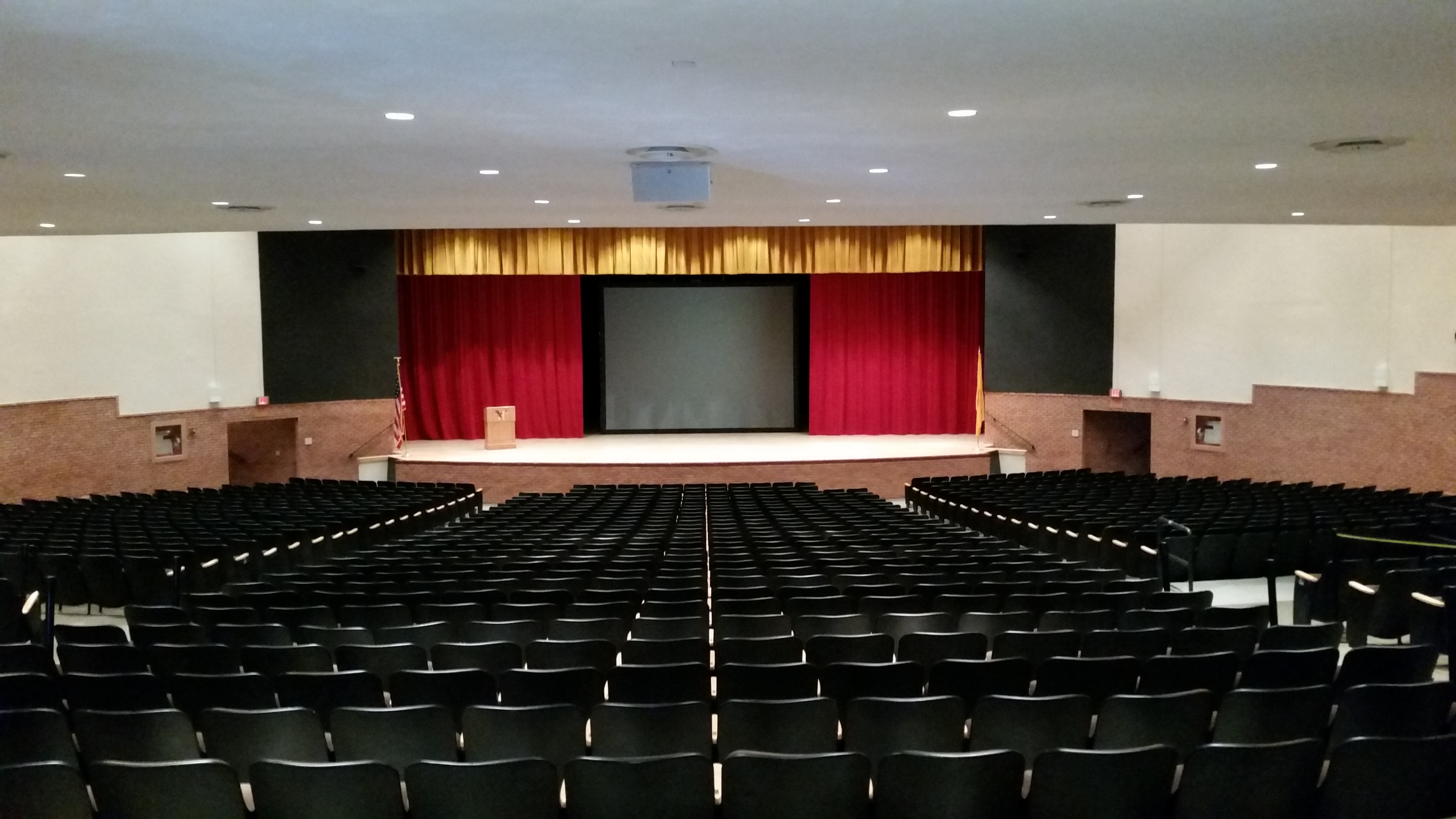
Tydings Auditorium Hobbs, New Mexico
As usual though, those little Monarchs simmered down. And they helped to keep my focused.
Actually, I go looking for them before each presentation.
Whether the audience is a 1,000 or 10, I ALWAYS get butterflies. For me, that remains a positive. They give me an edge, keep me alert, and let me know that I still care about what I do. The day I stop getting a little bit anxious before addressing a group is the day that I need to stop speaking.
For some folks, though, the butterflies create massive anxiety, dread, and a loss of confidence. The following eight strategies have helped me tame my butterflies. Adapt as necessary for your situations.
Video recommendation for the week:
Rehearse. If you want to feel more confident, you need to know your material, props and technology. Don’t “go on” if you are not prepared. It’s insult to the audience.
Walk-through. Whenever possible do a walk-through of the venue. Know what it looks like from the stage (front of the room) and what the audience will see from their seats. Consider a virtual walk-through before you even get to the venue. As I readied myself for the Hobbs talk, I found the venue (Tydings Auditorium) online and then found a video of someone giving a talk from the stage I would occupy. In this manner I was fairly well prepared when I walked into the auditorium. No big surprises about the room.
Tech check. During my walk-through I do a tech check. Video, sound, projector, microphone, and lighting.
Image: Arvind Balaraman/ FreeDigitalPhotos.net
Meet and greet. Before I start speaking, I always find it calming to meet members of the audience, shake hands and exchange a welcome. In large groups, it’s impossible to connect with each person but the mere fact that I am out and about lets the other audience members see me. I find it disarming (in a good way) for me and them.
Nourished and hydrated. I know what my body needs (light snack and water) and does not need (ice and carbs) right before an engagement.
Quiet moment. In larger venues, a dressing room can provide an oasis of solitude. Most of the time you won’t have that luxury. So a walk down a quiet hallway, a moment in the restroom, or simply closing your eyes can provide the solitude needed.
Kind eyeballs. This is something I learned from reading and listening to the late Leo Buscaglia. Once I get in front of the group, I scan the audience for those folks who are looking at me. I notice the dancing and gleaming eyes. While I speak to my entire audience, initially such kind eyeballs can put me at ease.
Structure. The first few minutes of any presentation are critical. This is where you will lose, gain, or at least buy some time from the audience. Do/present something that catches attention. It could be a pertinent story, a funny video (very short), or a demonstration with a member of the audience. This, of course, requires planning and rehearsal. See #1 above.
Understand that butterflies are a speaker’s friend. Nurture yours. Let them guide you.
A functioning community moves beyond listing and reciting core values. It shares and lives those values. And, it provides a safe place for its members to explore, stretch, learn, fail, and grow.
Steve is not a life coach and does not provide legal advice. He facilitates conversations and helps raise and confront important questions about what we do, why we do it, and how we do it.










 The Growth and Resilience Network®