
(#191) React, Respond or Initiate?


Managers react. Leaders initiate.

Ready for a little equation solving? What does each letter represent?

E + R = O


This equation (I believe it is attributed to Clement Stone) reminds us to pause in our interactions and avoid making hasty decisions.

E = event. R = Response. O = Outcome.

Many times, we will react rather than respond.  Reaction has more of a knee-jerk connotation connected to it.  Someone says or does something and you fire off a flaming email—only to wish you could “unsend” it a few hours later. Reaction can be more emotional than thoughtful and deliberative.

Response, on the other hand, indicates we take time to consider what has happened, use critical thinking skills, and draw considered conclusions.

Bottom line: Events do not necessarily cause the outcome.  The event obviously has an impact on the outcome but our response (or reaction) will create the outcome.

tribes

Seth Godin, in his book Tribes: We Need You to Lead Us, adds another dimension.  He explains it this way:

The easiest thing is to react. The second easiest thing is to respond.
But the hardest thing is to initiate….Reacting is intuitive and instinctive
and usually dangerous. Managers react. Responding is a much better
alternative….Initiating is really and truly difficult, and that’s what leaders do.
(p. 86)

Initiating indicates proactive movement. Rather than wait for someone else to act and then respond (react) to him or her, you can be transformative!


Video recommendation for the week:


Think of last week.  Were your actions more reactive, responsive or indicative of initiative? Think of the coming week.  What can you do to replace reactions with responses in your relationships (personal and working)?  And where can you show your leadership abilities by initiating action? Initiative can make a difference—a dent in the universe.

You can always be in a position to respond to environmental stimuli. AND you can always create the space to take initiative—even in small increments—and be the orchestrator of both events and outcomes.

I = E + O


Make it a wonderful week—H.T.R.B. as needed.

Check out my website (http://www.stevepiscitelli.com/programs.html) for programming information as well as details about upcoming webinars (http://stevepiscitelli.com/webinars.html).

 (c) 2014. Steve Piscitelli. All rights reserved.

Posted in Critical Thinking, leadership, Motivation | Tagged , , , , | Leave a comment

(#190) R.O.I. or R.O.R.


R.O.R. (Return on Relationships) trumps R.O.I. (Return on Investment).
In fact, effective R.O.R. will build R.O.I.

A little more than a year ago I wrote these words, “Our success—and that of our students, colleagues, and family members—will not be measured by the size of our ‘friend’ list. Rather, we need true connections—meaningful connections to other people and to a greater purpose.”  Networking is not about numbers. It is about people.

Listen to some of today’s thought leaders in community activism, social media, leadership training, or education and one word resonates: Relationships.

Consider the following:

    • Scott Stratten, author of Unmarketing: Stop Marketing and Start Engaging, emphasizes the importance of going beyond having a presence in social media to actually being present.  When used correctly social media is not simply a digital brochure; it is a place to listen and have a conversation.  Relationships need conversations—not collective monologues.
      Unmarketing
    • Noted leadership coach John Maxwell teaches that effective leaders exhibit both care and candor.  They have compassion for their followers; they validate them as individuals and professionals.  At the same time they communicate with candor—clear and unvarnished honesty.  One cannot exist without the other.  If the only aim is to be nice—and ignore the elephants in the corners—effectiveness and growth will be lost.  If, on the other hand, all the leader does is find fault without any human connection being established, she will soon lose her followers.  And a leader without followers is simply a lonely person taking a walk. Caring and candor must take place together. If one is present and the other is not, serious concerns present themselves for the leader, the team, and the organization. Caring and candor create the foundation for a trusting relationship
    • My dean at Florida State College at Jacksonville, John Wall, echoes Maxwell when he exhorts his faculty to maintain classroom rigor while at the same time building rapport with their students.  A hard-nosed “this-is-my-way-or-the-highway” approach without a hand of understanding and support loses effectiveness and humanity.  Giving access to a college education without corresponding support, direction, and mentoring to succeed in college is misguided.
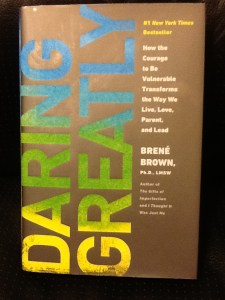
    • Brené Brown (Daring Greatly) shares a wonderful thought: “Belonging is being accepted for you. Fitting in is being accepted for being like everyone else.”  A trusting relationship asks (requires) we accept each other, not control and mold each other.
      Daring Greatly


      Video recommendation for the week:

    • Seth Godin reminds us of the obvious: The number of “friends” and “followers” and “connections” we have on social media represent little more than a fake scoreboard.

  • And in a quote attributed to Peter Drucker: “Culture eats strategy for breakfast.”  Don’t say that relationships are important—prove it with your actions.

Validation. Appreciation. Conversation. Belonging. Presence. Trust.

R.O.R. (Return on Relationships) trumps R.O.I. (Return on Investment). In fact, effective R.O.R. will build R.O.I.

Choose well. Live well. Be well—and H.T.R.B. as needed!

Thank you for taking the time to read my blog post. Please share it (and any of the archived posts on this site) with friends and colleagues. You also can follow me on Twitter, LinkedIn, and Facebook. If you get a chance, visit my Facebook page and join in–or start–a conversation (www.facebook.com/stevepiscitelli).  If you have suggestions for future posts, leave a comment.

Make it a wonderful week—and a wonderful New Year!

Check out my website (http://www.stevepiscitelli.com/programs.html) for programming information as well as details about upcoming webinars (www.stevepiscitelli.com/webinars.html).

(c) 2014. Steve Piscitelli. All rights reserved.

Posted in Appreciation, Appropriate Behavior, leadership, Personal growth, Relationship | Tagged , , , , , , , | 2 Comments

(#189) Be Bold. Be Daring. Be Authentic.


Be the person you want to be
on the way to being the person you want to be!

The New Year always brings calls for new beginnings, resolutions, and renewal.  At the risk of adding to the cliché catalogue of exhortations, I want to challenge you to think and act boldly in 2014.

Deepak Chopra reminds us that “inner happiness can become obscured by constricted awareness, limiting thought patterns, and emotional turmoil.”  We can stymie ourselves if we constantly make happiness contingent upon external forces.  We can dash our own dreams if we constantly wait for “the right time” to do this or that.

In her book Daring Greatly, Brené Brown says that to dare greatly we have to believe we are worthy.  We must believe in ourselves.  That begins with action—small steps to larger goals.  Too often we might find ourselves kicking the can down the road. “I will do [you fill in the blank] when the holidays are over or the in-laws leave or the kids go to school or the house is paid off or Junior graduates from college or…..”  The list goes on and on.

Daring Greatly

Voltaire said it best, “Don’t let the perfect be the enemy of the good.”  Realistically, there will probably never be a “perfect” time to do what you want. And you will never get it just “perfect.” Waiting on “perfect” does not get you closer to your dream. It can become a powerful excuse.  But there is this time (now) to move closer to your dream. Repeat after me, “Now is my time.

Here is your homework:

  • Imagine your dream. What is it that you want to do, achieve, or be?  Be bold. Be true to yourself.
    • Example: I see myself in a career where I make a difference in the lives of people around me. It is not a job—it is a calling.
  • Imagine you have reached your dream.  How do you look, act, or feel?
    • Example: I feel confident. I walk with an air of accomplishment. I smile. I have learned to listen more and talk less. I am a nutritious person for those around me.
  • Be the dream NOW.  Start behaving like you have reached the dream.
    • Example. Smile, listen, and nurture now—on your way to your dream.  Why wait? Be the person you want to be on the way to being the person you want to be!

The time to act, look, speak, and feel like your dream is not when you get there. Do it along the journey to the destination. If you are authentic (living and pursuing a dream that resonates with your core) then the actions will ring true within your heart.  Brené Brown says that when we live whole-heartedly we cultivate (pp. 9-10):

  • Authenticity
  • Self-compassion
  • A resilient spirit
  • Gratitude and joy
  • Intuition and a trusting faith
  • Creativity
  • Calm and stillness
  • Meaningful work
  • Laughter, song, and dance

Are you living your life or someone else’s life? If your happiness is contingent upon what others think or do, then you will forever be living a contingent life—contingent on whether someone else approves of your dreams.

The world needs you and your authentic and virtuous vision. Remember, others may think you are crazy—but you just may need that craziness to make your world (and ours!) a better place. YOU have a lot to offer.


Video recommendation for the week:

In the words of the iconic Apple commercial: “Here’s to the crazy ones…because the people who are crazy enough to think they can change the world are the ones who do!”


DO NOT let anyone tell you that you CANNOT be bold, daring, and authentic.

Choose well. Live well. Be well—and H.T.R.B. as needed!

Thank you for taking the time to read my blog post. Please share it (and any of the archived posts on this site) with friends and colleagues. You also can follow me on Twitter, LinkedIn, and Facebook. If you get a chance, visit my Facebook page and join in–or start–a conversation (www.facebook.com/stevepiscitelli).  If you have suggestions for future posts, leave a comment.

Make it a wonderful week—and a wonderful New Year!

Check out my website (www.stevepiscitelli.com) for programming information as well as details about upcoming webinars (http://stevepiscitelli.com/webinars.html).

 (c) 2014. Steve Piscitelli. All rights reserved.


Posted in Being REMARKABLE, change, Creativity, Dreams, growth, happiness, Life's purpose | Tagged , , , , , | 7 Comments

(#188) A Blogger’s Retrospective: 2013 in Review


In May of 2010 I made the decision to begin my first blog. I had 3 goals:

  • Experience a new (for me) aspect of social media
  • Develop and flesh out new ideas
  • Provide something of value—not just another cyber rant.

I believe I have accomplished the first and the second. It is up to you whether I have accomplished the third. My blog posts contain videos, book recommendations and summaries, questions to ponder, and always a takeaway to apply immediately to life.  I have stayed true to my commitment to publish one blog post per week. This post marks the 188th consecutive week.

Thank you for reading, commenting, and sharing.  I would love to hear what you found of value on this blog. And, please feel free to share any ideas you have for future posts.

For this last-of-the-year post, I have returned to each of the previous 51 posts I have made to this blog in 2013—and provided a statement about each. I have linked each title to the actual blog should you want to read it or re-read it.

Perhaps a nugget or two will provide inspiration. Thank you for your continued support and comments. All the best to you and your family and your friends as you enjoy a wonderful 2014! May you experience all this wonderful world has to offer in 2014—and beyond.

And now, here is the listing of my 2013 blog titles:

Choose well. Live well. Be well—and H.T.R.B. as needed!

Thank you for taking the time to read my blog post. Please share it (and any of the archived posts on this site) with friends and colleagues. You also can follow me on Twitter, LinkedIn, and Facebook. If you get a chance, visit my Facebook page and join in–or start–a conversation (www.facebook.com/stevepiscitelli).  If you have suggestions for future posts, leave a comment.

Make it a wonderful week—and a wonderful New Year!

Check out my website (http://www.stevepiscitelli.com/programs.html) for programming information as well as details about upcoming webinars (http://stevepiscitelli.com/webinars.html).

 (c) 2013. Steve Piscitelli. All rights reserved.


Posted in Blogging, change, Life lessons, Motivation, retrospective, Year in review | Tagged , , , , , | 4 Comments

(#187) Teacher Evaluation: I’m Not A Plumber for a Good Reason (Part 2)


I am not defending poor teaching. Far from it.
I don’t want the lazy or incompetent or worse in my calling.
But do evaluations need to be geared to the lowest common denominator?

Last week I wrote about poorly-conceived and poorly-orchestrated teacher evaluations.

In brief, there are numerous shortcomings with teacher evaluations (from my experiences) not the least of which is a faulty beginning premise by many evaluators: If the students do not make the grade (whatever that may be or however it may be determined), the teacher is to “blame.”

How about this real-life medical metaphor:  I have a friend who had knee surgery recently. This person did NOT follow the disciplined post-surgical exercise regimen prescribed by the surgeon needed to properly heal. Result: Slow recovery; pain; limited mobility.  Is the doctor to blame?

Yet, in our society, there are many who will readily point to the teacher as the problem.  It does not matter if the student followed the educational prescription or not—the teacher has to defend against nonfeasance, misfeasance or malfeasance.

I am not defending poor teaching. Far from it.  I don’t want the lazy or incompetent or worse in my calling.  But do evaluations need to be geared to the lowest common denominator?

Unfortunately, political agendas lead to little more than one collective monologue after another.

Image: jscreationzs/ FreeDigitalPhotos.net

Image: jscreationzs/
FreeDigitalPhotos.net

Here is my shortlist for supervisors to move them toward more effective teacher evaluation:

  • TRUST AND AUTONOMY. Without trust there never will be an effective evaluative tool. Period. It requires excellent and common sense leadership to nurture and build this culture. Part of this component requires that the leader motivate his/her faculty by allowing autonomous development.
  • MASTER TEACHERS. Only true master teachers should have the privilege to evaluate a teacher.  Not a bureaucrat. Just because everyone at one time or another has been in a classroom as a student (or taught years ago or sat in on a focus group), that does not make them effective teachers or evaluators.  A supervisor who can develop a tight schedule of classes and teaching assignments is not necessarily competent to judge a teacher.
  • MEASUREMENT. Develop a tool that measures TEACHING. Not committee work; not clerical work; not administrivia.  Actual teaching with students.  Include areas that add value to the calling (research, writing, publication, creative endeavors and the like). But be mindful of what you SAY you are measuring and what you really REWARD (or PUNISH).
  • MENTORING. Reduce the evaluation load of supervisors.  If a supervisor has to evaluate 40 teachers plus carry out a myriad of other administrative duties, he will not be able to mentor teachers as needed.
  • ENGAGEMENT. Speaking of mentoring….Engage and support teachers in meaningful professional development—and let them have a say in what that development will be.
  • BIG PICTURE. Supervisors need to do what they can to make observations a priority. Observe teachers many, many times during the academic term. Participate for the entire class period and come at different times of the day (e.g., an early morning class and an afternoon class).
    • Side note:  I know (again from experience) that some contracts make it difficult for ad hoc visits. Again, I believe this goes back to a culture of trust replacing an environment of fear, retribution and mistrust.  Tall order.
  • As soon as possible after each visit, sit with the teacher and discuss the observation.  I can hear the protests that this is not practical. Sorry. If you want effective communication and relationship building, make it practical. Period.  If evaluation is truly a tool for professional development (and not a “gotcha!” or one more thing to check off the bureaucratic checklist) it MUST become a priority item in fact—not just in lip service. For another take on this, see Bill Gates’ op-ed piece in the New York Times (2/22/12).
  • Encourage meaningful student input into the evaluative process.  Anonymous drive-by evaluations are of little use (IMHO).  Anybody can post a flaming or praiseworthy note and not sign it.  It takes courage to own feedback.  Without identification, I find it of little value.

Video recommendation for the week:

Daniel Pink speaks about Autonomy, Mastery, and Purpose.


Teachers need to be proactive as well. One of my few effective supervisors (thank you, Joe Davis!) advised me long ago to keep an ongoing portfolio of my evaluation-worthy activities.  Toward that end I suggest teachers consider the following:

  • TRUST. See my first note on the list above.  Faculty have an important role in this evaluation process as well.  Be daring; be bold; be vulnerable.
  • SHARE. Invite your supervisors in often.  I have invited supervisors and board members into my classroom.  My message:  I am proud of what we (my students and me) do in the classroom—come visit! Keep a log of the visits. Keep copies of any pertinent emails (invitations and thank you notes for instance).
  • PORTFOLIO. Maintain an ongoing file/folder/large envelope in which to place notes, letters, copies of emails, conference papers, conference programs, invitations, and student thank you notes (maintain confidentiality of the student; think FERPA).
  • CONTRIBUTIONS. Keep copies of any authored and/or published materials.  In fact, as you contribute to the profession (curriculum development, program presentations, webinars, articles, books, blogs, and videos) make sure to provide your supervisor with complementary copies/links.
  • COLLABORATION. Visit (sit in on) colleague classroom presentations. Collegial collaborations and collegial collisions can be more valuable than any formal tool.  What can you adapt for use with your students? Log what you have learned and applied.
  • COLLISIONS. Invite colleagues into your classroom. Ask for meaningful feedback.
  • COMMUNITY. Become part of a community program on which you can speak or facilitate a conversation (this is a community-based example of your teaching skills).
  • EDUCATION. Enroll in and complete course work at a local college.  Maintain a record of your transcripts and noteworthy class projects.
  • CONNECTION. Know the mission and goals of your school (or district).  Show evidence of how you make the worthy principles part of your teaching activities.

Teaching is my calling. I am proud to be a teacher.  We (me and my teaching colleagues) can all grow—and thus improve the calling.  It is too important to leave to chance or bureaucratic ineptitude.

Hug a teacher—again—this week.  ♥

Choose well. Live well. Be well—and H.T.R.B. as needed!

Thank you for taking the time to read my blog post. Please share it (and any of the archived posts on this site) with friends and colleagues. You also can follow me on Twitter, LinkedIn, and Facebook. If you get a chance, visit my Facebook page and join in–or start–a conversation (www.facebook.com/stevepiscitelli).  If you have suggestions for future posts, leave a comment.

Make it a wonderful week!

Check out my website (http://www.stevepiscitelli.com/programs.html) for programming information as well as details about upcoming webinars (http://stevepiscitelli.com/webinars.html).

 (c) 2013. Steve Piscitelli. All rights reserved.
Posted in collaboration, common sense, effective teaching, Integrity, leadership, Student success | Tagged , , , | 2 Comments

(#186) Teacher Evaluation: I’m Not A Plumber For A Good Reason!


Just because everyone at one time or another has been in a
classroom as a student, that does not make them effective teachers or evaluators.
Heck, I use toilets many times each day. That does not make me a plumber!

What is the best way to evaluate classroom teachers? Is it by supervisor observation? Student evaluation? Test scores?

Truth be told, this is not an easy process.  How does one really measure the effectiveness of relationship-building and helping students develop a sense of self-efficacy? Can it be done with a paper and pencil assessment?  Can it be done by sporadic administrative intrusion into a classroom?

How do you know effective teaching when you see it?

Justice Potter Stewart famously opined in a 1964 Supreme Court case attempting to classify pornography: “I know it when I see it….”

My experience tells me the same when it comes to recognizing effective teaching: I know it when I see it.  You can quantify what a student spits back on a state high-stakes test.  You can attempt to equate knowledge with how many As, Bs and Cs have been awarded (maybe even earned).  But how do  you evaluate the curiosity, initiative, efficacy, social integration and social responsibility? I know those questions will not/do not sit well with the number crunching proponents for evaluating teachers.  I do not shy away from meaningful evaluation; unfortunately, I have seen it only on a few rare occasions in the last three decades.


Video recommendation for the week:

Listen to a student speak about testing and teacher evaluations–and the challenges therein.


In fact, when it comes to effective teacher evaluation, in 32 years I have seen little of substance.  I cannot remember (really, I cannot recall) one time when a supervisor who was evaluating my teaching ever witnessed an entire classroom session of my teaching. What generally has passed as a “classroom observation” has the observing party doing something close to:

  • Entering my class after I have started the lesson;
  • Writing notes or checking boxes on a clipboard for about 20 or 30 minutes;
  • Leaving the class before we have completed the lesson.

The evaluation, then, consists of a person not seeing how the lesson began or concluded. And he/she typically comes in looking for some pre-determined “data-informed benchmarks” that indicate how well I am doing.


Video recommendation #2 for the week:

Hmm…..


In my situation this happens twice per academic year (at my college). And then I have a formal evaluation—months later.  My “teaching evaluation” is pretty much predicated on what has been viewed in 40 to 60 minutes for an entire year.  If a teacher is on an annual review, he/she gets feedback once a year—and not necessarily immediately after the observation.  Usually, my first observation is in October…the sit-down formal review in March or April.  And in that short meeting we talk about other “important” issues like committee work.  (For a while, we had an administrator who wanted to evaluate us how neat and organized our offices were. Really? Really!)

Think about having a golf coach who observed your swing for 20 minutes during one round of golf—and then gave you feedback months later.  How valuable would that be? How about if that same coach did not see you address the ball, swing or hit the tee shot—but he showed up when you were standing over the ball for your second or third shot? And he left the course before you holed out?  Not really very effective, is it?

I am not apologizing for poor teaching. Far from it, I have always advocated for more strenuous evaluation and coaching. I have constantly invited supervisors and colleagues into my classroom.  In fact, if you are my supervisor, you better be a master teacher. If you are not, how am I to learn from you?  I already know how to check off boxes on clipboards.

There are obviously problems in our educational system. The convoluted and tortured manner in which our teachers are evaluated does not (IMHO) fix the challenges. I question if it even addresses the problems.  Next week we will examine some common-sense approaches (again, IMHO).

Hug a teacher this week!

Choose well. Live well. Be well—and H.T.R.B. as needed!

Thank you for taking the time to read my blog post. Please share it (and any of the archived posts on this site) with friends and colleagues. You also can follow me on Twitter, LinkedIn, and Facebook. If you get a chance, visit my Facebook page and join in–or start–a conversation (www.facebook.com/stevepiscitelli).  If you have suggestions for future posts, leave a comment.

Make it a wonderful week!

Check out my website (http://www.stevepiscitelli.com/programs.html) for programming information as well as details about upcoming webinars (http://stevepiscitelli.com/webinars.html).

(c) 2013. Steve Piscitelli. All rights reserved.

Posted in effective teaching, leadership, Life lessons, Teaching | Tagged , , , , , | 6 Comments

(#185) Who Should Really Get Off The Bus?


If leaders cannot encourage and support open debate—
even when it questions the direction of the bus—maybe they should get off the bus.

In his best seller, Good to Great: Why Some Companies Make the Leap…and Others Don’t, Jim Collins put forth a metaphor that constantly pops up in the literature, business meetings, and management circles.  Unfortunately, it seems to be misrepresented at best or manipulated at worst.

Collins found that great companies did not start with a grand new vision and strategy.
We found instead that they first got the right people on the bus, the wrong people off the bus…

Every time I have heard someone use this bus reference, it has been in the context that the “right people” dutifully sit in their seats and go where the bus takes them. In corporate speak it is a nice way to tell people to be a “team player” and “stay on point.” To do otherwise would be non-collaborative and violate the interests of the “stakeholders.”

There are, however, two more elements to this bus formula that seem to be conveniently ignored:
…and the right people in the right seats—and then they figured out where to drive it. (13)

This does not square with the wrong-headed approach of weak managers who say “get on my bus, sit in the seat I tell you to, and stay put while I drive the bus. Stay behind the yellow line. And whatever you do, please do not talk to the driver!”  If you got talented people on the bus, why in God’s name are you not listening to them?


Video recommendation for the week:

Jim Collins speaks about getting the right people on the bus and the right people off the bus.


The weak managers live by the clipboard. They do little more than what is needed to check off their bureaucratic to-do lists.  They make a career of saying “No!” or “Let’s wait and see.” The poor managers do little more than kick issues down the road; they fear making a decision that might “not work.” And most of all they would never think of telling their supervisors (or their own egos) that the bus is going in the wrong direction.  To do so, in their minds, would get them thrown under the bus.

And the bus keeps picking up speed as it makes one wrong turn after another. No one says anything; there is no regrouping.  Feedback is considered ill-advised—and any criticism gets that thinker labeled as a non-team player who has failed to stay on point. He/she needs to be silenced.  And everyone stays quietly in their seats, watching the bus gather speed and heading for the cliff.

Image: thephotoholic/ FreeDigitalPhotos.net

Image: thephotoholic/
FreeDigitalPhotos.net

Does that sound like leadership to you?

Please, if you are on one of those buses, speak up or get off.   The consequences of not speaking up can be disastrous for you, the bus, and its other riders. Collins quoted a leader who inherited such a corporate culture. “I came away quite distressed from my first couple of management meetings. Not only couldn’t I get conflict, I couldn’t even get comment. They were all waiting to see which way the wind blew.” (43)

The great leaders want a non-scripted conversation—even if it might change the direction of the bus. They don’t shut down debate—they encourage it. If they truly believe they have “A” team members on the bus, then the leaders want to hear what they have to say. If you shut these valuable assets down and ignore their input over and over, don’t be surprised when they push back or head for the door to work for a competitor.

So, a message to the leaders who find comfort (and manipulation) in the bus metaphor:  If you cannot encourage and support open debate—even when it questions the direction of the bus—then maybe, at the least, you are in the wrong seat on that bus.  Or maybe you should just pull the cord and get off the bus so it can have a more productive journey.

Choose well. Live well. Be well—and H.T.R.B. as needed!

Thank you for taking the time to read my blog post. Please share it (and any of the archived posts on this site) with friends and colleagues. You also can follow me on Twitter, LinkedIn, and Facebook. If you get a chance, visit my Facebook page and join in–or start–a conversation (www.facebook.com/stevepiscitelli).  If you have suggestions for future posts, leave a comment.

Make it a wonderful week!

Check out my website (http://www.stevepiscitelli.com/programs.html) for programming information as well as details about upcoming webinars (http://stevepiscitelli.com/webinars.html).

 (c) 2013. Steve Piscitelli. All rights reserved.

Posted in collaboration, Critical Thinking, leadership, teamwork | Tagged , , , , , | 5 Comments

(#184) Gratitude: Appreciating Wonder


Life is one choice after another. Why not choose gratitude?
The rewards are wonderful.

Before class this past Wednesday (day before Thanksgiving) I took out a piece of paper and wrote “Thankful for…” across the top. In a short time, I had a long list. Not surprisingly, the list focused on non-material things. What came to mind immediately were the people and experiences that have had an impact on me and those around me.

A sense of gratitude benefits from what is known as “the beginner’s mind.” By seeing the world like an awe-inspired child viewing each experience as a new wonder, we help ourselves and those around us to grow.  At times it is difficult when all seems to be crumbling around us.  We can get caught up in the could’ve been rather than the what is.

Consider: Right now my knee throbs (from years of wear and tear) and my shoulder aches (from attempting to act like a twenty-something in the gym).   I could dwell on those as painful negatives. Or I can focus on the lessons learned—and move forward to new fitness goals and routines.

As you know, life is one choice after another. Why not choose gratitude? We have to practice looking for the good—and we have to practice it consistently. The rewards are wonderful.

Image: StuartMiles/ FreeDigitalPhotos.net

Image: StuartMiles/
FreeDigitalPhotos.net

Shawn Achor reminds us that “…consistently grateful people are more energetic, emotionally intelligent, forgiving, and less likely to be depressed, anxious, or lonely.”   If only for selfish reasons think of the positives of gratitude!  But it goes beyond selfish feelings. To embrace gratitude is to feel good within—and to help others feel that energy as well.

As you read my short list, consider your gratitude list. I am sure it is great—in scope and length.  I know that the more I ponder my list, the more I add to it.  So here is my initial listing of what I am thankful for:

    • Family (wife, relatives—alive and deceased)
    • Friends

      Video recommendation for the week:

      • There is a great scene and lesson at the end of one of my all-time favorite movies, It’s a Wonderful Life. Clarence the Angel leaves a reminder for George Bailey: “Remember no man is a failure who has friends.”

  • Colleagues on campus
  • Colleagues around this nation
  • Mentors (and there are many)
  • People who inspire us
  • Publishing opportunities
  • Students who keep me young and vibrant
  • Fitness coaches
  • Good health
  • Atlantic Beach, Florida
  • Teaching
  • Thanksgiving at Pete’s! (It’s a beach thing…♥)
  • Music
  • Well-crafted lyrics
  • Beautiful melodies
  • A fast computer connection
  • Sun-filled days
  • Summer rain
  • Walks on the beach
  • Bike rides
  • Acts of civility
  • Curiosity
  • Challenges and their opportunities
  • Buddy (my dog)
  • Minimal morning traffic
  • Delay-free air travel
  • An empty seat next to me on the plane
  • An upgrade
  • People who read my blog
  • People who share my blog
  • Reflective time
  • Each new sunrise

Yes, there are bumps in the road. There are days that have been a huge inconvenience and pain in the posterior. I don’t ignore the potholes; and many times I need to stop and do some unanticipated road repair to continue the journey. But, in sum, it is a wonderful journey. Why would I possibly want to focus on the potholes when there is so much beauty to enjoy along the way?


Video recommendation #2 for the week:

Sing it Louie! Ponder the wonders–small and big.


Choose well. Live well. Be well—and H.T.R.B. as needed!

Thank you for taking the time to read my blog post. Please share it (and any of the archived posts on this site) with friends and colleagues. You also can follow me on Twitter, LinkedIn, and Facebook. If you get a chance, visit my Facebook page and join in–or start–a conversation (www.facebook.com/stevepiscitelli).  If you have suggestions for future posts, leave a comment.

Make it a wonderful week!

Check out my website (http://www.stevepiscitelli.com/programs.html) for programming information as well as details about upcoming webinars (http://stevepiscitelli.com/webinars.html).

(c) 2013. Steve Piscitelli. All rights reserved.

Posted in Gratitude, happiness, Mindfulness, Personal Wellbeing, Reflection, resilience | Tagged , , , , | 3 Comments

(#183) Now Is My Time


NOW is truly all we are sure of at anytime.
What are we doing with the NOW we are experiencing?

This week I received my blog inspiration from a Deepak Chopra meditation session. His centering thought came in a few simple words: Now is my time!  His premise is simple. Wherever we find ourselves, no matter the situation, recognize this is where we need to be at this time. Embrace it. Grow with it.  The “now” is what we have in hand.

Chopra reminds us that constantly focusing on the end result will cause us to miss the journey. “Regardless of where we are in life,” Chopra intones, “we are exactly at the place we are supposed to be.”  Our choices have brought us to our current place.

While this, at times, might be difficult to comprehend, there is a bit of peace in this philosophy. Speaking as someone who is very goal-driven, I realize I spend far too much of my life either focused on what I have no control over (the past) or that which has yet to transpire (the future).  When I spend time in the past and in the future, I miss the present.  I miss what is with me—and will soon become the past. And when I ruminate on making the future better—again I miss the present.  Do you see the endless self-defeating cycle?

[For the social media addicted, think of this corollary: “HERE is my time.” Ever been with people who are not with you in the present moment? Rather than be WITH you, they constantly tap their  smartphones to see what is happening on Facebook, Instagram or Twitter? Those people appear to be more interested in living someone else’s NOW.  Kind of sad.]

Image: dan/ FreeDigitalPhotos.net

Image: dan/
FreeDigitalPhotos.net

NOW is truly all we are sure of at anytime.  What are we doing with the Now we are experiencing?

As we near finals week on campus, I wanted to help my students celebrate what they have accomplished this semester (past), what was ahead of them (future), but more importantly, I wanted them to remember that what they become today (present) will move them along their journey.

I sent the following email to my students this week. Maybe there is a morsel, a nugget of inspiration for you as you begin your day.

Good morning, young scholars!

You have arrived into the homestretch of the semester…Now, you can actually see what you have accomplished.  Congratulate yourself.  And get ready to cross the finish line with style and grace! 

Here is a quick strategy to keep your energy and passion flowing.  Repeat the following out loud: “Now is MY time!”  Say it again. “Now is MY time!”

Yes, you may have lots of responsibilities with family, children, work, and school. (You must always take care of the NON-NEGOTIABLE priorities in your life.)  And at times you might even feel like quitting.  Remember that each day brings you closer to your dreams—but only if YOU continue to move toward your dreams.  This is your time…what will you do with it?

I look forward to a wonderfully energizing end of the semester.  And remember to say—and mean it—and be it: “Now is MY time!”


Video recommendation for the week:

Finally, the following video that a colleague forwarded to me (thanks, Amy Baskin!) reminds me of the power of now.  Watch the beginning when a little girl steps forward and places a coin in the hat. The experience grows as each new person and group continues to build the now into a powerful experience.  Imagine, if you would, a person passing through the square at the time the coin was placed in the hat. His gaze to the ground, his mind on the destination, as he scurries past the people around him.  What a wonderful concert (the “now”) he misses.


As you prepare for your week ahead, embrace today. Tomorrow, today will be yesterday.  Now really is the time.  How will you embrace and nurture it?

Choose well. Live well. Be well—and H.T.R.B. as needed!

Thank you for taking the time to read my blog post. Please share it (and any of the archived posts on this site) with friends and colleagues. You also can follow me on Twitter, LinkedIn, and Facebook. If you get a chance, visit my Facebook page and join in–or start–a conversation (www.facebook.com/stevepiscitelli).  If you have suggestions for future posts, leave a comment.

 Make it a wonderful week!

 Check out my website (http://www.stevepiscitelli.com/programs.html) for programming information as well as details about upcoming webinars (http://stevepiscitelli.com/webinars.html).

 (c) 2013. Steve Piscitelli. All rights reserved.

Posted in Gratitude, Mindfulness, Personal Wellbeing | Tagged , , , , , , | 8 Comments

(#182) Making Ends Meet on $27,500 per Month


Why did our college leaders
give a newly minted millionaire a housing allowance?

NOTE: Those of you who follow this blog on a regular basis recognize that I write affirming posts about student and life success issues. Please pardon me, as I digress this week.  While not necessarily an “affirming” post, this topic does affect higher education (and beyond).

My college, Florida State College at Jacksonville, just hired a new president.  The hiring was seen by many as a welcomed change.  We had just endured the lengthy separation process of the previous college president (with a subsequent high dollar payout and questions of ethics issues).  Unfortunately, what transpired during the “expeditious” contract negotiations for the new president continues to raise questions about college leadership decisions.

I want to be clear. This is not about the new president (the person).  From all I have read and heard, she is a wonderfully capable administrator.  No, this is about the contract the Board of Trustees decided to approve.  And, I am not writing this as a faculty member.  This comes from the perspective of a taxpaying working-class citizen in our community.

The contract, according to The Florida Times Union, provides the incoming president with an annual salary of $330,000 through 2016 (that is $27,500 per month for a grand total of $990,000 in base salary over three years).  Additionally, she will receive a $25,000 per year housing allowance ($75,000 for 3 years) + $12,000 per year car allowance ($36,000 for 3 years).  I guess it is difficult to make ends meet on $27,500 per MONTH.

                                                                                                                                Image: renjith krishnan/ FreeDigitalPhotos.net

Image: renjith krishnan/
FreeDigitalPhotos.net

So, the way I read it, the college’s District Board of Trustees extends a contract that virtually makes the new president a millionaire—and gives her additional money to help her make her mortgage payments and pay for gas and oil changes ($1,000 per month to support car expenses).  One board member, to her credit, raised concerns about the add-ons.

Why did our college leaders give a newly minted millionaire a housing allowance? Is this an example of “government housing assistance”—the kind we seldom talk about?

Apologists in these situations are quick to fall back on the old canard that we need to pay these candidates to attract the best and brightest; and that the contract is “within the market.” But, who has set that market?  The various college Boards of Trustees?

Consider the following:

  • The new president currently earns (again, according to The Florida Times Union) $201,000 at her current college.  She comes into her first year at FSCJ with a nice pay bump of about 65%.
  • According to the 2013-2014 salary index for FSCJ the starting ANNUAL salaries for an Administrative Assistant 1 (office support staff) or an Adviser comes in at $25,704—less than what the new president will earn in base salary each MONTH and about the same as the housing allowance she will receive.  An Academic Tutor will pull in the princely sum of $29,160. And a Human Resource Specialist will command (at the starting level) $27, 504.
  • According to the poverty guidelines released by the United States government, a family of 4 earning $23,550 ANNUALLY is at the poverty level. (Source: U.S. Department of Health and Human Services. http://aspe.hhs.gov/poverty/13poverty.cfm#thresholds. Accessed November 14, 2013.)

So, our new president will be given as much money for her housing allowance as we believe people who are vital to office/support/student success at the college get for an entire year to feed their families, pay a mortgage or rent, and perhaps build a savings plan.  If you listen to the board’s audio minutes of November 12, you will hear dialogue about these allowances. Even some of the Board members seemed uneasy with this arrangement.  It appears that the allowances were added to the compensation package (in part) to make sure that the base pay does not look egregiously high. The college still pays the same amount—it just looks better to separate some cost from the base salary because no college wants to be “number one” in presidential compensation.  There was only one opposition vote on the Board to this contract.

When I asked my students (many of whom are working class members of our community) how much they thought a person would have to earn in the Jacksonville area (without government assistance) to be able to provide his/her family with affordable housing the answers were in the $40,000 to $55,000 per year range.  One young woman told the class that she did it on less than $30,000 per year.


Video recommendation for the week:

Florida  Governor Rick Scott initiated an investigation (about a year ago) into the level of college president compensation.  Were the college governing bodies out of touch with the fiscal realities of the common workers in their respective community markets? Does the new FSCJ Board find itself in the same situation with financial compensation for the people at the top?


What do you think? What represents fair and equitable compensation for college leaders?

I realize I am “just a teacher” but I don’t understand.

Choose well. Live well. Be well—and H.T.R.B. as needed!

Thank you for taking the time to read my blog post. Please share it (and any of the archived posts on this site) with friends and colleagues. You also can follow me on Twitter, LinkedIn, and Facebook. If you get a chance, visit my Facebook page and join in–or start–a conversation (www.facebook.com/stevepiscitelli).  If you have suggestions for future posts, leave a comment. Make it a wonderful week!

Check out my upcoming webinar free webinar on Blogging with a Purpose on November 20.  Click here to register now for the webinar.  Or go to my website for registration information.  This webinar is part of the Innovative Educators’ webinar series.

(c) 2013. Steve Piscitelli. All rights reserved.

Posted in leadership | Tagged , , , , , , , , , | 7 Comments