
(#201) Collegial Collaborations: Building Connections With Adjunct Faculty


When it comes to developing and appreciating our adjunct faculty,
we need to find ways to build opportunity, supervision, community, advancement, and respect.

This past week I had the opportunity (along with my dean and associate dean) to celebrate our college’s adjunct faculty.  We sponsored an evening program to thank them for what they do for our college and students.  More pointedly, though, we wanted to take the opportunity to continue to forge collegial connections between adjunct and full-time faculty.  For at the heart of it, whatever our designation in HR may be, we are faculty and our students depend upon us for delivery of relevant, rigorous, and engaging lessons.

Image: xedos4/ FreeDigitalPhotos.net

Image: xedos4/
FreeDigitalPhotos.net

The following statistics remind us of the importance of our adjunct faculty:

According to the National Center for Education Statistics from 1991 to 2011:

  •        Full-time faculty increased 42 percent
  •        Part-time faculty increased 162 percent
  •        The percentage of part-time faculty increased from 35 percent to 50 percent

The Coalition of the Academic Workforce reports:

  •        There are 1.8 million faculty in two and four-year degree-granting institutions
  •        Of the 1.8 million, more than 1.3 million (more than 75.5%) were “contingent positions”

Video recommendation for the week:

Take a look at one view of who “adjuncts” are, what they do, and circumstances they face.


Adjunct concerns can be classified as institutional (pay and benefits for example) or classroom support (access to technology and departmental mentoring for instance).

If we place pay and benefits to the side (and that in no way indicates they are not important), so many adjuncts are looking for ways to at least be able to connect with other faculty and the institution.  Many of our adjuncts teach at night or on the weekends when most full-time faculty are not on campus. They become “PCP faculty”: Parking lot—Classroom—Parking lot. It becomes imperative for our institutions of higher education to find ways to provide opportunities for collaboration for our contingent faculty.  We need to examine creative ways to build opportunity, supervision, community, advancement, and respect.

If I could only choose one of the above, I would focus on community.  When we truly develop a community, we have a group of people who validate one another and will do whatever it takes to make sure that each person is accountable and successful!  And all else has a better chance of falling into place.

A few ways in which to build community include:

  •        Convocations for all faculty
  •        Orientation programs
  •        Mentor-Mentee relationships
  •        Invitations to faculty meetings
  •        Inclusion on faculty emails
  •        Office space and support facilities
  •        Recognition for a job well done
  •        Certification programs
  •        Funding for professional development participation

What does your institution do to support its adjunct faculty?

Make it a wonderful week—H.T.R.B. as needed.

Check out my website (http://www.stevepiscitelli.com/programs.html) for programming information as well as details about upcoming webinars  (http://www.stevepiscitelli.com/webinars).

Information on my newest book, Choices for College Success (3rd ed.), can be found at Pearson Education.

 (c) 2014. Steve Piscitelli. All rights reserved.


Posted in adjunct faculty, collaboration, Community, Teaching, teamwork | Tagged , , , | 2 Comments

(#200) Have We Become More App-Dependent than App-Enabled?


Apps are tools that can have a
transformative effect on our world.

[A quick note: Today marks the 200th consecutive weekly post for my blog. While we have not uncorked any champagne here at world headquarters in Atlantic Beach, Florida, I would like to offer celebratory gratitude. Thank you for your support and comments. Thank you for sharing this with your friends, family and colleagues.  Mostly, thank you for the difference you make in your community.  Now on to this week’s post and the next 200 weeks!]

Spring Break allowed me to spend a little time digging into The App Generation: How Today’s Youth Navigate Identify, Intimacy, and Imagination in a Digital World by Howard Gardner and Katie Davis.

app generation

I am about midway through the book and I would like to pose some intriguing questions that this work has already raised for me.  I do not see this (the book or this post) as bashing digital natives, apologizing for digital immigrants, or dismissing technology.  Perhaps we would be better served if we stop, think, question assumptions, identify any cognitive traps that may be present, and then continue to use technology to help us as we develop the most fulfilling lives we can.  With that in mind, here are few questions to ponder.

  • What is the impact that apps (as in smart phone apps) have had on the identity, intimacy and imagination of the younger generation?   (By extension, I would ask the same of any generation that is digitally connected.)
  • Gardner and Davis’s argument is that apps are tools that can have a transformative effect on our world. So, do we control the apps or do the apps control us?
  • Apps have created, among other things, the ability for us to “take care of ordinary stuff and thereby free us to explore new paths, form deeper relationships, ponder the biggest mysteries of life, and forge a unique and meaningful identity.” (9)  But have we become more app-dependent than app-enabled? (45)
  • Looking into a screen is thought to be less risky than looking into one’s eyes.  If we are with someone and the moment turns awkward (read: requires some real communication) it becomes easier if we both just turn to our own respective screens.  Consequently, have we become a society that is “always connected, but not always connecting?” (100)

    Image: Ambro/ FreeDigitalPhotos.net

    Image: Ambro/
    FreeDigitalPhotos.net

  • Gardner and Davis relate a story of parents helping their children smuggle in a 2nd smart phone to summer camp so that they could stay in contact even after their child’s (supposedly only) phone was turned over to camp counselors. What have parents taught their children—and are they (the parents) dependent or enabled…or enabling?
  • One person interviewed said that “On Facebook, people are more concerned with making it look like they’re living rather than actually living.” (63) So, for those of us (all ages) posting status updates, are we concerned about reporting the present or living the present?
  • We used to have moments to sit alone with our thoughts. Now those moments are cluttered with “compulsory listening to music, text messaging, or playing games on our digital devices.” (75). Where is our reflection time now?  Do we know how to reflect? Are we comfortable being alone?
  • We can be witty in 140 characters or less but it becomes increasingly difficulty (if not impossible) to “communicate and respond to each other’s complex feelings.” (102) Have apps allowed us to justify a superficial world?

Video recommendation for the week:

I am reminded of a commercial that made the rounds a few years back. It had (basically) one spoken word: Really? It is comical.  The App Generation made me resurrect it.


Is there an app for reflecting, connecting, and living?

Make it a wonderful week—H.T.R.B. as needed.

Check out my website (http://www.stevepiscitelli.com/programs.html) for programming information as well as details about upcoming webinars (http://www.stevepiscitelli.com/webinars).

Information on my newest book, Choices for College Success (3rd ed.), can be found at Pearson Education.

 (c) 2014. Steve Piscitelli. All rights reserved.

Posted in Appropriate Behavior, Communication, Social Media | Tagged , , , , , | 1 Comment

(#199) Retirement? Let’s Rename It


Whenever “retirement” comes for me, I know it will not
be a work stoppage or a forgetting of the past but rather a
grand anticipation and embrace of what the future holds.

At the beginning of this calendar year, I received an email from my employer’s human resources department reminding me that this is the year I will hit my retirement age.  Not that I needed a reminder; and not that I have not been planning for this for decades. But the email still made me stop and think.

Wow!  Retirement.  As cliché as it sounds, it really does seem like just yesterday that I started teaching at Stanton College Preparatory School.  And whether I leave the classroom this year or in five years, there is a bigger point I have been considering for most of the previous decade: What will retirement look like for me?  Besides the financial end (which is huge and will have an impact on what I write below), what will my day-to-day activities look like?

For starters, I don’t like the word retirement.  At least not in the sense that it came to take on with earlier generations.  Retirement always seemed like a cessation of work; sitting back and doing whatever leisure activity the retiree wanted to do.  And I had heard that such a retirement—one lacking a real and sustainable purpose in life—could actually shorten lifespan.  I recently heard that successful retirees chase after more than a golf ball or a secluded beach. Retirement is not the opposite of work–at least not in my eyes.

Photo: Steve Piscitelli

Photo:
Steve Piscitelli

An article in The Wall Street Journal reported on a study that suggested a purposeful retirement accounted for significantly better cognitive functioning.  A retiree who is a regular at my gym always says, “Motion is the lotion.”  He simply means that if a person stays active, he/she will have a better chance of a more limber body and mind—one that will continue to carry him/her forward to enjoy life.

Whenever “retirement” comes for me, I know it will not be a work stoppage or a forgetting of the past but rather a grand anticipation and embrace of what the future holds.  I have loved (and still do) classroom teaching. When I walk off campus for the last time, I will not be walking away from anything.  All those years will have prepared me for what lies ahead. And I have been preparing for quite a while–financially, professionally, and personally. It is not something I want to consider for the first time when I wake up in the post-working world life.

A much younger colleague recently asked me, “Well, what will you do when you retire?”

Image: jscreationzs/ FreeDigitalPhotos.net

Image: jscreationzs/
FreeDigitalPhotos.net

Below is my shortlist of what I will do. The interesting point for me is that as I review the list, each one of those actions is something I have attempted to do during my “working years” with varying degrees of success.  A retired professor told me that even though he remains busy with professional activities, retirement has allowed him the time to truly reflect on all that he has read and done during the so-called “working years.”  And it has made him a more effective post-working world professional.

Life has a way of firing-hosing us over the years. The so-called retirement years provide a great opportunity to reflect and synthesize those experiences. And then give back to our community in new ways.

With that mindset, maybe we should not think about retiring. Here are a few thoughts—and I would be interested in yours as well. Consider:

  • Reflecting
  • Reinventing
  • Repurposing
  • Recalibrating
  • Refreshing
  • Redesigning
  • Renewing
  • Reinvesting (beyond dollars and sense)

Make it a wonderful week— H.T.R.B. as needed.

Check out my website (http://www.stevepiscitelli.com/programs.html) for programming information as well as details about upcoming webinars (http://www.stevepiscitelli.com/webinars).

Information on my newest book, Choices for College Success (3rd ed.), can be found at Pearson Education.

(c) 2014. Steve Piscitelli. All rights reserved.

Posted in change, Choice, growth, happiness, Integrity, legacy, Making a Difference, resilience | Tagged , , , , | 5 Comments

(#198) Appreciation


It was a reminder to appreciate my obligations
and continue to find and embrace ways to meet them head on.

Two and a half weeks ago I had rotator cuff surgery on my left shoulder. Having gone through the process almost three years ago on my right wing, I had realistic expectations for what lay ahead.

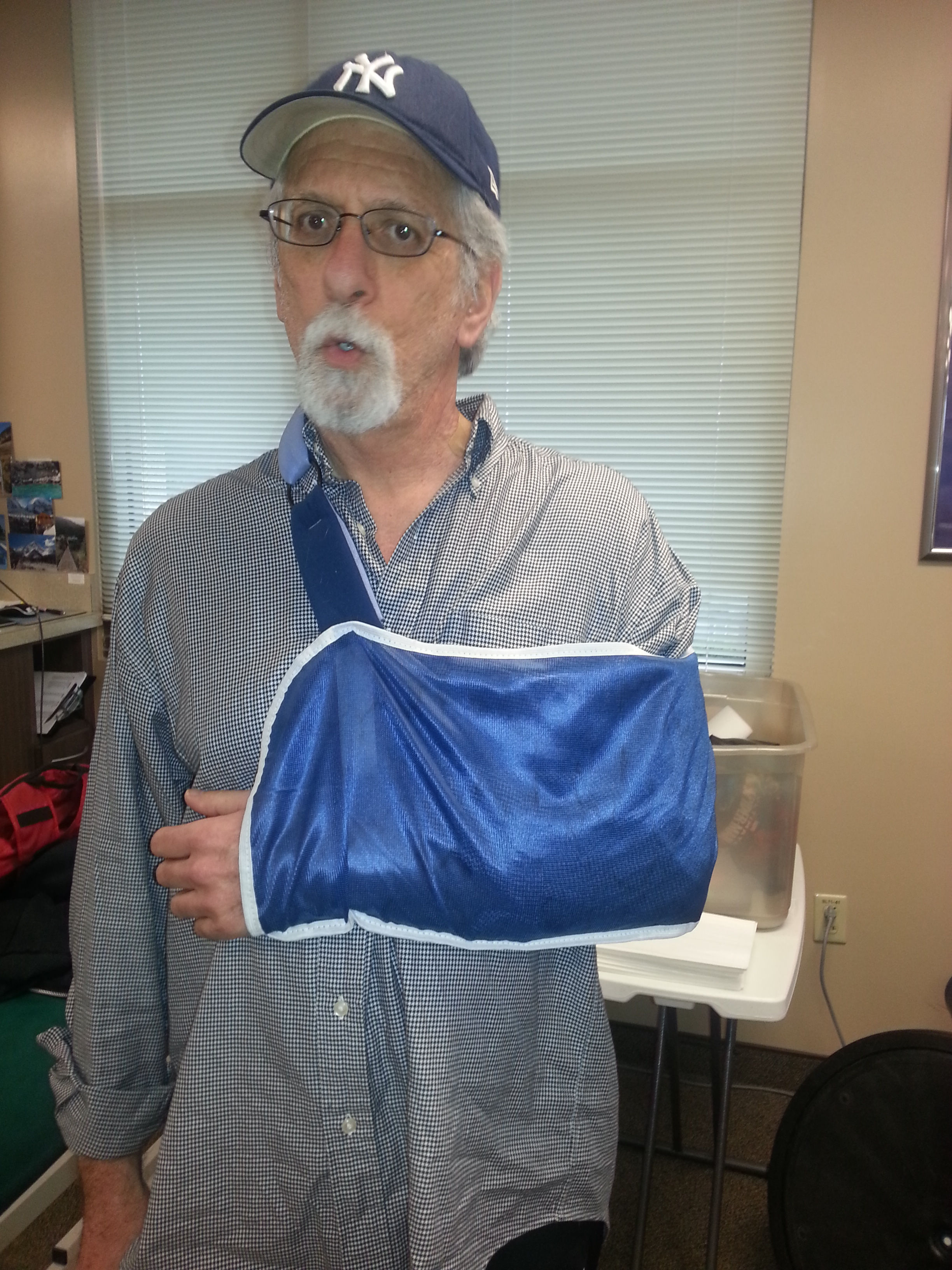
While I still have about three-and-one-half months to go for full recovery, I am in full appreciation mode. Having to navigate the world with a wing in a sling for a few weeks has forced me to slow down (a little bit) and reflect on what’s important.  Here is my surgery-inspired gratitude list.

*Perspective. Shoulder surgery can be painful but it is not deadly. I am not dealing with cancer or a heart attack. At worst it’s an inconvenience. I still taught my classes and was able to meet my speaking obligations.

At my first PT session 4 days post-op

At my first PT session 4 days post-op

*Marvels of medicine.   I hear a lot of people bad mouth our medical system. All I know is an MRI was able to confirm the problem and my doctor has the tools and expertise to fix me.

*My doctor. Two shoulder surgeries but one doctor. Dr. Steven Lancaster (Jacksonville Orthopedic Institute) exhausted all possibilities before “cutting” on me. Gotta love a surgeon whose default setting is NOT to immediately operate.

*Pain control. Immediately following the first surgery, on a scale of 1 to 10 my pain was 25! This time around, thanks to a new technology (On-Q), my pain was minimal.

*My PT. I discovered from my first shoulder surgery that the key to a successful recovery is to religiously follow the prescribed physical therapy. My physical therapy team knows its stuff.

*Insurance. I am thankful to have coverage for this process. Not sure I’d be able to afford it otherwise.

*My bed. For the first 9 nights after surgery I had to sleep in a reclining chair. Enough said.

*Acting now! I’ve heard physically active folks say they would not want to interrupt their activities for four months.  True. I will miss out on full workouts…but in four months I will have recovered. If I had kicked the can down the road, guess where I would be in four months? I would be four months older and still with declining strength and limited range of motion.

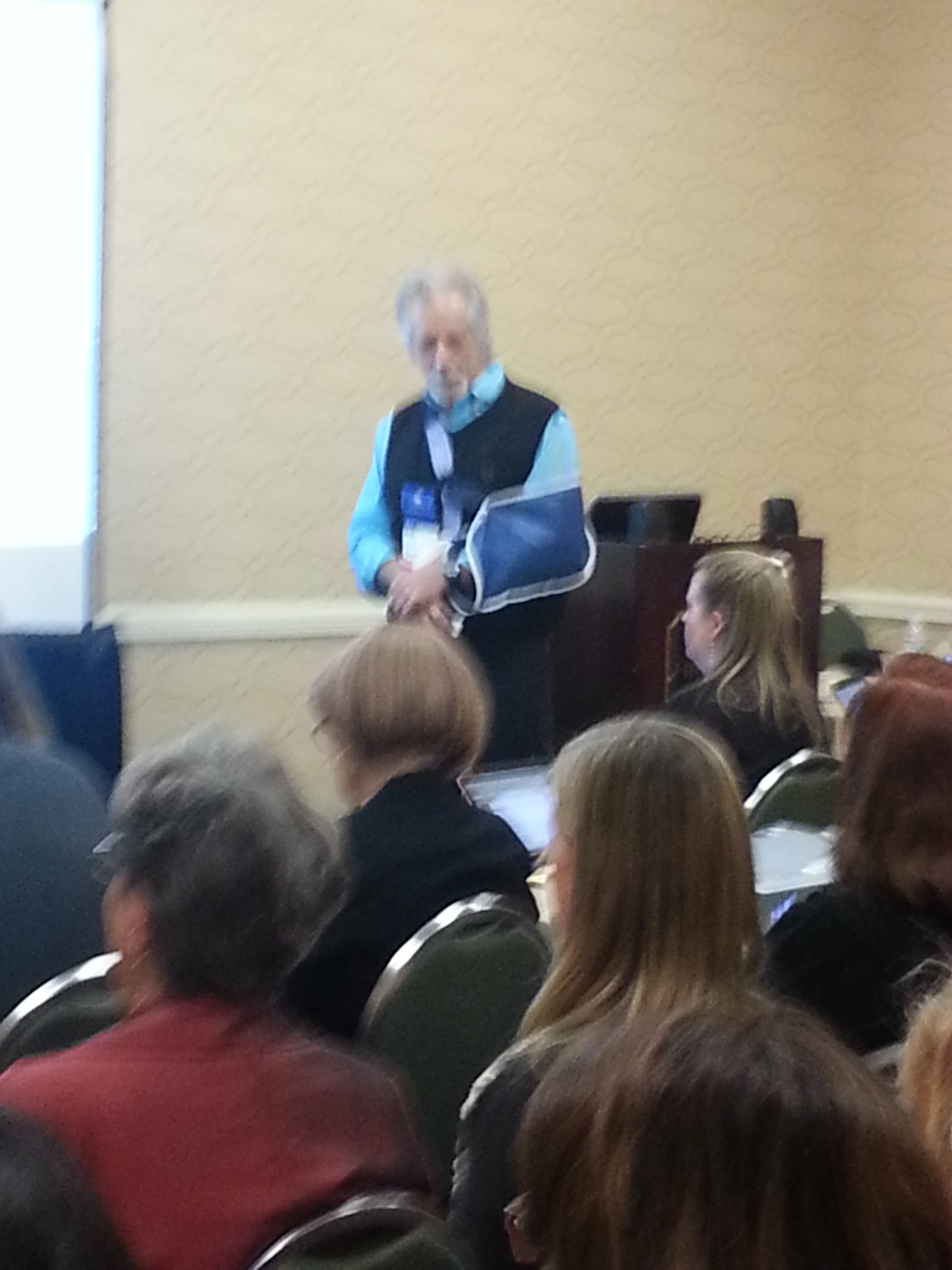
At a speaking engagement 2 weeks post-op

At a speaking engagement 2 weeks post-op

*Limitations. I have a renewed appreciation for people with real disabilities.  As temporary an inconvenience as this has been (and let’s be real, that is what this has been–an inconvenience), I remind myself that there are millions of people with permanent disabilities who have to learn to navigate their world with accommodations of one sort another. My respect is immense.

*My wife.  I’m a weenie when it comes to pain and inconvenience.  My wife was always present to wrap my shoulder with ice, drive me here and there, and keep a watchful eye out for my well-being. The first two nights she slept on the couch next to my chair.  My own private-duty nurse.

*Dependable transportation. I could not drive for two weeks after surgery. I had to depend on friends for rides. Because I have dependable friends, I did not miss any appointments or obligations. I have renewed empathy for folks who must constantly depend upon others or public transportation.

*No excuses. Yes, I’ve had to make lots of adjustments that cost me time and money. But I did not make excuses. It was a reminder to appreciate my obligations and continue to find and embrace ways to meet them head on.

*Surrender. People who know me understand that one of my flaws is my need to control situations. This recovery has forced me to surrender to circumstances that I cannot control or speed up.

*God. All the above did not happen by chance. I might not understand the plan…but I believe there is one.

It’s easy to complain. I know I do my share. And fear can be paralyzing.  I find it so much healthier to reflect on the blessings around me. The challenges do make me stronger–and more appreciative of what I have.


Video recommendation for the week:

Focus on gratitude and cast fear aside.


Make it a wonderful week— H.T.R.B. as needed.

Check out my website (http://www.stevepiscitelli.com/programs.html) for programming information as well as details about upcoming webinars (http://www.stevepiscitelli.com/webinars).

Information on my newest book, Choices for College Success (3rd ed.), can be found at Pearson Education.

(c) 2014. Steve Piscitelli. All rights reserved.

Posted in Appreciation, Excuses, Gratitude | Tagged , , , , | 4 Comments

(#197) Significance and Passion


So, what single project or task do you consider to be
your most significant career accomplishment?

I read a thought-provoking article this past week about interview questions. It focused on THE one question to ask job candidates:

What single project or task would you consider
your most significant accomplishment in your career to date?

At first, I thought, “Well, that’s easy to answer.”  And then I had no answer.  I was stumped. I kept coming back to it over the next few days. Was it my first publishing contract? Getting hired by the college? Speaking engagements around the nation? Establishing a blog? Building a YouTube channel? Mentoring students?

All of those were important steps in my calling but did they qualify as the “most significant accomplishment”?

Finally, as I replayed my teaching years, it hit me.  The year was 1983. April 19, 1983 to be exact.

I was in my second year of teaching—and I had seventh grade geography students at Stanton College Preparatory School in Jacksonville, Florida. I developed and organized a Model United Nations for approximately 340 seventh graders.

The students represented nations from around the world. They developed the topic for debate. They researched and role-played “their” nations.  We had an international luncheon. Parents were on hand. We developed “Delegate Rules” and learned how to prepare a resolution. The students sent letters (yep, with real postage stamps) to embassies requesting information.

The students learned about public speaking, creative problem solving, diversity (before it became the topic of concern), research skills, peer interaction, governments, and political philosophies.

Image: dan/FreeDigitalPhotos.net

Image: dan/FreeDigitalPhotos.net

So why was it significant to me?  This event hooked me on interactive teaching and learning.  It taught me the importance of having supportive supervisors; they let me run with my idea; no micro-managing; they trusted me—a new teacher. I saw upfront and personal the importance of detail planning and collaboration.

And I learned that no matter how beneficial educational outcomes might be there would always be those questioning teaching motives.  I actually was contacted by a then-state legislator wanting to know what the hidden agenda was with my activity!  He had read a report by a conservative think tank that found activities like the Model UN to be questionable and unbalanced.  I dutifully went to speak to the legislator and assured him my only hidden agenda was how to keep 340 intellectually-gifted seventh graders on-task for an entire day!

That one activity helped me, early on in my calling, to mature as a teacher and classroom leader. I did not receive any special funding nor did I receive any unique recognition. I did come to understand, though, the importance of psychic wages—the internal reward we get when our actions align with our passion and purpose. For more than 30 years, I have continued to follow my gut when developing engaging activities for my students (and audiences for professional development events). My actions become magnified (and significant) when they connect to my passion and enthusiasm. My guess is the same holds true for you.

So, what single project or task do you consider to be your most significant career accomplishment?


Video recommendation for the week:

Here is one version of the importance of passion.


Make it a wonderful week— H.T.R.B. as needed.

Check out my website (http://www.stevepiscitelli.com/programs.html) for programming information as well as details about upcoming webinars (http://www.stevepiscitelli.com/webinars).

Information on my newest book, Choices for College Success (3rd ed.), can be found at Pearson Education.

(c) 2014. Steve Piscitelli. All rights reserved.
 

Posted in Passion, Purpose | Tagged , , , , , , , | 3 Comments

(#196) On Collegiality and Collaboration: Reflections from San Diego


It takes more than exchanging an email address or a
business card to build meaningful connections.

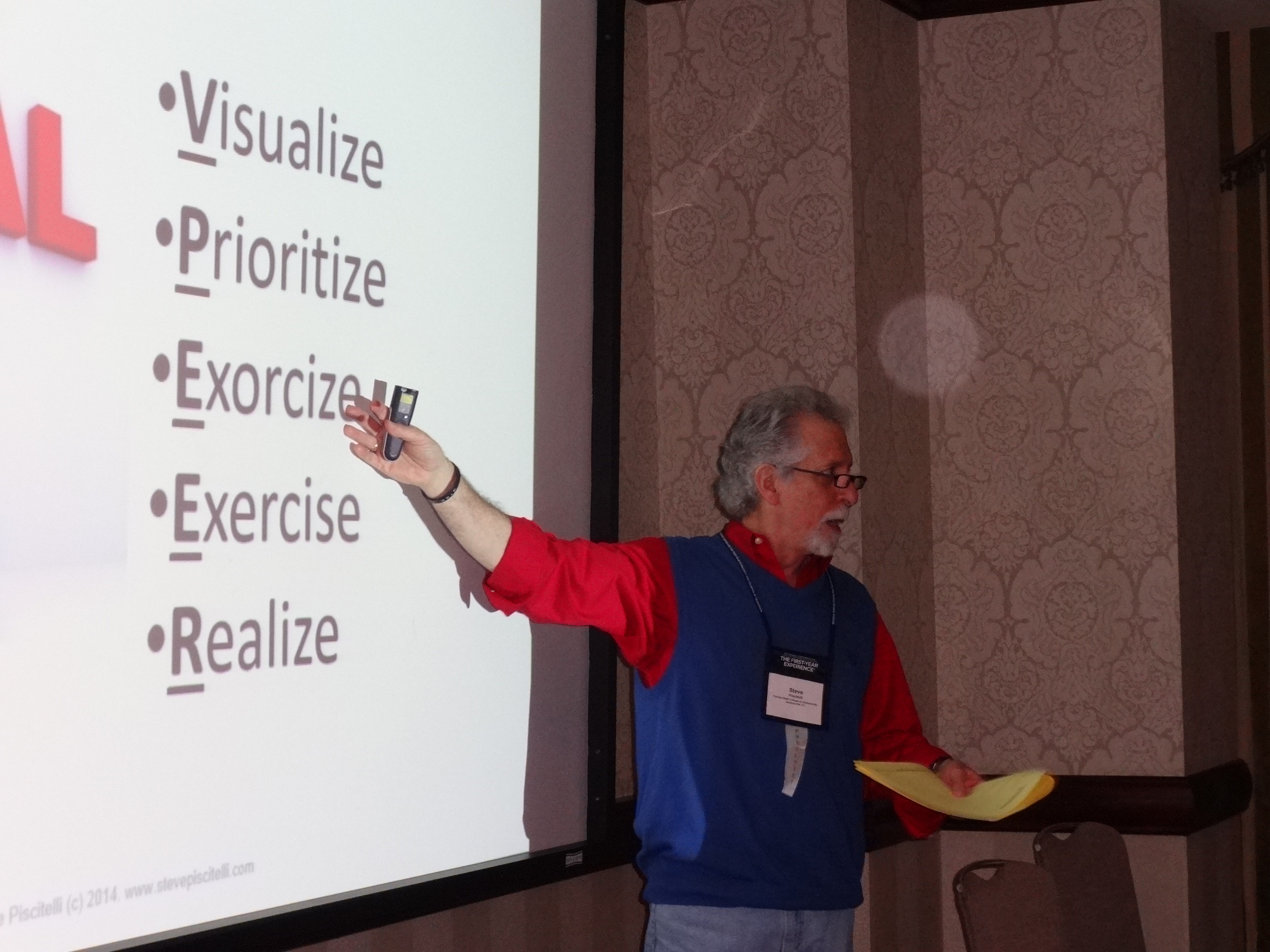
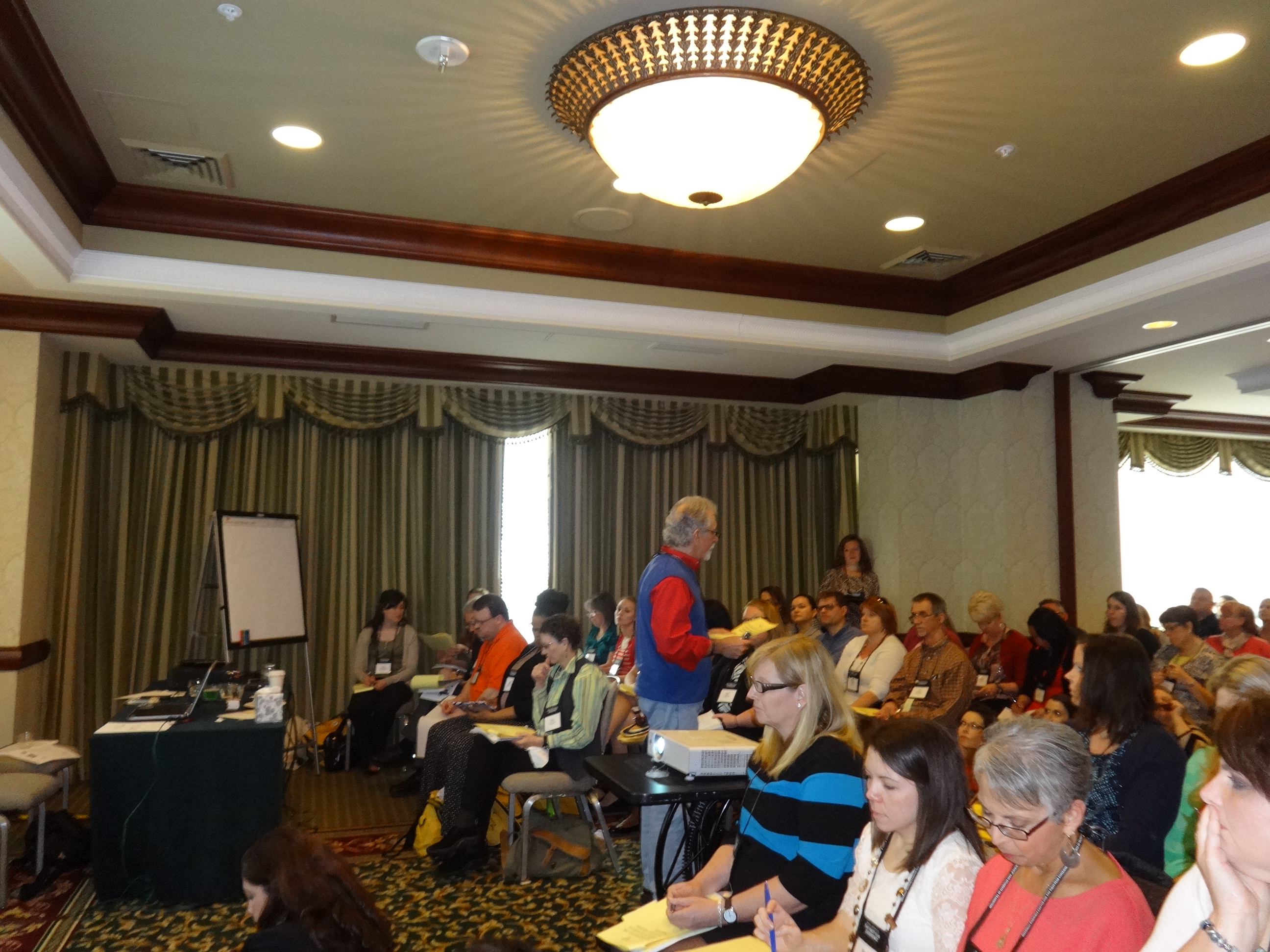
It’s early morning and I’m sitting in the San Diego airport as I write this week’s blog. For the past few days I had the opportunity to participate in one of the larger student success conferences in the nation.  Year after year, the Annual Conference on the First-Year Experience brings together professionals from around the nation (and world) to discuss critical issues of student success.  The multi-day event helps higher education professionals develop and fine tune programs to meet student and community needs.

2014-02-16 12.59.34

Higher education issues of budget, classroom strategies, faculty development, retention and persistence, learning communities, recruitment, and characteristics of our first-year and first-generation students are some of the agenda offerings.

But there is something more that stands out to me; an intangible that you generally will not find listed as a program offering.  National programs like “FYE” (as well as others I will participate in this year: NADE, Noel-Levitz, Teresa Farnum and Associates) provide a network for collegiality that is hard to duplicate.  It allows us to move away from our insular communities on campus to connect and share with colleagues from around the nation. True, in the age of social media, we can Skype, Hangout, and chat.  But there is still nothing quite like the feeling of shaking a colleague’s hand, taking time to sit down for a cup of coffee, and look into one another’s eyes. It provides me with personal validation, opportunities for social integration, and a sense of professional relevance.

Years ago, when I first got into higher education, a colleague of mine constantly encouraged me to attend professional development opportunities.  I typically waved him away with the explanation that I did not have the time—and I did not need to take the time from my campus culture.  I have come to understand and appreciate my older colleague’s encouragement.

2014-02-16 12.32.45


Video recommendation for the week:

When I am on the road, I also take the opportunity to connect my students with the places and events I have the good fortune to visit.  I started a “series” called “Where in the World is Professor P?”  I shoot on location a (usually) 90-second video that asks students to guess where I am.  I use questions (pop culture, history, geography, sports, and the like) as clues.

(http://www.youtube.com/watch?v=v-AdiJNXCS4)


These videos are fun to do and my students get a glimpse of a world beyond our campus.  But I did not understand a collateral benefit until one of my international students responded to one particular video by saying that my videos inspired her to continue her education because she wanted to be able to travel like me.  In a small way, my attendance at an out-of-town conference helped connect a student to a larger world and made her college dreams more relevant.

I cannot over estimate what I receive professionally and personally from these events.  I constantly learn.  I continually build networks: strengthening long-time connections and forging new ones.  As the National Resource Center for the First-Year Experience explains on its website, the conference setting provides an ongoing forum where higher education professionals can share experiences, concerns, and accomplishments related to supporting student learning, development, and success in the first college year.

It takes more than exchanging an email address or a business card to build meaningful connections.  If you cannot attend a national event, find a forum closer to home. Or start one for you and your colleagues. Do what you can to be an agent of collegiality and collaboration.

Make it a wonderful week— H.T.R.B. as needed.

Check out my website (http://www.stevepiscitelli.com/programs.html) for programming information as well as details about upcoming webinars (http://www.stevepiscitelli.com/webinars).

Information on my newest book, Choices for College Success (3rd ed.), can be found at Pearson Education.

 (c) 2014. Steve Piscitelli. All rights reserved.
Posted in faculty development, professional development, Relationship | Tagged , , , , , | 5 Comments

(#195) Nurturing an Internal Locus of Control


A person’s interpretation of an event can have
a powerful impact on future motivation.

One of the most powerful strategies for success focuses on the concept of locus of control.  Where is the focus of power in your life?  Do you believe the world happens to you (external locus of control)—or do you believe you create the world you live in (internal locus of control)?

While none of us may be totally “external” or totally “internal” we

Image: markuso/ FrereDigitalPhotos.net

Image: markuso/
FrereDigitalPhotos.net

probably trend toward one side of the spectrum.  For instance, I tend to have a strong internal locus of control.  I do believe that what I do has an impact on the world I live in.  I also understand that there are times when I am at the mercy of forces beyond my control. A recent example: I was scheduled to be in San Diego this past Thursday. Well, the snow/ice storm that raged through the Southeast had other plans for me!  Yep, I was upset; I fumed; I called Delta. And the airlines still cancelled flights.  My dean reminded me that it was a great lesson in “letting go.”

A related theory is the Attribution Theory of Julian B. Rotter.  (Also, see Bernard Weiner.) Think of an attribution as an explanation. This area of research focuses on how a person’s explanation or interpretation of an event motivates him or her to perform in the future. For example, a person’s view of success or failure will depend on four attributes (or explanations).

 Attribute (why something happened)

Description of the attribute

Effort The person did or did not exert the required effort to be successful.
Ability The person did or did not have the required skills to be successful.
Task difficulty The task was or was not too difficult to complete.
Luck The person was lucky or unlucky.

These attributes can determine one’s motivation in the future.  If, for example, a student believes his lack of effort on a test led to a failing grade, he might be motivated to put in more study time before the next exam.  Since he knows that he could have done better, the student believes that change for the better is within his control. On the other hand, if the student believes he did poorly because the instructor writes incredibly difficult exams that no one could possibly pass, he might resign himself to doing poorly in the course because, he thinks, there is nothing he can do about the writing of the instructor’s exams.  His motivation declines (a form of learned helplessness?)—he might very well fail the subsequent exam.

Bernard Weiner found that effort and ability were generally associated with an internal locus of control.  On the other hand, task difficulty and luck were found to have an external locus of control.


Video recommendation for the week:

Some people never let obstacles stop them. Take Tony Melendez for example.


Where is your power? Where do live on the locus of control spectrum? Do external obstacles stop you or push your further?

Make it a wonderful week— H.T.R.B. as needed.

Check out my website (http://www.stevepiscitelli.com/programs.html) for programming information as well as details about upcoming webinars (http://stevepiscitelli.com/webinars.html).

Information on my newest book, Choices for College Success (3rd ed.), can be found at Pearson Education.

 (c) 2014. Steve Piscitelli. All rights reserved.

Posted in creating your future, Discipline, Excuses, Goals, Personal Wellbeing, Success | Tagged , , , , | 10 Comments

(#194) Honor the Past. Celebrate the Present. Embrace the Future.


“Life can only be understood backwards;
but it must be lived forwards.” (Soren Kierkegaard)

In 2009 I was at Lynn University to facilitate a series of presentations for faculty and students. During one segment of a studio interview I reflected on what effective teachers do for their students. Beyond academic achievement (which is obviously non-negotiable), we need to help our students honor their past, celebrate their present and look to their future.

Honor the Past. The past, obviously, is our history. It has been the vehicle that has carried us to this moment. I encourage my students to understand and respect their past. Sure there are moments, events, people and issues that may be troubling at best and traumatic at worst. “Honoring” in this context means to recognize that from those times, you have grown into the person you are.  It does not diminish what happened as Jennifer Gilbert’s story shows. The past should not be an excuse—nor should it be a shackle. It happened; cannot be undone. There is no mulligan.

Image: StuartMiles/ FreeDigitalPhotos.net

Image: StuartMiles/
FreeDigitalPhotos.net

I have watched organizational managers state they were not responsible for the past they inherited. They would not be bogged down in memories.  I agree.  Of course these new folks did not create the history of the organization. However, they are creating a new history. And to not understand and respect what their organization has gone through—the culture that their followers have experienced—is short-sighted and disrespectful.  NEVER lose sight of institutional memory. How can the organization move forward? (See Embrace the Future below.)

Celebrate the Present.  Dr. Leo Buscaglia once opined that “the past is a cancelled check, the future a promissory note, and the present is cash in hand.”  How true.  The present is all we truly have. While there is wisdom in preparing for the future, we can get lost in it and miss what we are truly experiencing. The present is our time to live and coincidentally create our evolving history. When we hold on to the past (going beyond honoring to “stuck in the past”) it robs us of our present.  When we live in the future, we vacate the present.  We cannot get the present back.


Video recommendation for the week:

The time for life is today.


Embrace the Future. For some, the future is scary. For others, that unknown is cause for excitement rather than trepidation. There is, to be sure, a practicality in looking to the future. Think, for example, retirement planning. The crisis faced by the baby boom generation has been well documented. Planning for the future takes place in the present. Today is the tomorrow you prepared for (or not) yesterday.

Students enter college with their dreams—what they hope for in the future.  In many ways, those of us who have the privilege to work in the classroom help coach these folks to their future.  Inspirational and far-sighted leaders have a responsibility to focus on the future.

Soren Kierkegaard reminded us that “Life can only be understood backwards; but it must be lived forwards.”

As you look to the new week that you will make for yourself be mindful to honor, celebrate and embrace.

Image by: Steve Piscitelli

Photo by: Steve Piscitelli

Make it a wonderful week— H.T.R.B. as needed.

Check out my website (http://www.stevepiscitelli.com/programs.html) for programming information as well as details about upcoming webinars (http://stevepiscitelli.com/webinars.html).

Information on my newest book, Choices for College Success (3rd ed.), can be found at Pearson Education.

(c) 2014. Steve Piscitelli. All rights reserved.
Posted in Appreciation, creating your future, Dreams, Excuses, Gratitude, Integrity, Mindfulness, Personal growth, resilience | Tagged , , , , | 18 Comments

(#192) Be Brave and Go There


 If I have learned anything over the years, playing it safe is usually the biggest risk…
We could well find ourselves in an unacceptable environment that we
quietly let grow around us.

Martin Niemöller spent seven years in a Nazi concentration camp.  He may be known best for his quote:

First they came for the Socialists, and I did not speak out–
Because I was not a Socialist.

Then they came for the Trade Unionists, and I did not speak out–
Because I was not a Trade Unionist.

Then they came for the Jews, and I did not speak out–
Because I was not a Jew.

Then they came for me–and there was no one left to speak for me.

While the quote may appear with some variation of wording, the message I have always taken from it is that we need to stand up when we see injustice.  Martin Luther King, Jr. reminded us that “An injustice anywhere is a threat to justice everywhere.”

Some very wise friends have told me for years that at times we must “surrender” and understand what we cannot change.  An old college friend (at my age, is there anything other than an “old” college friend? I digress….) and life-long dedicated educator shared with me that in order to survive it might just be better to “not go there.” And, you know at times, that may be the best option.  What was it our parents and teachers told us? “Know when to pick your battles.”


Video recommendation for the week:

Consider Minnie Jean Brown-Trickey, though.  She was one of the Little Rock Nine.  I cannot even imagine what it must have been like for those young students and their parents when they walked through angry mobs into Central High School in 1957.  Our nation benefited because those nine young and brave students went there.


Whatever the issue, there are those who will speak up and present a challenge when needed. But many, many, many more will not.  They settle for what they believe is the “safe” route. They stay “on point.” Playing it safe is usually the biggest risk.  Often times we must go there. If we don’t, we could well find ourselves in an unacceptable environment that we quietly let grow around us.

I’m not advocating boorish, rude, or disrespectful behavior. Integrity to self and those around us must remain. Speaking up and having a true conversation is critical for the health and well-being of any organization. The effective leaders understand this. The same for relationships.

Decades ago, a dear man and at the time an assistant superintendent (I believe) of a school district outside of Boston, gave me poignant advice: “If you surround yourself with ‘yes men’ [or women] they will lead you down the primrose path to destruction.”

Most of us will never face what Martin Niemöller or Mini Jean Brown-Trickey had to endure.  But we can make a dent in our universe by standing up, speaking out, and striving to thrive. It doesn’t have to be momentous. Small, measured and well-thought out steps can be effective. And you don’t have to go there alone. A coach, a mentor, a counselor, a friend, a spiritual leader or a family member can guide you. Who can help you? Who can you help?

Being courageous does not mean lack of fear. It means that we persevere in the face of fear. It is not always easy to be brave; it can be scary. And it can be exhilarating. Sara Bareilles sings

And since your history of silence

Won’t do you any good,

Did you think it would?

Let your words be anything but empty

Why don’t you tell them the truth?

Might just be a great place to go.

{http://www.youtube.com/watch?v=yNd_YXJXZOA}

Make it a wonderful week— H.T.R.B. as needed.

Check out my website (http://www.stevepiscitelli.com/programs.html) for programming information as well as details about upcoming webinars (http://stevepiscitelli.com/webinars.html).

 (c) 2014. Steve Piscitelli. All rights reserved.
 

Posted in Choice, Civility, collaboration, creating your future, influence, leadership, Making a Difference, Personal growth | Tagged , , , , | 8 Comments