
(#231) Rookie Mistakes and Life Lessons


The takeaway for me is not that we made errors
but we have taken time to reflect and grow.

We just passed the halfway point of our semester.  It is a natural reflection point to examine where we have been and where we would like to go.  In my student life skills classes this week, I asked my students to consider advice they would give to first semester college students.

In short, I prodded them to pass along lessons they have learned.  Or more poignantly, what do they wish they knew then (when they started college) that they know now? What “rookie mistakes” would they avoid?

Image: tiverylucky/FreeDigitalPhotos.net

Image: tiverylucky/FreeDigitalPhotos.net

Not surprisingly, their advice goes beyond the classroom. Here is a shortlist of their suggestions. Beneath each is my takeaway.

  • Understand and practice priority management.
    • This was probably the most repeated lesson.
  • Stay committed. Don’t quit like a child with a new toy.
    • Persistence! 
  • Know your campus. Know your resources.
    • Reach out for assistance. No need to go it alone.
  • Stay organized even when the professors are not organized.
    • You cannot control what others do, but you can control what you do.
  • Focus! Know why you are here [in college].
    • Know your purpose.
  • Sometimes we need to travel one road in order to find the right road.
    • Be open to the possibilities that present themselves.
  • Proofread your work.
    • Don’t be sloppy or in a hurry. Your work reflects you.
  • Don’t fall behind. Have a plan of attack and follow it.
    • Goal setting needs action.

Their collective wisdom above falls into a few categories:

  • Purpose.  Know what you do and why you do what you do.
  • Discipline.  Follow a regimen of consistency.
  • Resources. Seek out mentors, coaches, and resources to help you on your journey.
  • Consistency. Slow and steady may not be “sexy” but it will move you down the road.

My students—just like all of us—have made their share of rookie mistakes. And we will continue to make missteps as we stretch and grow. The takeaway for me is not that we made errors but that we have taken time to reflect and grow.

Video recommendation for the week:

The first step to meaningful change has to be awareness of where we are, what we do, and why we do what we do.

Make it a wonderful week—H.T.R.B. as needed.

Check out my website (http://www.stevepiscitelli.com/programs.html) for programming information as well as details about upcoming webinars  (http://www.stevepiscitelli.com/webinars).

Information on my newest book, Choices for College Success (3rd ed.), can be found at Pearson Education.

(c) 2014. Steve Piscitelli. All rights reserved.


Posted in change, Discipline, focus, Goals, Life lessons, Priority management, Purpose | Tagged , | Leave a comment

(#230) Your Habits—Your Choices


As Aristotle said, “Excellence is not an act, but rather a habit.”

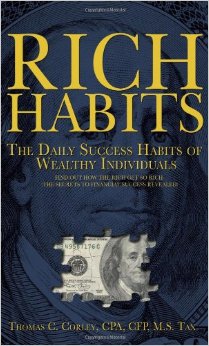
Ever wonder what separates the achievers from the non-achievers (besides what they actually achieve)? In the November issue of Success Magazine, Tom Corley outlines what he calls “Rich Habits-Poor Habits” (from his book Rich Habits: The Daily Success Habits of Wealthy Individuals).

Based on his research, he found the clear differences between the wealthy and the poor existed not in talent, charm or intelligence but rather in their daily habits.  The Success article outlined 16 Rich Habits (see pages 73-76 of the magazine).  For our purposes this week, I will focus on the five habits that spoke to me.  As you read each one, do a quick mental check of how you fare in these areas.

rich habits

  1. Read every day.
    Read at least 30 minutes per day.  And it’s not just any kind of reading.  The rich habit focused on reading to learn—to gain knowledge about career, business, balance and well-being.
  2. Forget television and web surfing.
    Corley found that nearly two-thirds of the wealthy people in his study spend less than one hour per day in front of the television or on the Internet (unless it is job-related). Tellingly, more than three-quarters of those who struggle financially spend more than one hour per day in front of the boob tube.
  3. Go above and beyond in your work.
    The poor habit found itself mired in the “it’s-not-my-job” syndrome. What employer wants to entrust that mindset with the keys to the kingdom? Contrast that with the workers who go above and beyond to make themselves invaluable to their bosses and clients.  Yes, focus is important (see #5 below) but so is being a self-starter. The rich habit here is to keep stretching yourself. Find ways to learn more about what you do for your calling.
  4. Avoid toxic people.
    I have written often on this blog about energy vampires—and all of their toxic consequences. Corley found that 86% of successful people associate with successful people, while “96% of those struggling financially stick with others struggling financially.”  Think of the power of networking.
  5. Know your main purpose.
    Video recommendation for the week:  Steve Jobs spoke of the power of saying “No!”  This rich habit is about understanding what your core values are and focusing on them.  In business, that means not being distracted by the little things that may seem interesting or not saying yes because it would make someone feel good.  Your actions should complement your purpose.

To start your week, address each of the habits above. For instance:

  1. I will set aside 30 minutes each day to read for personal/professional development. You could do this with an audiobook or while riding the stationary bike in the gym or getting up 30 minutes earlier to have one-half hour of sustained silent reading.
  2. I will limit my television time to 60 minutes or less. Consider this: If you spend two hours/day in front of the TV that equates to 10 hours per week. (I’m not even counting weekend viewing.) In the course of a month that is the equivalent of one full work week (40 hours). Over the course of the year, you have just kissed more than three months good bye! Really?
  3. This week I will explore one area in my workplace that really is not in my job description. I will work to understand how this area fits with what I do for whom I serve.
  4. I will not only minimize my time with energy-sucking people, I will seek out and continue to develop (start to develop) a relationship with at least one positive and nutritious person this week. Need I really say more?
  5. This is an area that I have had to really work on during my career. I have gotten better—but still need work. My current goal is to work with a mentor by year’s end to help sort through all of my projects and re-focus on/fine tune my core purpose and avoid projects that distract me from that purpose.

As Aristotle said, “Excellence is not an act, but rather a habit.”

Make it a wonderful week—H.T.R.B. as needed.

Check out my website (http://www.stevepiscitelli.com/programs.html) for programming information as well as details about upcoming webinars  (http://www.stevepiscitelli.com/webinars).

Information on my newest book, Choices for College Success (3rd ed.), can be found at Pearson Education.

(c) 2014. Steve Piscitelli. All rights reserved.
 

Posted in focus, Goals, habits, Purpose, say no | Tagged , , , , , | Leave a comment

(#229) Where Can You Declutter Your Life?


Where have you allowed clutter to invade your life?

When you hear the word clutter, what pops into your mind?  A desk with piles upon piles of paper?  Your kid’s bedroom? Your bedroom? The kitchen sink? The backseat of your car? The garage? Your sock drawer? The bottom of your closet?

Often, we associate clutter—mess and disorganization—with material stuff.  And as the short list above attests, such a connection can be apt. Any number of physical locations can become black holes for the condition I call “drop and leave.”

Image: BillLongshaw/FreeDigitalPhotos.net

Image: BillLongshaw/FreeDigitalPhotos.net

Clutter can cost us in time lost looking for something, money spent (for items we thought we had lost), money lost (because of wasted productivity) and stress endured dealing with the overwhelming mess that feels like a hurricane about to slam ashore.

And it can interfere with our true priorities as it distracts us from the important things in our lives.

Clutter seeps into our lives in so many other ways. And each can create stress, lost productivity, and strained relationships (personal and business). Where has clutter been allowed to invade your life?  Consider that our days can easily become cluttered with:

  • Acquisitions (obsessed with buying—while unused items get lost in the back of the closet?)
  • Appointments (does a full calendar really equate to a meaningful day?)
  • Choices (distracted by things that do not get you to your goals?)
  • Financial worries (overextended and underfunded?)
  • Global anxieties (constantly paying attention to “alerts” and “breaking news”?)
  • Health obsessions (neurotic about calorie counting or time on the treadmill?)
  • Numbing agents (one more latte, wine or hour of television?)
  • Promises to others (can’t say no?)
  • Promises to yourself (do you overestimate what you can do in a day, week or month?)
  • Relationships (success and connections measured by the number of social media “friends”?)
  • Technology (three devices going at once and thus not really where you currently are?)

What else clutters your life?

If you want to de-clutter, start with by asking yourself some straight-forward questions:

  • Is all this stuff making me happy? How do I know?
  • What are my core values? Does the clutter add to or detract from these values? One of the most poignant gut-check questions I read recently was in a post about balanced life:  “Why did we have kids if you’re too busy to see them?” Ouch!
  • Are you holding on to stuff because you “might” use it in the future? Really? When was the last time you used that set of dishes or golf clubs?
  • Look at the list above (and anything else you added to it). What small clutter item can you start on today? Then, where can you move to tomorrow? Think large and long-term. Act small and short-term.

If you can’t get a handle on your clutter, find a coach, mentor or expert who can.  A friend (and former student) of mine has created such a business where they act as “personal trainers for your stuff.” Find a trainer for your situation.

Whatever it takes, wrestle control of your life back to where it belongs—with you.

Video recommendation for the week:

Delbert McClinton sings to us about the challenges of too much stuff!

Make it a wonderful week—H.T.R.B. as needed.

Check out my website (http://www.stevepiscitelli.com/programs.html) for programming information as well as details about upcoming webinars  (http://www.stevepiscitelli.com/webinars).

Information on my newest book, Choices for College Success (3rd ed.), can be found at Pearson Education.

(c) 2014. Steve Piscitelli. All rights reserved.

 

Posted in Goals, Motivation, organization, priorities | Tagged , , , , | 4 Comments

(#228) Motivation: What Gets You Going—and Keeps You Going?


Identify a motivational best practice you have used in the past.
How can you apply this to a current dream you have?

On the first day of class each semester, I ask my students to write their college dream into their notebooks.  What do they hope to achieve by attending Florida State College at Jacksonville? Why did they decide to pursue that particular course of action?  I ask them to be as specific as possible.

Throughout the semester, I ask them to turn to what they wrote on day #1.  What kind of progress have they made? Are they happy with their progress? Has there been progress?  What keeps them on course? What choices have worked for them and which ones have created obstacles?

This week my students examined the related topics of motivation and goal achievement. To prepare them for the topic I asked them to complete two exercises.  As you ready yourself for the coming week, take a moment and complete each exercise as a reality check for your goals and motivation.

Image: dan/ FreeDigitalPhotos.net

Image: dan/
FreeDigitalPhotos.net

  1. Where do you find your motivation?
    1. Identify a personal “best practice” that helps you stay motivated. Most pointed to extrinsic factors: their children; money; desire for a better life style; or to please a parent. Some wrote about intrinsic practices like the desire to learn more today than they knew yesterday. One student said she placed a sticky note on her refrigerator that simply said, “I’m not a quitter!”
    2. How do you know this is a best practice? How do you know this assumption is accurate? Track record is what came up here. Each student could point to specific times their best practice helped them stay the course. They could point to something that actually worked for them.
    3. How can this best practice help you reach a current goal that you want to reach? While the transfer and application may be a bit forced here, again I saw a commonality. Each student recognized he/she did in fact have a best practice and then started to see how it could be applied to their dream that they identified on the first day of the semester.

Reflection time for you.   What is a dream (huge outrageous goal) that you have?  What are your personal motivational best practices? How can you (do you) apply your best practices to your current dream?

  1. Stare at whom I want to become.
    1. Borrowing the words from Daniel Coyle (Talent Code), I ask them again to look at their written dream from the first day of class.
    2. Close your eyes. I then ask them to envision that they have reached the dream. They have arrived!  I ask them to take inventory of this “future self” and answer the following:
      1. What do you look like when you see yourself having reached your goal?
      2. How do you carry yourself?
      3. What are you wearing? 
      4. Are you smiling? Frowning?  
      5. How do you speak? 
      6. When you walk into a room, how do people respond? Why do they respond this way?  
      7. How do you behave in a team meeting or social situation? 
      8. What else do you notice, feel, smell, or hear?
      9. The future is now. Once they open their eyes I ask them if they act that way now. If not, when do they plan on starting? When will they start creating this future me?  Later? (Later can become the killer of dreams).  Today looks like a great day to start a new habit!

Video recommendation for the week:

Reflection time for you.   Close your eyes and see your dream.  Answer the questions above.  Are you living the dream now? When will you start? Consider the three-step reflection model I describe in the video below as a way to jumpstart your movement.

One last suggestion.  Go to www.futureme.org and type an email to yourself.  Type your dream—be specific. Type your best motivational practice to keep you focused and working on the dream.  Send the email to yourself (you specify a future date).  This will be your own personal nudge.  Another motivational practice to keep moving—or get moving.

Make it a wonderful week—H.T.R.B. as needed.

Check out my website (http://www.stevepiscitelli.com/programs.html) for programming information as well as details about upcoming webinars  (http://www.stevepiscitelli.com/webinars).

Information on my newest book, Choices for College Success (3rd ed.), can be found at Pearson Education.

(c) 2014. Steve Piscitelli. All rights reserved.


Posted in Dreams, Goals, Life lessons, Motivation, Personal growth, Reflective practice, resilience | Tagged , , , , , , | 5 Comments

(#227) Action


It is often said what we think we become.
Let’s take that one step further: What we do we become.

Two weeks ago on this blog I introduced three ideas worth practicing in our lives: Awareness, Assumptions, and Actions.  Once we have an understanding of what we do, and why we do what we do what we do, we have a better chance to plot an appropriate course of action.

Actions help create our movement for improvement—beyond our limits and toward our potential.  Dreams can be great motivators. However, without disciplined action those dreams will quickly turn to fantasies.

Image: StuartMiles/ FereeDigitalPhotos.net

Image: StuartMiles/
FereeDigitalPhotos.net

Some students come in all fired up and ready for action—or so they assume.  They have the latest technology; they have a full load of classes; they are ready to tackle it all and get to their finish line as soon as possible. “Come on, professor, give it to me. I’m ready, ready, ready. I can see the degree in one hand and my first million in the other.” What do I see? In four weeks they’re out of gas.

Sometimes we feel like that, too—we run out of gas.

Some students run out of gas because they lack an awareness of how “to do college.” But more so, there’s a question of discipline; a question of “stick-to-it-iveness.”  And many times they are not aware of this.

A recent study of first-year college students by Noel-Levitz found that nearly one-third self-reported that they either get bored or quit within a few minutes of a study session.  About 40% said they do not have a system of personal self-discipline.

Video recommendation for the week:

It becomes difficult to succeed in school, relationships and life without persistence or disciplined action.

Here’s your homework. Let’s apply these ideas. Pick one area of your life where you would like to gain (or begin to gain) a clearer awareness of what you are really doing. It could be a goal, a challenge or a full-blown crisis.  Something that you would like to confront. Something that if challenged or embraced will require that you tap into the genius that is already living in your soul.

1st. Are you truly aware of what you are already doing or would like to do in that space? Can you describe it in detail? How do you know what you say you do is what you actually do?  Consider a coach, mentor, good friend or video feedback to help you reflect on your action.

2nd. Once you know exactly what you are doing, ask yourself, “Why do I do what I do?” Why do I respond like I do? Why do I act like I do? What values underlie my actions?”   Are you validating yourself or are you betraying yourself? Once you know exactly what and why you do what you do, then you have a better chance to plot an effective course of action.

3rd. We need to move from preparing for action to creating action. And that requires discipline and commitment to make those constant little adjustments necessary that are the prelude to serious action and then lead us on our movement to improvement. Ask yourself again how you know this is the correct course for you. Does it align with your values? Again, dreams without actions are fantasies.

On stage at TEDxFSCJ (9/27/2014)

On stage for the TEDxFSCJ event (9/27/2014)

It is often said what we think we become.  Let’s take that one step further: What we do we become.  Awareness. Assumptions. Actions.  Let those become the three ideas worth practicing in your life!

Make it a wonderful week—H.T.R.B. as needed.

Check out my website (http://www.stevepiscitelli.com/programs.html) for programming information as well as details about upcoming webinars  (http://www.stevepiscitelli.com/webinars).

Information on my newest book, Choices for College Success (3rd ed.), can be found at Pearson Education.

(c) 2014. Steve Piscitelli. All rights reserved.

 

Posted in action, Choice, Goals, growth, Mindfulness, Reflection | Tagged , , , , , , , | 1 Comment

(#226) Kaizen: Movement Toward Improvement


Assumptions not only invite us to ask questions,
they beg for questions.

Last week on this blog we examined the importance of awareness.  Do we really know what we do in any given space in our lives? What strategies can help us become more aware of what we are doing?

This week, let’s look at the next step.  Once we have an understanding of what we do, we then need to examine why we do what we do.  Our assumptions not only invite us to ask questions, they beg for questions.   Can we separate fact from fiction; rationale from rationalization?

Consider baseball players who hit for a .300 batting average.  Experts consider that an excellent season.  But if you look at that in another way, those productive batters have actually failed more than two thirds of the time they are at the plate.  What’s going on here? Do you think they operate on the assumption that each time they go to the plate they will make an out? Or that there are pitchers and pitches that they will never be able to hit? Not likely.  That would be a self-limiting and self-defeating.

Image: stuartmiles/FreeDigitalPhotos.net

Image: StuartMiles/FreeDigitalPhotos.net

These star players understand that they must confront what challenges them in the batter’s box. They are aware to stay in “the show,” they need to get beyond their hitting limits.  They practice; they watch film. They keep going and growing.  They have reflected, responded, and created movement to improvement. They challenge themselves with each pitch.  They assume they will master the next pitch.


Video recommendations for the week:

Successful athletes do what the Japanese call Kaizen.  They make constant little adjustments to improve what they do.  The process is not just for what is not working, but it also can help us by examining what does work–and understanding how it can work even better.  Toyota has incorporated kaizen as one of its core values.  If the value is not respected, the product or service will suffer.


And so it is with each of us as well.  We all have our limits—and beliefs about those limits.

There is a great Michael Crawford cartoon of two people standing at the altar on their wedding day.  They look at each other and say, “You’ll do!”

“You’ll do?”—“This’ll do?”—“I’ll do?”

And sometimes we can be like that.  Rather than confront our assumptions about what is in front of us or what we are about to face, we will “settle” (rationalize) for why where we are is “good enough.”

Or we might run and numb with alcohol, drugs, staying at the office longer than we need to or exercising excessively or inordinate amounts of time on social media or in front of the TV.  Whatever we choose, the temporary numbing avoids confronting the crisis—that can well be a limit in our lives.  Guess what? After you numb, the crisis is still present—maybe even a bit worse.   Are you happy with that picture?

The limits remain—and they limit our potentiality.

Where in your life, this week, can you practice kaizen? What assumptions do you need to begin (or continue) working to understand? Where would you benefit by making little tweaks that will make you a better version of yourself?

In short, challenge your assumptions and create action—movement toward improvement.  One little step at a time. Kaizen!

Make it a wonderful week—H.T.R.B. as needed.

Check out my website (http://www.stevepiscitelli.com/programs.html) for programming information as well as details about upcoming webinars  (http://www.stevepiscitelli.com/webinars).

Information on my newest book, Choices for College Success (3rd ed.), can be found at Pearson Education.

(c) 2014. Steve Piscitelli. All rights reserved.

 

Posted in assumptions, Goals, Motivation, Reflection | Tagged , , , , , , | 2 Comments

(#225) Awareness


If we think we are the best we can be,
then we will never be the best we could have been.

On September 27, I have a wonderful opportunity to deliver a TEDx talk in Jacksonville, Florida.  I get fifteen minutes to present an “idea worth sharing.”

During my time on the 10 x 10 carpet I will focus on the power of confronting and going beyond our limits.  For any of us to accomplish this, we must focus on three things:

  • Raising AWARENESS of what we are currently doing.
  • Understanding ASSUMPTIONS of why we do what we do.
  • Creating ACTIONS for movement to improvement.

For this week’s blog post, I want to drill down on the first step for any meaningful change to take place: Awareness of what we are doing.  Do you really know what you are doing in any given space in your life? What strategies can help you become more aware of what you are doing?


Video recommendation for the week

First, understand that there is a difference between Reflecting IN Action and Reflecting ON Action. I know there have been too many times when I thought was reflecting on what I was doing but ended up getting distracted by the very doing I had hoped to evaluate.  This can happen during a class activity. Or during a deep conversation. Or while I am working out in the gym. Consider the following ways to get reflection ON action—and thus raise your awareness.


  • Use video. This can be particularly helpful in a professional setting. Either set up a camera on a tripod or get a colleague to do the “shooting.”  With video cameras so readily available, this is quick, easy and effective.  Later in the day, upload the video clip to your computer and watch your performance.  I have also used this in the gym to take a look at my form.  It’s funny how I think I am doing so well while I reflect IN action. I think my form is great while I am doing the exercises.  It’s only when I give myself the opportunity after the fact to watch and reflect on what I actually did that I can then grow with the feedback.
  • Work with a coach. This week I spent ninety minutes with a speaking coach. Paul critiqued my content and delivery for my TEDx talk.  When I told friends and colleagues about the coaching session, they were a bit confused.  “Why do you need a coach? You do this for a living.”  Paul allowed me the luxury of getting another perspective—and he proved to be powerfully helpful.  We can always use a coach. If we think we are the best we can be, then we will never be the best we could have been.  I have another coaching session scheduled this week.  (Thanks, Paul Hendrickson!)
  • Talk with a close friend or mentor. A few days ago I spoke with a close friend and colleague who has been instrumental in my publishing success. She has never been too busy to offer her perspective on my writing and speaking. In fact, she has pushed me to tackle subjects I might never have broached on my own. Our recent conversation brought us to the topic of crafting stories to make a presentation point. While the strategy was not new, the context helped me see one of my upcoming university presentations in a new light. (Thanks, Amy Judd!)
  • Journal or blog—and then re-read. Take time to write or type your thoughts. This blog has been helpful for me. I get to go back more than four years and see how my perspective has evolved.  Another example of reflecting ON action.
  • Meditate. I am a work in progress here. When I practice, meditation allows me to slow down for a few minutes, quiet the mind, and refresh my perspective. Awareness is heightened.

In his book, The Talent Code, Daniel Coyle issues the challenge “Stare at who you want to become.”

talent code

That requires awareness of what you are doing.

Here is your call-to-action for the coming week. Pick one area of your life where you would like to gain (or begin to gain) a clearer awareness of what you are really doing. Choose one of the strategies above (or another that fits your situation) and begin the work of reflecting on action.  Let me know how it works.

What do you want to become?

Make it a wonderful week—H.T.R.B. as needed.

Check out my website (http://www.stevepiscitelli.com/programs.html) for programming information as well as details about upcoming webinars  (http://www.stevepiscitelli.com/webinars).

Information on my newest book, Choices for College Success (3rd ed.), can be found at Pearson Education.

(c) 2014. Steve Piscitelli. All rights reserved.


Posted in awareness, growth, Mindfulness, Personal growth, Personal Wellbeing, Reflection, Reflective practice, resilience | Tagged , , , , , , , | 5 Comments

(#224) Every Student Has A Story: Great Teachers Build On That Story


A teacher’s calling is to recognize each of these types (and combinations thereof)
and reach out with encouragement, 
challenge and recommendations to appropriate resources.

[NOTE to reader: This week’s post comes from my forthcoming book (work-in-progress) on mentoring faculty.  In the weeks/months ahead look for posts on this blog that relate to the topic of effective teaching and mentoring faculty. As always, I appreciate your comments. Make it a great week!]

As cliché as it sounds, classroom teachers will have all types of students in their classes.  I did the following demonstration the first day of the semester for my students.

Three student volunteers each hold one class of water.  Into the first glass I drop an aspirin; glass two gets the type of effervescent tablet that explodes with bubbles and fizz; and into the third I drop a tablet that is used to clean dentures (it fizzes and changes the color of the water).  I then explain that each tablet represents types of students who walk through our classroom doors.

Image: Ideago/ FreeDigitalPhotos.net

Image: Ideago/
FreeDigitalPhotos.net

*Student #1 (aspirin): Sits there. Not much happening—not much in the way of participation or other form of engagement. Not much impact on the environment. Much like the aspirin.  Kind of just sitting there (in the back of the room).  Some days he quietly puts his head down and sleeps. No splash of any kind. 

*Student #2 (effervescent tablet):  Makes an initial splash.  Energetic; participatory; probably has all the technological tools (smart phone, tablet, and laptop). May even sit in the first couple rows of the classroom.  The initial enthusiasm gives way around weeks 3 or 4.  Feeling overwhelmed with all she has bitten off this semester, she starts getting to class late and missing assignments.  She cannot sustain the initial momentum.

*Student #3 (effervescent + color changing tablet): Starts off strong and eventually begins to make changes that are visible (more confident; higher assignment and test grades; leadership role in class). She always participates.  Not only does she grow with her changes, she has an impact on the class as well.

I then pose these questions to my students: “Why do you believe these students have behaved in the ways shown here?  Where do you stand (or sit) in this scenario? Which student are you—and moreover, which student do you want to be at the end of the semester?”

It is possible for all three tablets to be a metaphor for one student who starts off tentative and cautious; then gets a spurt of energy and inspiration; and eventually is a change agent for himself and the classroom (and maybe even the campus).

The demonstration, if left to itself, can be overly simplistic.  Reality is that we have as many types of students as the number that walk into the room.  This exercise does open up the conversation of why some students behave as they do and how those actions lead to long-term consequences. And what teachers can do.


Video recommendation for the week:

The list of what great teachers do is long and includes: inspire, encourage, listen, model, coach, energize, risk, create, laugh, and lead. I stumbled on this powerful video. Take a few minutes and absorb the message.


Whether you are a classroom teacher, a corporate trainer, or a community activist you will have to collaborate (eventually) with each of the above scenarios.  What is the best way to encourage the best from each?  Consider these questions as starting points for a larger conversation with your colleagues:

  • Student #1. Would you just ignore him?  Why might he be acting in this manner?  What would you say to him? Or would you ignore him and let him sleep? Why do you think he behaves in the way he does? Is he sleeping because of late night partying, disinterest—or is there a health (physical and/or emotional) or substance abuse problem?  Is he a risk to himself or others in the classroom?  Does he feel intimidated and anxious? Has he enrolled in the wrong class?
  • Student #2. Why is she losing energy and focus within the first month?  Too much on her plate?  Besides the workload, what else is going on in her life?  Are there childcare issues? Maybe she needs a little help identifying and organizing her priorities.
  • Student #3. Can she become a model student for the class? Is there any harm in letting her be the leader in class participation? Or could she possibly stifle discussion? Will other students just let her answer?  What can the instructor do to encourage other students to participate in class?

A teacher’s calling is to recognize each of these types (and combinations thereof) and reach out with encouragement, challenge and recommendations to appropriate resources.  That requires differentiated approaches.

Make it a wonderful week—H.T.R.B. as needed.

Check out my website (http://www.stevepiscitelli.com/programs.html) for programming information as well as details about upcoming webinars  (http://www.stevepiscitelli.com/webinars).

Information on my newest book, Choices for College Success (3rd ed.), can be found at Pearson Education.

(c) 2014. Steve Piscitelli. All rights reserved.


Posted in Being REMARKABLE, Creativity, Education, effective teaching, influence, Motivation, Passion, Personal Wellbeing, Teaching | Tagged , , , , , , , , , , , | 5 Comments

(#223) The Longest Movie of Your Life


It’s my challenge and duty to make the “movie” worth viewing.
And it’s their job to be engaged with the movie.

The first day of class brought a familiar lament. “Professor, I need you to understand that I work and depend on the bus. So I will need to leave class early on most days. But I’ll only miss about 15 minutes.”

What the student asked for, in reality, was to miss 20% of the class–for the entire semester.

These are great teaching moments. “So, tell me how long you would last on a job if you told the boss that she needed to understand that you would be missing 20% of the workweek. And you still expected a full paycheck.”

This week I pulled out an old story that I haven’t used in years.  I got the idea from a conference session I attended years ago. (I do not remember who planted this thought.)  I call this “The Longest Movie of Your Life!”  Here are the quick bullet points of the story.

Image: stockimages/ FreeDigitalPhotos.net

Image: stockimages/
FreeDigitalPhotos.net

  • A young man paid for a ticket to see a new movie. The movie was 2.5 hours long.
  • Unfortunately, he arrived five minutes late, walked into the already-started movie and walked down the aisle and found a seat in the middle of a row. He had to clamber over a number of people.
  • Fifteen minutes later, he got up to go to the bathroom. He came back ten minutes later.
  • He settled in for about twenty minutes to watch the movie—when his stomach growled. Up he stood, moved down the row, and went to the refreshment counter for a snack. He returned ten minutes later.
  • His cell phone rang. He answered it. And he had a brief conversation (albeit he did attempt to be very quiet).
  • When he ended the call, he turned to the person next to him and said, “Did I miss anything important?”
  • Five minutes before the end of the movie, he left. He had to get to work.
  • Later that day at work: “That was the worst movie I’ve ever seen. I have no idea what it was about! I don’t even remember its name.”

Interestingly, as I let this story unfold, the students are laughing and making spot-on observations like:

  • Why did he waste his money?
  • He keeps disturbing people!
  • He missed the beginning, middle and end of the movie.
  • What an idiot!
  • How can he judge the movie? He really has no idea what it is about.

That leads me to the lesson.  I tell the class:

Now, get ready for the longest movie of your life. Like the movie, our class meets 2.5 hours a week and it lasts for 16 weeks.  If you come in late, leave early, stay distracted (with technology, conversations, or leaving the room) you will miss the class.  You will disturb your classmates and the professor. You will have wasted your tuition money.  You made the choice to pay the “price of admission” (in dollars and time) to this class.    It’s jammed pack with powerful and relevant material.  You will get out of it what you put into it.  Yes, you can choose to ‘blow of the class’—but you have no right to interfere with anyone else.  So, find your seat…and let’s start the movie.


Video recommendation for the week:

It’s my challenge and duty to make the “movie” worth viewing. And it’s their challenge to be engaged with the movie. In this “movie” we both have responsibilities. Let’s move into the future with purpose. Consider this digital tool for reminding us about the “plot line” in our movie.


Make it a wonderful week—H.T.R.B. as needed.

Check out my website (http://www.stevepiscitelli.com/programs.html) for programming information as well as details about upcoming webinars  (http://www.stevepiscitelli.com/webinars).

Information on my newest book, Choices for College Success (3rd ed.), can be found at Pearson Education.

(c) 2014. Steve Piscitelli. All rights reserved.


Posted in effective teaching, Student success | Tagged , , , | 2 Comments

(#222) Thirty-Three Years of Dreams


I never lose sight of the fact that I have an obligation
to each and every person in the seats in that room.

This coming Monday, I will have the opportunity to begin my 33rd year in the classroom.  I know it sounds cliché, but it’s difficult to believe that time has gone so quickly. In a blink. In recent Facebook postings, a few students I taught in 1982-83 (when I was teaching 7th grade geography at Stanton College Preparatory School) shared their fond memories from 30 years ago.  Our time together still resonated.

Whether it was 7th grade geography in the 80s or student success classes in the 21st century I am grateful for my good fortune to have been a small part of the journey these students were traveling on the way to their dreams.

I often think about the biggest changes I have noticed in these thirty-three years. For me the most obvious is technology—and all it means for teaching and learning.  My first year in the classroom I was using ditto machines, overhead projectors and 16mm film. (If you have never had the pleasure of threading a 16mm film projector, here is 4 minutes of pure historical “wow.”) My classroom did not have a VCR, television or even a tape deck. Computers? Huh?

Image: dan/FreeDigitalPhotos.net

Image: dan/FreeDigitalPhotos.net

One thing that remains constant: The student quest for a dream.  Yes, some are laser-focused while others seem to be meandering and lost souls.  But deep inside each of my students has been a desire to find a purpose and follow a satisfying journey.

This week as I prepared for the first day of class, I engaged in a ritual I do at the beginning of each semester.  Once the syllabi have been duplicated, the technology checked for working order, and my thoughts gathered for my initial comments and exercises, I sit in my classroom.  Not just in the “teacher’s chair” mind you.  I sit in the student seats in various parts of the room.  I do this for two reasons.

One, it gives me a real-time view of what the students will see from those seats.  Can they see the screen? Hear the sound?  Are there distracting noises? Are the seats close enough for collaboration yet separated enough for a little personal space?

The second reason I do this is because it reminds me—grounds me—that there will be real people sitting in these seats.  To me, they are not statistical points on data sheets.  They each have a reason for being with me. They each have a dream. And whether they choose me because of me, or are taking the course because it is a requirement, or because it was the only thing that fit their schedules, I never lose sight of the fact that I have an obligation to each and every person in the seats in that room.

In a way, my students have given me the best seat—one on their dream train.  I am thankful and full of gratitude for that opportunity.


Video recommendation for the week:

I’ll finish with a video I recently “re-discovered.” It was shot in 2008. While the melody of the song changed when I recorded it in 2010, the sentiment remains.


(Video source: https://www.youtube.com/watch?v=RbVZQ8bGzMs)

Make it a wonderful week—H.T.R.B. as needed.

Check out my website (http://www.stevepiscitelli.com/programs.html) for programming information as well as details about upcoming webinars  (http://www.stevepiscitelli.com/webinars).

Information on my newest book, Choices for College Success (3rd ed.), can be found at Pearson Education.

(c) 2014. Steve Piscitelli. All rights reserved.


Posted in Appreciation, Dreams, effective teaching, Goals, Impact, Integrity, Passion, Purpose | Tagged , , , , , , , | 5 Comments