
(#211) The Power of the Crowd


Well-constructed and delivered staff training/development programs represent a
“value-added” investment in an organization.

The evolution of a team or organization depends on continuous growth.  Forward looking leaders understand the importance of continuous professional development opportunities for their followers. PD should not be hit or miss—and it should never be considered a “luxury.” The leader must have a plan….and that plan must take into account the needs of the team members as well as the team itself.

I had the opportunity this past week to work with an energetic and positive group of higher education professionals at the Wyoming Student Affairs Conference in Jackson Hole. Once again, I came away convinced of the power of the crowd. Gatherings such as WSAC allow for what Tony Hsieh (Zappos) calls collegial collisions. By creating situations that bring colleagues together the chances for collaboration, creativity, and communication increase.

2014-06-02 10.13.18

One of the benefits of teaching is that we have the opportunity each class period to close the classroom door and orchestrate our daily lessons and strategies. And that benefit can also be a detriment as it can become an easy habit to erect our own small silos as we become more and more insulated from what happens around us. We miss out on those collegial collisions. And this can happen in any field. In the day-to-day hustle and bustle it can become easy for silos to develop. I have seen it in teaching. We get immersed in our disciplines and individual classes.


Video recommendation for the week:

Bringing people together in state, regional, national, and international professional settings can stimulate change and innovation.  Chris Anderson speaks of the benefits Crowd Accelerated Innovation.


*Crowd. The gathering of a large group of people who share a common interest. Bringing people into close physical proximity provides a fertile setting for innovation. These people create an “ecosystem” says Anderson.
*Light. Once the crowd assembles, it provides an opportunity for you to show your stuff and colleagues to share theirs. That is, there is opportunity for empowerment—and that can stimulate change and innovation.
*Desire. Once the collisions and exposures occur, doers get stoked to roll up their sleeves and do the work needed to bring about innovation.

Even if large scale change does not develop, seeds are planted and relationships developed and strengthened. Let me give you three quick examples from WSAC.

1. After my keynote about developing resiliency, Chelse shared two powerful video links that she found to have powerful impact on her students. I will use these with my students–and colleagues.

2014-06-02 11.00.33
2. Rick, a coach and faculty member, shared how his athletes develop their skills and habits with “deep practice.” This led to conversation about how strategies on the practice field can be applied in the classroom.

3. I had the opportunity to have dinner with a wonderful group from Laramie County Community College. During our dinner conversation, Julie helped me better understand federal financial aid guidelines—and what colleges have to do to help students understand their obligations.

Too often staff training/development is viewed as a “perk and boondoggle” rather than the “value-added” investment it can be. This is shortsighted. In fact one can argue that it is especially in those lean times that we need MORE opportunities for collisions, seeing what others are doing, sharing what you are doing–and creating an atmosphere for innovation and growth.

A tip of the hat too WSAC and all of the other organizations who place an emphasis—a priority—on personal and professional development. They provide opportunities for communication, collaboration, and creativity by creating a space of caring for the people in their callings.

Make it a wonderful week—H.T.R.B. as needed.

Check out my website (http://www.stevepiscitelli.com/programs.html) for programming information as well as details about upcoming webinars  (http://www.stevepiscitelli.com/webinars).

Information on my newest book, Choices for College Success (3rd ed.), can be found at Pearson Education.

(c) 2014. Steve Piscitelli. All rights reserved.


Posted in collaboration, collegiality, Communication, Community, Life lessons, Passion, sharing, wisdom | Tagged , , , , , , | 4 Comments

(#210) Keeping the Hands Raised


[NOTE to my readers/followers: Today marks the beginning of my 5th year writing this weekly blog.  I have not missed a week in that time–and look forward to more great weeks and years ahead.  Thanks for all of your support!  As for today, there is no better way to start the 5th year than with the energy of our future generation!  So…read on…]

I’m thinking we should hire these young folks
to help our so-called “leaders” understand the
basics of human dynamics and collaboration.

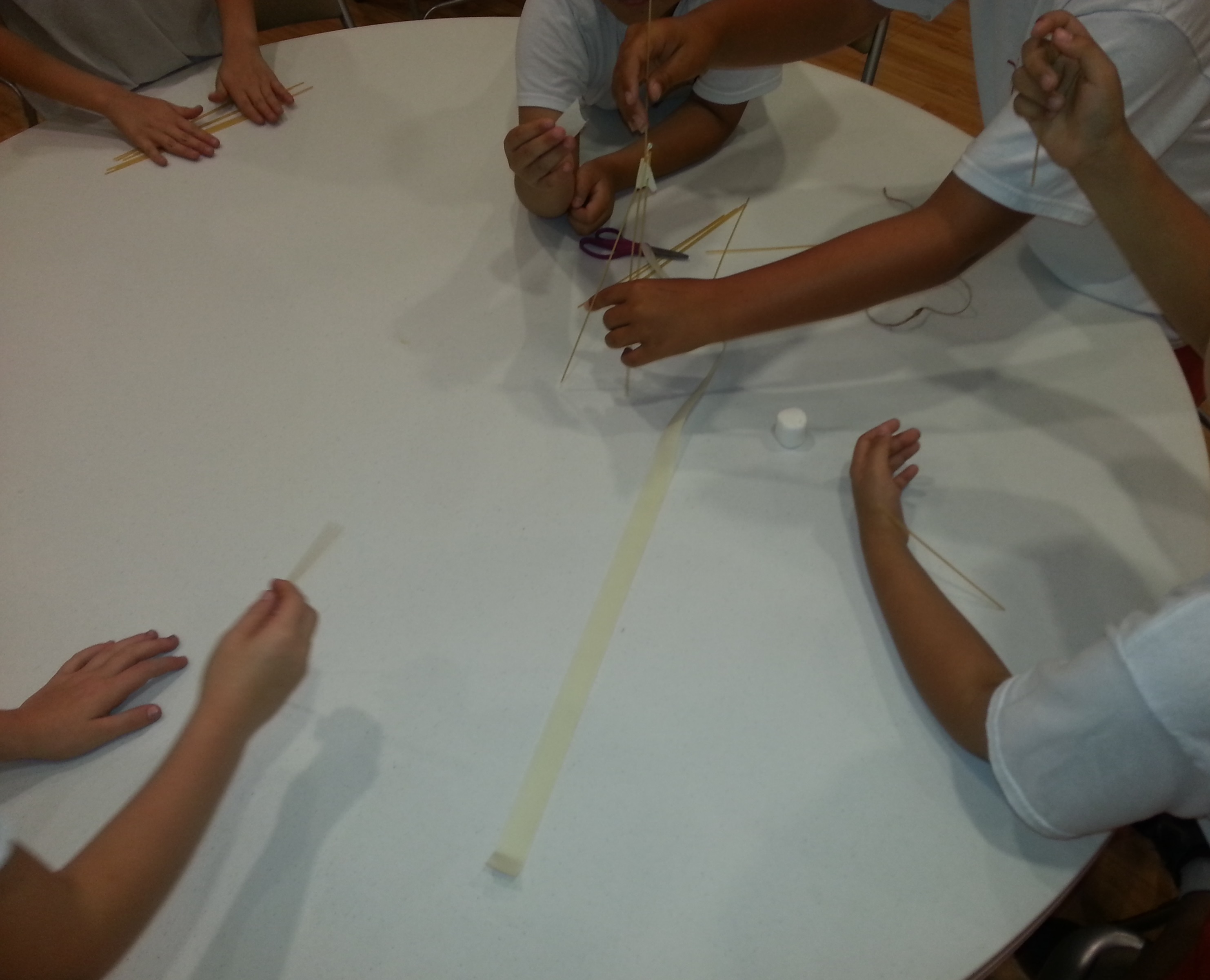
I have used The Marshmallow Challenge as a summation activity on the final day of the college semester for my students. It has proven to be a wonderful instructional tool on many levels.  I also have had good fortune introducing various faculty groups (higher education) to it around the nation.

This past week I ventured into the realm of 3rd graders to do the activity.  While the Marshmallow Challenge always creates a lot of energy and excitement, I had not experienced anything quite like what Mrs. Jeanne Shober’s class brought to the activity.

First, I loved the hands in the air. These kids wanted to talk, interact, explain, vocalize, and share their opinions.  There is an old cliché in teaching that our children start out as question marks—but end up as periods.  As we move higher up the educational ladder, fewer hands tend to go up…and that is a loss. We need to keep the curiosity and passion in the learning! Cheers to the teachers who do that—and sustain the energy for both their students and themselves. (No short order.)

2014-05-28 09.16.07-cropped


I was not quite sure what to expect when I did the end-of-activity debriefing with the wide-eyed 3rd graders.  But with expert questioning from the teacher, principal, and class assistant, these young scholars arrived at some astonishingly perceptive conclusions.  Here is a short list of their insights—and remember these are their words (pretty near verbatim):

 “What did you learn from the activity?”

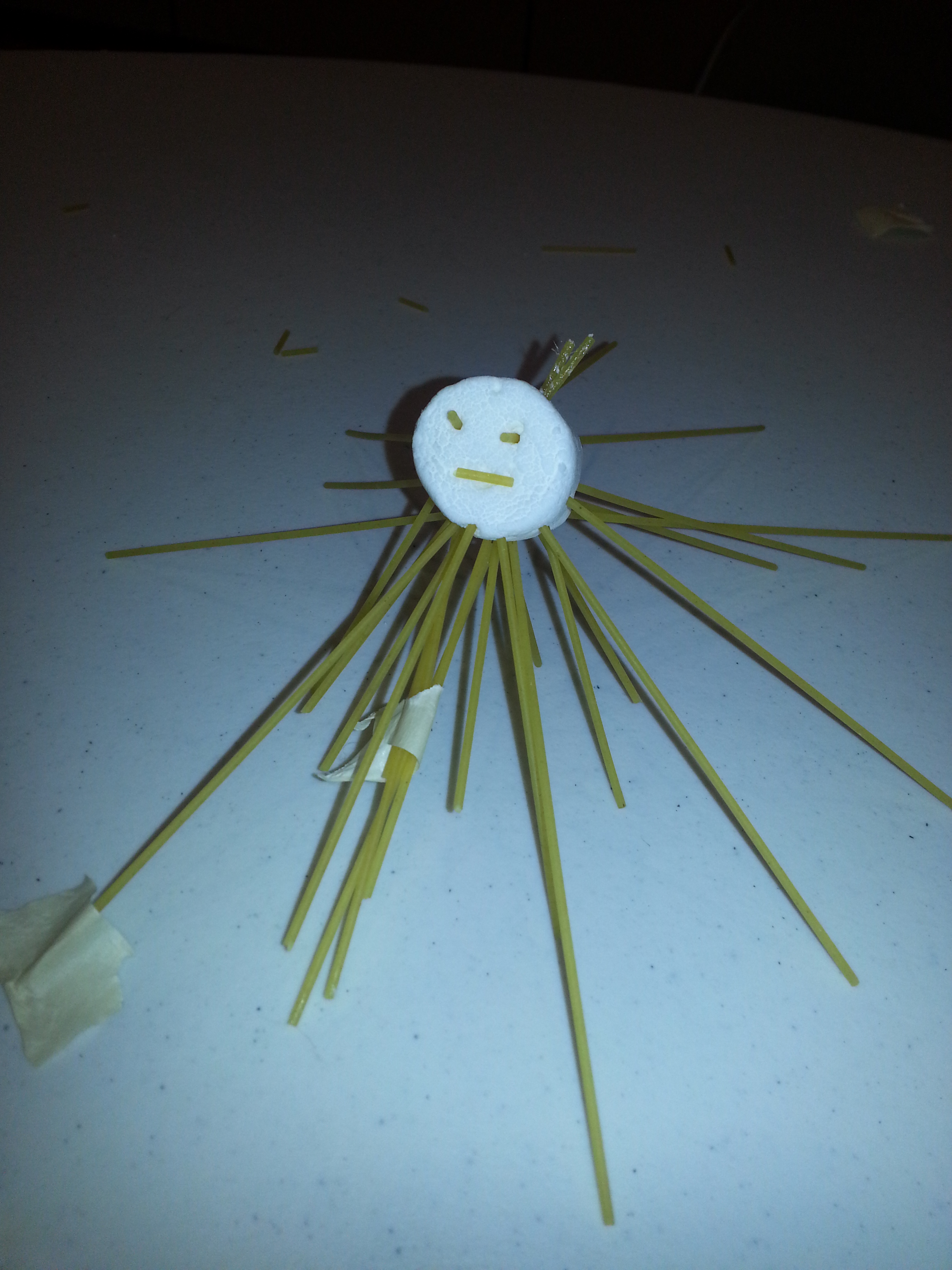
  • It’s not about how big [NOTE: one group due to the small size of the structure it built had no way to “win” but they were creative and had fun, regardless. See photo below.]
  • Work as a team.
  • Have fun.
  • You never know.
  • Never quit.
  • Something is worth it even if it looks bad.

2014-05-28 09.31.56

“What was not working during the activity?  What did you do when it didn’t work? What was frustrating?”

  • Everyone had their own ideas.
  • Fighting doesn’t get things done.
  • Sometimes you run out of materials.
  • We broke the material too soon.
  • The first thing we thought was that it could’ve been worse.
  • We started ‘discombobulated’!

“What lessons did you learn? How did you know what to do first…then 2nd?”

  • Look for hard workers.
  • Don’t play with your materials.
  • Use time wisely.
  • Be eager to help.
  • Be creative.
  • Experience helps.
  • Put different ideas together…and sometimes things will end up better than your idea.

WOW!  “Fighting doesn’t get things done.” “Have fun.” “Never quit.” “Use time wisely.” “Be eager.” “Put different ideas together.”  “Work as a team.”

I’m thinking we should hire these young folks to help our so-called “leaders” understand the basics of human dynamics and collaboration.

Just saying….


Video recommendation for the week:

How do business people (adults!) do with the challenge?  Click here for a peak.


Make it a wonderful week—H.T.R.B. as needed.

Check out my website (http://www.stevepiscitelli.com/programs.html) for programming information as well as details about upcoming webinars  (http://www.stevepiscitelli.com/webinars).

Information on my newest book, Choices for College Success (3rd ed.), can be found at Pearson Education.

 (c) 2014. Steve Piscitelli. All rights reserved.


Posted in collaboration, common sense, Communication, curiosity, Passion | Tagged , , , , , , , , | 3 Comments

(#209) What Consequence Have You Created Today?


We all have choices. What’s your choice–and consequence–today?

We all have choices. Every choice has a consequence. When you set the bar low, what’s the consequence? When you set the bar a bit higher than your comfort zone, what’s the consequence? What’s your choice—and consequence—today?

In my book Choices for College Success (3rd edition) I wrote the following:

You are a work in progress…Self-aware people reflect on their
actions, understand how those actions affect themselves and
others, and assume responsibility for their choices.  Self-aware
people do not have all the answers. None of us do…Self-aware
people are, at least, more alert to circumstances around them—
and how those circumstances may have an impact on themselves
and their surroundings.
(p. 264)

Every one of us has potential. Lots of it.  But how many of us live up to it—or even realize what we have in the tank?  What is the possibility of you becoming a stronger you?

Image: supakitmod/ FreeDigitalPhotos.net

Image: supakitmod/
FreeDigitalPhotos.net

As an article in Harvard Business Review states, examining whether you are reaching your potential requires “taking a very personal look at how you define success in your heart of hearts and then finding your path to get there.”

So what is your path?

For the coming week engage in a bit of reflective practice for yourself:

  1. Raising Awareness.  Do you even know what you are doing? Is your life about earning a living? Creating a space? Making a difference? Finding a different path?  What is it that you do each day?
  2. Challenging Assumptions. Once you identified what you are doing, do you know why you are doing what you are doing? You may need a mentor to bounce ideas off of for this item.  Why do YOU do what YOU do each day? Are you just surviving? Have you stopped looking at alternatives? Have you backed yourself into a corner—and if you have, is there really no way out?  Sure there is!  A mentor or coach can help. Are you ready to listen and adjust?
  3. Creating Action.  Ambition (the desire to do something greater) is wonderful. Potential (the possibility of becoming something greater than you are) is intoxicating.  But, ah, the rub comes with initiative.  Will you take the action needed to reach the ambition and enjoy the potential?

Video recommendation for the week:

How can we look at our world from different perspectives?


Yes, we all have different circumstances.  And some of those are downright taxing, scary, and foreboding.  If we can remember that events do not create outcomes we can take control of where we are going.  Events obviously have an impact on the outcome.  But it is our response (rather than reaction) to the event that creates the outcome.

Each day the smallest of choices you make will have long-term consequences for you.  Choose to standout. Set the bar high.  Be prepared to miss the mark from time to time.  But never set your bar lower just to make it comfortable.  Because if you do, you will reach the bar—but you will not be comfortable.

Make it a wonderful week—H.T.R.B. as needed.

Check out my website (http://www.stevepiscitelli.com/programs.html) for programming information as well as details about upcoming webinars  (http://www.stevepiscitelli.com/webinars).

Information on my newest book, Choices for College Success (3rd ed.), can be found at Pearson Education.

 (c) 2014. Steve Piscitelli. All rights reserved.
 

Posted in Choice, potential | Tagged , , | 3 Comments

(#208) Community


What do you see as the primary characteristic of a community?
What greater purpose does it serve?

This weekend our little beach community put on the 28th edition of Dancin’ in the Streets. A day of fun music (2 stages), food, beverage, kids’ activities, and crafts.  My wife and I volunteer for a few hours and then wander the street listening to music, visiting with friends, and enjoying the food and sights.

2014-05-17 11.00.25


The event reminds us of the wonderful community we live in and enjoy each day.  And it reminded me of the importance of “community” in all of our lives.

In its most general form, a community is any group of folks that shares something in common. Often it is associated with a geographical location. With the Internet, however, many of our communities have become virtually boundary-less and limitless.  For instance, there are the communities found in and around:

  • Neighborhoods
  • Churches
  • Coffee houses
  • Classrooms
  • Schools
  • Teacher lounges
  • Professional organizations
  • Sports teams
    2014-05-17 15.16.50
  • Families
  • Volunteer organizations
  • Political organizations
  • Activist organizations
  • Professional associations and conferences
  • Occupations
  • Callings
  • Yoga classes
  • Gym weight rooms
  • Reading clubs
  • Morning jogging groups
  • Car pools
  • Daycare centers
  • Substance abuse counseling groups
  • Animal rights proponents
  • Civil rights activists

And I’m sure you can add to the list.

For me, communities have the potential for great positive power.  The powers of support, encouragement, love, and growth come to mind.  Think of the last natural disaster you heard about—and then remember the news stories of all the people who came together, digging through the rubble to begin the process of rebuilding and healing a community.


Video recommendation for the week:

What communities would you add to the above list? And what do you see as the primary characteristic of a community? What greater purpose does it serve?


Make it a wonderful week—H.T.R.B. as needed.

Check out my website (http://www.stevepiscitelli.com/programs.html) for programming information as well as details about upcoming webinars  (http://www.stevepiscitelli.com/webinars).

Information on my newest book, Choices for College Success (3rd ed.), can be found at Pearson Education.

 (c) 2014. Steve Piscitelli. All rights reserved.
Posted in Balance, Community | Tagged , , , | 1 Comment

(#207) Building a Transcript—or Building a Life?


Just like the dashboards of social media that measure
“likes,” “friends,” “followers,” and “connections,”
we have to examine if  the numbers by themselves have any real meaning.

It’s the end of the semester and with it comes to usual calls, emails, and urgent pleas for an opportunity to “do whatever it takes” to raise a grade.  Unfortunately, the “whatever it takes” was not applied diligently by these students during the semester.  They want to “fix” the problem now!

One student asked me a leading question: “If a student has an 89.6% average, shouldn’t the professor give her the other .4%?”

I explained it was a professor call. And, I countered with: “If all you need is .4%, are you telling me that you were not able to be just .4% better to avoid this situation during the previous 16 weeks?”

Image: dan/ FreeDigitalPhotos.net

Image: dan/
FreeDigitalPhotos.net

And there are the other students who constantly have their calculators out, adding and averaging every grade.  They are consumed by the “If-I-don’t-get-an-‘A’-my-life-is-ruined” mentality.  All energies focus on the grade. They will argue for one point—not because of content or learning. Simply for the grade.

Most times these students’ faces are scrunched up with stress. They get caught in the dreadful grip of grade anxiety.  Some believe they must be perfect; they have to be number one. They care about what people think.  They tend to take fewer chances/play it safe (if those risks will/might affect the GPA).  They miss the journey and the joy that is possible.


Video recommendation for the week:

“When perfectionism is driving, shame is always riding shotgun,” says Dr. Brene Brown.


During my last meeting with my classes this past week, I asked them a simple—and I hope a thought-provoking question, “Are you building a transcript here at college—or are you building a life?”

Please do not misunderstand me.  There are a number of students I wish took a little more interest in their grades!  And I understand that GPA is a barometer for certain things in higher education like some scholarships or admission to a particular school within a university, for instance. And maybe in some job screening situations, the GPA may be given a quick check.  I get that.  But as in most things in life there has to be balance and common sense.

I graduated as the valedictorian of my under graduate college class. #1!  Nice honor.  But guess how many people (in my career space) have EVER asked me about that? How many employers? Schools who call on me to speak? Publishers?

The answer: Not one.

Beyond the ego gratification, it means little.  I guess it does show that I was disciplined…but that 3.993 GPA did not build my life.  It is a small part of it that I earned nearly 40 years ago.  It’s just a number.  And more specifically, it was just a number at that given point in my life. It did not measure me as a person. In fact, when I started my first career job just 6 weeks after graduation in 1975, the GPA was already a distant memory.  Is GPA a predictor of success?  You can find arguments on all sides of this.  A better point to measure may be the consequences of the obsession with GPA.

You may know people in your office who measure their importance by how many committees they are on; how many meetings they had this week; how many times the boss called them or (more pathetically) said hi to them in the hallway.  They keep score as they attempt to build a résumé and sense of self-importance—but they lose sight of the life they may be ignoring or creating on the job and beyond.

And just like the dashboards of social media that measure “likes,” “friends,” “followers,” and “connections,” we have to examine if these numbers by themselves have any real meaning.

Step back from the numbers. You are more than that. You are not a data point.  How do you stand out as a person beyond some ranking?

Make it a wonderful week—H.T.R.B. as needed.

Check out my website (http://www.stevepiscitelli.com/programs.html) for programming information as well as details about upcoming webinars  (http://www.stevepiscitelli.com/webinars).

Information on my newest book, Choices for College Success (3rd ed.), can be found at Pearson Education.

(c) 2014. Steve Piscitelli. All rights reserved.

 

Posted in Anxiety, Balance, Excellence | Tagged , , , , | 3 Comments

(#206) Two Shoulders. One Realization


Do you know when a goal is the wrong goal for you?

A couple months back, I wrote on this blog about my most recent shoulder surgery. (I had my right shoulder done 3 years ago. This year I “balanced” things with work on the left wing.)  Though my progress has been great, I am still a few months away from “being back to normal.” Whatever that means. New normal as they say?

Today, one of my gym buddies asked me about the prognosis for post-surgery life.  Would I be “good as new”? Would I be able to work out like a 20-something gym rat? Would I have limitations or a reduced capacity for activity?

Good questions that made me ponder, once again, the value of healthy goals.

No, I will not be able to mimic a 20-something in the gym.  But that was never my goal with this surgery. I had short-term goals (pain relief and ability to accomplish simple everyday functions that I was not able to do). Long-term I want to continue with my routine, albeit revised, in the gym.

Image: Markuso/ FreeDigitalPhotos.net

Image: Markuso/
FreeDigitalPhotos.net

Unfortunately, for too many years my gym goals centered on being able to lift heavier and heavier weights so that I could achieve a body type like others in the weight room.  That led to my first shoulder injury.  I did not learn from that experience—and went right back to feeling I could keep ratcheting up the regimen. And then I suffered through a second shoulder injury from attempting to act like a 20-year old in the gym.

So, it took two shoulders to understand the goals I had set in the gym were the wrong goals for me. As a trainer told me, no matter how much I lifted and trained I was not going to have the “guns” (biceps) of the “big boys” in the gym.  We just have different musculature.  Those packing the heavy “guns” would have a tough time keeping up with me in a cardio session/class.

For some people, recalibration of goals is a failure of sorts in their eyes.  “If I have to scale back then what good is the surgery? Why bother if the prognosis won’t allow me to be what I used to be?” Here are a few thoughts:

  • Keeping a goal that obviously harms me (physically, spiritually, emotionally, or socially) seems foolish.
  • Diminished capacity does not equate with diminished motivation, desire, and ability to achieve. I can still set lofty goals.
  • Reflective recalibration leads to a refreshing reality check.
  • Unhealthy goals lead to injury…which leads to pain…which leads to operating at less than capacity (anyway!)…which leads to down time.

I don’t have time for injuries. I don’t want to continually work around the injuries. I don’t want to spend money on injuries.  Especially when I can make an effort to avoid the injuries.

Some might call that rationalization or getting lazy or giving up or getting old. I don’t. As long as I continue to stretch myself and reach for challenging goals I will be fine. The trick becomes in identifying the line between challenging and damaging.  In my case, two shoulders have pointed out the line. And I have decided to listen.

Are you paying attention to your feedback?


Video recommendation for the week:

This week’s video takes a different look at whether or not we should announce our goals to the world.


Make it a wonderful week—H.T.R.B. as needed.

Check out my website (http://www.stevepiscitelli.com/programs.html) for programming information as well as details about upcoming webinars  (http://www.stevepiscitelli.com/webinars).

Information on my newest book, Choices for College Success (3rd ed.), can be found at Pearson Education.

(c) 2014. Steve Piscitelli. All rights reserved.


Posted in Goals, health, Life lessons | Tagged , , , , , , | 3 Comments

(#205) What? Why? How?


This exercise can help with major life decisions.

The theme for my student success classes comes wrapped in two questions: (1) What is your dream? (2) What are doing to get to your dream?

These two questions are even more succinctly stated on my business card: Dreams—Action—Reality.  Anyone can have a dream but without action you really have a fantasy. If you don’t act on your dream (or toward your dream) you will create a whole other reality.

The last unit of our semester (and my book Choices for College Success, 3rd ed.) focuses on college majors and careers.   I have written elsewhere on this blog of the intertwining and reinforcing activities my students do in order to drill down on their passion—their calling.  For many of us this is a life-long pursuit.

Image: dan/FreeDigitalPhotos.net

Image: dan/FreeDigitalPhotos.net

Today, I will concentrate on one of the activities that can have powerful results beyond choosing a major in college. This exercise can help with other major life decisions as well.

  1. Outcome. This initial step helps you focus on the end result….the accomplishment/achievement…the change…  In short, this is the WHAT of your process. As clearly as possible, what do you want the desired outcome to look like? How will you look? Walk? Talk? Dress? Interact? Feel? Create?
  2. Intent. Once you have the final outcome (as best as you can determine) in your mind’s eye, ask a simple question: WHY do I want to reach this destination? Why do I want to travel this journey?  Is it strictly for money? To make a difference? To be close to someone or some purpose? To be able to travel/move? To have stability in my life? To have a bit of chaos in my life?  Once you believe you understand the why, look back at the outcome you identified.  Ask yourself if the outcome is the only way you can scratch the intent’s itch?  Perhaps there are other outcomes—other options—that will allow you to just as passionately realize your why! As people far wiser than me have said: Be open to the infinite possibilities that surround you.  (This would be a great time to stop, reflect and do the Five Whys Exercise.)
  3. Implementation.  You know WHAT (outcome) and WHY (intent).  The next crucial step is the HOW step. How will you move toward your outcome? What actions will you take to satisfy your intention? This is where the work comes in—the legwork.  The first two steps require vision and planning. This step is all about execution.

Remember there may be false steps and obstacles (actually, there WILL be detours). Consider these signposts.  Be ready to make adjustments as needed.

A friend recently turned me on to a new (for me) metaphor: Many times those “problems” are really gifts wrapped in barbed wire. Once you navigate the difficulties you will reach the prize.  Aren’t our dreams worth it?


Video recommendation for the week:

View a powerful video by www.values.com by clicking or pasting the following link:  http://www.values.com/inspirational-stories-tv-spots/124-Finish-Line.


Make it a wonderful week—H.T.R.B. as needed.

Check out my website (http://www.stevepiscitelli.com/programs.html) for programming information as well as details about upcoming webinars  (http://www.stevepiscitelli.com/webinars).

Information on my newest book, Choices for College Success (3rd ed.), can be found at Pearson Education.

 (c) 2014. Steve Piscitelli. All rights reserved.


Posted in Goals, Life lessons, Passion, Personal Wellbeing, Values and virtues | Tagged , , , , , | 7 Comments

(#204) College Ready?


I think, more poignantly, the question for our colleges and universities comes down to
“Once the students (college-ready or not) are admitted, what do we do to best serve them?”

Preparing for my part of an online (virtual) conference this week I came across a number of sources looking at who is and who is not “college-ready.” Consider the following statistics:

  • 1.7 million college students enroll in remedial classes
  • About 40% of first-year students require remedial work
  • 26% of ACT takers are considered college ready
  • In 2012, states and students spent more than $3 billion on remediation
  • SB 1720 in Florida has restructured how remedial (developmental education) will be offered in the state.

The debate, while not new, seems to have reached new levels of urgency (and vitriol).  Does a high school education indicate a student is prepared and ready for college-level work?  What does “college-ready” mean—how do we quantify that oft-used term?

Image: Teerapu/ FreeDigitalPhotos.net

Image: Teerapu/
FreeDigitalPhotos.net

We could even debate whether these “non-college-ready” students should even be in college in the first place.  And if they aren’t, then where do they “belong”?  If more than 115,000 janitors currently sport four-year degrees, what is the future for those without any degree—and by extension, what is the future for our communities at large?

I think, more poignantly, the question for our colleges and universities comes down to “Once the students (college-ready or not) are admitted, what do we do to best serve them?”

Simply stated: “What can we do to break this cycle?”

Organizations such as Complete College America call for “clear paths to graduation.” Developmental education is tarred and feathered in political and academic debates about its level of effectiveness. State legislatures protest that they do not want to “pay twice” for the same education. That is, they question the sanity of paying for remediation in college for skills that were supposed to be taught and learned in high school.

Fingers point in all direction in what becomes a circular firing squad.

In my portion of this Friday’s virtual conference, I will address a few things those of us on the ground can do to help our students and thus help the greater community.  Included:

  • Recognizing that non-cognitive issues have a critical impact on success—as much or more than academic challenges
  • Infusing/embedding skills within existing courses as appropriate
  • Providing realistic and real-time mentoring and guidance inside and outside of the classroom
  • Connecting students intrusively with life success resources.

We can argue all day as to whom to blame for the current situation. (Like there is a single culprit in this mess!)    The situation IS urgent.  There ARE students coming to us who desperately need additional resources for success in school and beyond.

What I do know from my experience is that something has to be done to break the cycle.  That is not rocket science. Let’s continue to the conversation (true conversations—not collective monologues!) Let’s put aside our confirmation biases and recognize that even someone philosophically opposed to our views may have a kernel of truth and insight to help us and our students move forward.

These students, after all, are not just enrollment statistics. They represent investments in our community.


Video recommendation for the week:

For this week’s video clip, let’s look back at an opportunity I had to a few years back on a visit to Lynn University as a Scholar in Residence.


Make it a wonderful week—H.T.R.B. as needed.

Check out my website (http://www.stevepiscitelli.com/programs.html) for programming information as well as details about upcoming webinars  (http://www.stevepiscitelli.com/webinars).

Information on my newest book, Choices for College Success (3rd ed.), can be found at Pearson Education.

(c) 2014. Steve Piscitelli. All rights reserved.


Posted in college retention, developmental education, Student success | Tagged , , , , | 1 Comment

(#203) I Don’t Have Time To Grow Old!


Complete the following:
“If  you don’t have time to ______ then when will you ____?

A little secret about this blog: I generally do not know what I will write about until Thursday or Friday.  I then type my first rough draft and let it sit for 24 hours or so before I revise and post.  I have not created a long list of titles or topics or thoughts to write about.  But without fail, each week I am inspired by something I read, observe or that happens to me.  That has been one of the benefits of staying focused on posting each week (now at 203 continuous weeks and counting!).  I am always on the lookout for something noteworthy and life-affirming.

This week’s inspiration came from one of our 5 a.m. workout crew at the local gym.  Joe is an affable retiree who is sneaking up on octogenarian status.  As we were working out at nearby stations we were both extolling the benefit of our early morning regimens.  Joe then said, “I just don’t have time to grow old!”

I loved it!  And told him I was immediately appropriating his aphorism.

Another one of the gym “residents,” Bobby, often quips that “Motion is the lotion” when he speaks about the benefit of constantly exercising and stretching our bodies.

Image: Naypong/ FreeDigitalPhotos.net

Image: Naypong/
FreeDigitalPhotos.net

And both of these gentlemen reminded me of a college student I tutored more than 20 years ago.  That young 20-something opened one of our sessions with an insight he had finally gained: “Staying up to date is so much easier than catching up!”

The wisdom from each of these men is profoundly simple—and so often ignored.

That got me to thinking about completing this question:

“If  you don’t have time to ______ then when will you ____?

If, for instance, we “let our body go” it will become more difficult to get back into the healthy routine of diet and exercise than if we had remained on task.  If you don’t have time to go to the gym, eat healthy, get enough sleep or whatever else you need to do then when will you have the time to be sick and retreat to our bed or the sofa to recover? If you don’t have time to work out now, then when will you be able to when your body is weak and stiff?

Like the student who wants to do extra credit to bring up a grade point average. If you don’t have time to do the required work, then when will you have time to do extra work?

If you don’t have time to tend to and nurture a relationship, then when will you have time to mend that relationship?

If you don’t have time to plan for your financial future when you have the years to build the wealth, then when will you be able to do it once you need that money?

If you don’t have time to stop and put gas in the car, are you telling me you will have the time to wait on a tow truck?  How about if you don’t have time to put gas in your energy tank?  Then when will you have time to recharge your batteries?

What we create now, we reap later.


Video recommendation for the week:

Are you growing old or growing up?


Thanks, Joe, for the reminder.  We will all age—but we don’t have to grow old.  I know I don’t have time for that either.

Make it a wonderful week—H.T.R.B. as needed.

Check out my website (http://www.stevepiscitelli.com/programs.html) for programming information as well as details about upcoming webinars  (http://www.stevepiscitelli.com/webinars).

Information on my newest book, Choices for College Success (3rd ed.), can be found at Pearson Education.

(c) 2014. Steve Piscitelli. All rights reserved.

Posted in ageing, Procrastination | Tagged , , , | 6 Comments

(#202) Obstacles to Goal Achievement


Stating or writing a goal is the easy part.
The work is found in making a plan, executing that plan,
and re-calibrating along the way.

Information on goal setting can be found in the business success literature, leadership manuals, student success classes and textbooks, and coaching seminars.  It has received a lot of space on this blog as well. At times we can find ourselves inundated with advice on goal setting.

This coming Friday, I will be facilitating a webinar on the topic of goals.  More poignantly, I will address the need to go beyond goal setting to goal achieving.  Stating or writing a goal is the easy part.  The work is found in making a plan, executing that plan, and re-calibrating along the way.

Image: StuartMiles/ FereeDigitalPhotos.net

Image: StuartMiles/
FereeDigitalPhotos.net

One small piece of the webinar will examine why it is difficult for so many people to move beyond the setting to the achieving stage.  Let me give you the shortlist. Perhaps you have experienced one or more of these:

  •        Too big?
    •        Simply stated, you have set your sites much too high—at least for where you are right now.  The student who says “I will raise my English grade from an ‘F’ to an ‘A’ in one week” is delusional. So is the person who has never had a regular workout regimen and now vows to work out 2 hours per day for 5 days every week. Please don’t misread this.  Setting big goals—goals that force us to stretch separate the good from the great (as Jim Collins has said). This might be the place to break those huge goals into smaller and more manageable short-term goals. Start small…and stay steady!
  •        Too quick?
    •        Connected to the item above:  You may want to do too much too soon.  I see this every semester with students who come back to school some 10 or more years after high school. They believe they have “wasted valuable time” and will now take five classes per term (while continuing to work and take care of a family). Unfortunately, they do not have (yet) the academic chops to do this.  Remember, small and steady will win the race.  Overreaching and over-promising (even yourself) can have devastating time and confidence consequences.  Don’t kill your own momentum before you give it a chance to build.
  •        Too little discipline—but lots of positive words?
    •        To accomplish any goal discipline is required.  Talking will not get you to the result.  Consistent effort will.  Positive thinking and self-talk can be powerful. But there has to be substance with the words. No discipline, no plan, no realism, and no action = no goal achievement. I often meet people with lots of superlative words and positive thoughts. (Like, “God will provide for me.”  Well, OK. And didn’t God provide you talents that you have to use?) I had a supervisor who used to always say, “Absolutely fantastic!” whenever he was asked how he was doing.  He wanted to create a positive, can-do, excellent work atmosphere. Unfortunately, when everything is always “absolutely fantastic” the words lose the impact—and everything becomes rote and average at best.  What the person was attempting to create got lost by the redundancy and monotony of the mantra. I recommend Barbara Ehrenreich’s book Bright Sided: How Positive Thinking is Undermining Americafor an interesting view.
  •        Too removed from passion?
    •        Is your goal moving you? Are you excited about it? Maybe the reason you are not making progress is that you are not connected emotionally to the goal. Is it your goal or someone else’s?

      Image: Stuart Miles/ FreeDigitalPhotos.net

      Image: Stuart Miles/
      FreeDigitalPhotos.net

  •        Too tough on themselves?
    •        Don’t beat yourself up.  More than likely, you will stumble.  Recalibrate and move on. Again, slow and steady.
  •        Too fearful—of yourself and your critics?
    •        But I might fail!  What will “they” say? Yep, you might stumble–and the critics might be ready to pounce. And you might succeed! If you don’t take a step forward, how do you get beyond where you are now?

      Video recommendation for the week:

      Big goals can scare us. We feel vulnerable.  Brené Brown reminds us how this can be motivating. The doers get things done…the critic doesn’t.


Goals are powerful motivators. Setting them is the first step.  Are they realistic? Are they connected to whom you are as a person? What are you doing to get to the goals? Disciplined movement and continually re-calibration can help you stay on track.

Make it a wonderful week—H.T.R.B. as needed.

Check out my website (http://www.stevepiscitelli.com/programs.html) for programming information as well as details about upcoming webinars  (http://www.stevepiscitelli.com/webinars).

Information on my newest book, Choices for College Success (3rd ed.), can be found at Pearson Education.

 (c) 2014. Steve Piscitelli. All rights reserved.

 

Posted in Discipline, Goals, vulnerability | Tagged , , , , , , , | 3 Comments