
(#101) Ayekoo!


Feel free to pass this along to any new college student you may know.
You may even find some nuggets of advice for yourself…
I commend these students for a job well done! They have inspired me.

The final exam for my student success classes takes on a very personal note.  Students write about their dream (why they have decided to come to college), the actions they have taken this semester to get closer to the dream, and one challenge (with an action plan) that they need to tackle.

By far, it is one of the most powerful classes of the semester.  A number of students have never given their dreams much thought. Some have allowed the haters in their lives to hold them back. This semester allowed all of my students to focus on their meaningful future. A future of their creation.

There is an additional part to the final. On the day they turn their papers in, the students get a couple of minutes to speak to their dreams.  If they choose not to speak to their dreams, they have the opportunity to provide advice to incoming first-year college students.

For those who take the advice option, the question is simple: “Based on your experiences over the last 16 weeks, what advice would you give to first-year college students?”

For this post, I will share some of the advice from these wonderful folks.  Feel free to pass this along to any new college student you may know.  You may even find some nuggets of advice for yourself.

  • Prioritization will help you balance work, family and school.
  • Know what you are getting into.
  • When it comes to prioritization, understand what is negotiable and non-negotiable in your life.
  • Leave your school with a legacy; inspire someone.
  • Seek balance in your life.
  • Eliminate the word “try” from your vocabulary. Make conscious choices to do something.
  • Don’t give up. Stay positive. It’s your dream.
  • Take initiative.
  • Be determined. Your college success is up to you.
  • Get to know at least one class member.
  • Get to know your professors.
  • Use the college resources.
  • When you wake up in the morning, give yourself a morning positive pep talk!
  • Find and talk to supportive people.
  • There are consequences for your actions.
  • Be a role model.
  • Don’t let life’s storms distract you.
  • Remember why you are doing what you are doing.
  • Limit the amount of negative people you allow into your bubble.
  • Show gratitude.

I LOVE this final exam!  One of my students said (as many have over the years) that the process was emotional for her (in a very positive way).  Another student who is from Ghana said it best: Ayekoo!  It simply means, “Well done!”

Yes, indeed. I commend these students for a job well done! They have inspired me.


Video recommendation for the week:

Enjoy the music and the message–Well Done!


Enjoy your week—and H.T.R.B. as needed!

Thank you for taking the time to read my blog post. Please pass it (and any of the archived posts on this site) along to friends and colleagues. You can also follow me on Twitter, LinkedIn, and Facebook. If you get a chance, visit my Facebook page and join in–or start–a conversation (www.facebook.com/stevepiscitelli). Also, if you have suggestions for future posts, leave a comment. Have a wonderful week!

© 2012. Steve Piscitelli and Steve Piscitelli’s Blog.
Posted in Student advice | 1 Comment

(#100) Milestones: Endpoints or Checkpoints?


#100

Milestones remind me of the possibilities in life.

Today when we speak of milestones we most likely are referencing some significant event—personally, professionally, politically, physically, emotionally, spiritually, or culturally.


Video recommendation for the week:

Perhaps some of us might think about the milestones in rock history.


For me, this blog post is a milestone: it represents the 100th consecutive weekly post for this blog.  When I started blogging nearly two years ago, I didn’t know what to expect or how long I would continue to contribute my thoughts, observations, and suggestions. While there are bloggers who post much more frequently than I do—and have a much larger following than I do—I am still proud of this milestone.  And that got me to thinking about the concept of milestones. A few months back I asked folks through Facebook and email to tell me what they thought of when they heard the term milestone.  Here is what I posted:

  • Are there any milestones that you have achieved that you would be willing to share with my readers?  What made these things milestones in your life?
  • Do you find milestones important and goal-connected—or do they “just happen” in your life?
  • When you think of milestones do you think of certain categories: relationships, job promotions, accomplishments, financial, spiritual…..?
  • Do you have any advice when it comes to milestones?

For my 100th blog post, I share some of those thoughts. 

  • I don’t think in milestones—they seem too definite as if the goal/achievement/dream has ended and a new one has begun.
  • One could say that having a child is a milestone, as if it instantly changes you—well, you are changing before, during, and after. One could say turning a certain age is a milestone, but again, it means we are fixated on an artificial event/time of day/year, etc.
  • Milestones are created when you accomplish something significant in your life. When I enrolled in college, I had to overcome challenges, sacrifice time and money. Now, I can say “I am a college student!”
  • After forty-nine years of following the Boston Red Sox on a pitch-by-pitch basis, they finally win a World Series in 2004!” ­­­­­­­­­­­­­­
  • Hmmm…that takes some thought, actually.
  • It’s important to start with a clear intention of what you’d like to shoot for, but then to let go of the outcome because  the outcome you are expecting may not be the best option for you. Also, the outcome you are expecting might be less than the possibilities available to you! In other words, milestones are good check in points, but I think we can get too obsessed with EXACTLY what the best milestone should be. I think it’s good to set goals and place milestones, but I caution us all that we limit our full potential if we limit ourselves to what our egos can envision and we can pre-judge ourselves as being failures if we don’t reach the EXACT milestone that we set for ourselves.
  • My biggest milestone at the moment is realizing that there REALLY are some evil people in the world who will do anything to get ahead.  Say anything. Things that I STILL can’t wrap my head or soul around.  This has been a hard lesson to learn and accept –that there are two worlds in which people live and sometimes, they cannot be bridged. 
  • When I hear milestones these days it’s always in reference to infant developmental milestones (Is my son on track? Is he too slow? Too fast? Will I mess him up?). It’s challenging to think about my own life’s milestones and why I value these events.
  • I am a great believer in setting goals although I don’t always stick to my plans.  I sincerely believe that setting goals is far better than wandering around with no direction.  I have always used pictures—real or in my mind—of what I wanted to accomplish, and it seems to work.  I look at accomplishing goals as beginnings, not endings.  The accomplishment of one goal should be a stepping stone to another one or a different one.
  • The important thing to remember is that we can’t stop when we reach a goal or a milestone.  What we have accomplished should lead to bigger and more challenging milestones.  I don’t believe in “resting on one’s laurels” or reaching a certain place and stopping.  I think milestones and goals are important as long as one lives. I think human beings were meant to be striving and accomplishing in order to feel alive and fulfilled.   
  • Be prepared to change directions as new opportunities open up along the way.  Much of what has happened in my life appears to be taking advantage of opportunities that arose when I wasn’t looking for them and perhaps didn’t even know they existed.  Life is a series of choices—choices lead us to different milestones and opportunities.  The important thing is to make conscious, carefully considered choices and not just let life happen to you.

Thanks to everyone who took the time to respond. For me, milestones remind me of the possibilities in life.  They ARE those markers (like mile markers on the highway) that guide us.  They are something to shoot for like. But they are not the end of the journey.  Key West may appear to be the end with mile marker “0”.  All that means is that we can adjust course and head east…or hop on a boat and continue west to Ft. Jefferson.  Mile markers mark the progress along the journey.  They are not the end of the line.

Where is your next mile marker…and the next…and the next…?


Enjoy your week—and H.T.R.B. as needed!

Thank you for taking the time to read my blog post. Please pass it (and any of the archived posts on this site) along to friends and colleagues. You can also follow me on Twitter, LinkedIn, and Facebook. If you get a chance, visit my Facebook page and join in–or start–a conversation (www.facebook.com/stevepiscitelli). Also, if you have suggestions for future posts, leave a comment. Have a wonderful week!

© 2012. Steve Piscitelli and Steve Piscitelli’s Blog.


Posted in Dreams, Priority management | 3 Comments

(#99) Dreams: Remaining Open to the Possibilities


“I never got this far in my dream.”

-Bubba Watson-

Last week (April 8, 2012), Bubba Watson won the Masters Tournament at Augusta (Georgia).  His shot from the trees instantly became golfing lore.  The announcer reminded us that Bubba has never taken a golf lesson or “parsed his swing” from a video.  He is, those who know say, a golfing natural.

All of this makes for compelling human interest.  Even for someone like me who is a non-golfer, his story connected with me.  In particular, one statement from his post-tournament Green Jacket interview grabbed me. 


Video recommendation for the week:

When asked about his golfing dream and what this victory meant to him, Bubba said:

“I never got this far in my dream.”


Just a couple days before Bubba’s improbable victory, I had said to a friend at lunch something similar—but not quite as eloquent. The gist of my thought was simple. If you were to have asked me twenty years ago to articulate my professional dream for the year 2012, there is no way I would have (or could have) told you that in those twenty years I would become a professor, author, speaker, and songwriter. In essence,

“I never got this far in my dream.”

For me, that represented an enormous realization. One of my writing and teaching themes is encapsulated in two questions:

  • What is your dream?
  • What are doing to get to your dream?

 We can plan. We can gather our resources.  And we can analyze every little piece of big decisions we make. And we can end up missing the dream.  We don’t know when we will end up in the rough or the trees (as Bubba did on the last playoff hole).  If we stay focused and true to our journey we will see a way forward.

I recently heard an interview in which the person talked about people “running out of future.”  In essence, his point was that some people get to a point where they have reached their envisioned dream—and then stop there. I guess you could call it “plateauing.”  Bubba put a new twist on it for me.

Do we ever know when we have reached the dream?  Next week—my 100th post to this blog—I will share some thoughts about milestones.  Are they dreams? Endpoints? Benchmarks?  Or are they reminders to stay open to the possibilities of where our dreams can lead us?

Enjoy your week—and H.T.R.B. as needed!

Thank you for taking the time to read my blog post. Please pass it (and any of the archived posts on this site) along to friends and colleagues. You can also follow me on Twitter, LinkedIn, and Facebook. If you get a chance, visit my Facebook page and join in–or start–a conversation (www.facebook.com/stevepiscitelli). Also, if you have suggestions for future posts, leave a comment. Have a wonderful week!

© 2012. Steve Piscitelli and Steve Piscitelli’s Blog.
 

Posted in Dreams | Leave a comment

(#98) Fitness: A Better Version of Me


When it comes to your health be “responsibly selfish!”
Treat yourself with respect.

On January 1st of this year, my wife and I joined a number of friends in a New Years’ Day polar plunge into the Atlantic Ocean.  (Full disclosure: We live in Florida. “Polar” is used advisedly.We all posed for “before” photos and videos, ran into the water, and then posed for the “after” photos. Lots of fun. Refreshing. A good time!

Later that evening, when I reviewed the photos, there I stood in my bathing suit and New York Yankees ball cap. The suit and cap looked fine. Unfortunately, I cannot say the same for the ten extra pounds of Piscitelli I saw hanging over my bathing suit waistline.

That photo was my wake-up call. It made me come face-to-face with the hard and uncomfortable fact that I had become complacent with my daily exercise regimen and eating habits. 

That night—the first evening of 2012—I made a commitment:  I would become a better version of myself.  Not for anybody else. I wanted that for me. I wanted to be “more fit” than I was at that moment.  So here is what I did.

I set a specific goal.

  • I would lose ten pounds before March 1 came up on the calendar.

I set a specific plan.

  • I would pick up the pace on my 5:00 a.m. gym workouts.  I increased the intensity and duration of the workouts. Nothing crazy—but I pushed myself off the comfortable plateau I had been coasting along.
  • I would significantly decrease my evening meal portion size.

I took action.

  • Goals can quickly become fantasies if we don’t take action.  So I acted immediately.

I saw results.

  • By the end of the 6th week (mid-February), I had not lost 10 pounds.  I had lost TWELVE POUNDS!
  • Last week I had to have my pants altered.  I had lost 1½ inches from my waist.
  • I had become a better version of me!

Video recommendation for the week:

A few weeks ago I asked my fellow 5:00 a.m. gym travelers to share a few words of advice as to the hows and whys of their respective fitness regimens.  Click on the video below to hear what they had to say.


Did you notice that there were a few repeating themes in the video?

  • The process (the exercise) of staying fit makes them feel good.
  • Start your exercise routine by doing something you enjoy.
  • Start easy; start small; build from there. Small steps lead to big results.
  • Be consistent about your workout and your diet.

Your action plan.

Do you have a vision of a better version of you?  I am not talking about being a body builder or a swimsuit model.  Maybe you want to shed a couple of pounds.  Or perhaps you want to walk after dinner each night. Identify just ONE thing you can do now that will have a positive and healthy impact on your fitness level.

  • Be smart. Set small specific goals on the way to the larger goals.  You may need to consult your doctor or a certified fitness trainer for a plan that is matched to your needs and abilities.
    • What is your goal? What is that better version of you that you want to become?
  • Do it. Take action. Remember goals not acted on become fantasies.
    • When will you start?
  • Be consistent.  Do it again…and again…Make it a habit. Make it a life style.
    • How often will you work toward your goals?  What new habits do you have to create? What old habits do you have to stop.

When it comes to your health be “responsibly selfish!”  Treat yourself with respect.  As one of my fitness likes to say, “The worst thing that can happen is that you will get in shape.”

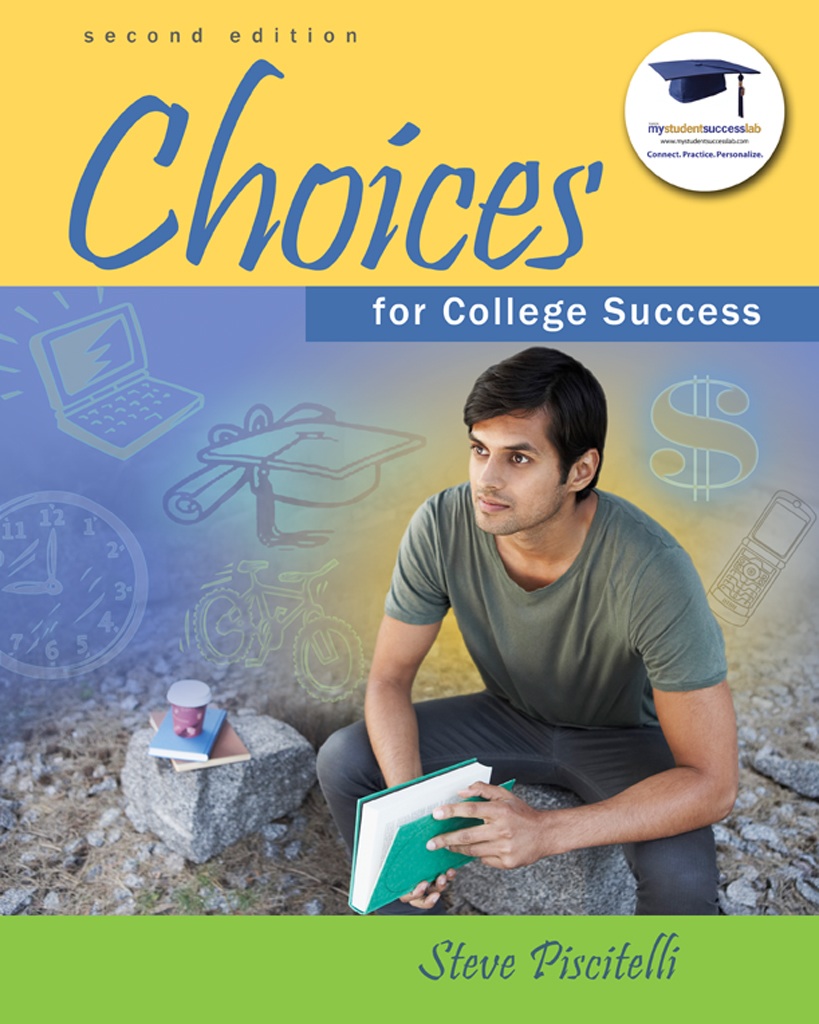
For more on fitness and treating yourself with respect, see Chapter 11 of Choices for College Success, 2nd edition (Piscitelli; Pearson Education, 2011). Please visit my website (www.stevepiscitelli.com), contact me at steve@stevepiscitelli.com, or visit Pearson EducationAmazon and Barnes and Noble.

Enjoy your week—and H.T.R.B. as needed!

Thank you for taking the time to read my blog post. Please pass it (and any of the archived posts on this site) along to friends and colleagues. You can also follow me on Twitter, LinkedIn, and Facebook. If you get a chance, visit my Facebook page and join in–or start–a conversation (www.facebook.com/stevepiscitelli). Also, if you have suggestions for future posts, leave a comment. Have a wonderful week!

© 2012. Steve Piscitelli and Steve Piscitelli’s Blog.


Posted in fitness, Goals | 15 Comments

(#97) Study Skills: A Baker’s Dozen


“Everybody, sooner or later, sits down to a banquet of consequences.” -Robert Louis Stevenson, author-

Back in the 13th century—one story goes—baker’s faced the possibility of severe punishment if they shorted an order. That is, if someone ordered a dozen donuts but only got eleven, the baker could find himself in some pretty deep yogurt (if you get my drift). So, in order to protect against an inadvertent mistake, bakers over-compensated by putting thirteen donuts in a dozen of donuts.  Hence the expression was born: a baker’s dozen.

Well, today, I want to give you a baker’s dozen of study skill tips. For the past twelve weeks this blog has focused on one study skill per week. This week’s blog will quickly review those 12—and throw in a one for good measure.  Remember, while these are “study skills” each one has applicability to life and career as well.  For your convenience, I have also linked each study skill to the appropriate blog post. Just click on the title by each number.


Video recommendation for the week:


1.       Do I Really Need This Stuff? *Do a realistic assessment of your skills and challenges. We all have things to learn, things to tweak, and progress to make. *Video link for an introduction to study skills.

2.       Critical Thinking.*Critical thinking is an “across-the-board” skill. It is a life skill.  Remember the simple yet eloquent acronym: R.E.D.  Recognize Assumptions. Evaluate Information. Draw Conclusions. *Video link for the R.E.D Model

3.       Priority Management.  *You cannot manage your time…but you sure can manage your priorities.  Know how to recognize the negotiable and non-negotiables in your life. Focus by making time for your most valuable priorities each day. *Video link for priority management.

4.       Information Literacy. *Know how to effectively locate, evaluate, and use information.  Also, understand how to use social media for your academic, career, and personal benefit. *Video link for information literacy.

5.       Motivation and Goal Setting. *When you think of goals, think of the acronym S.O.A.R.: Specific, Organize, Action, Reason. *Video link for goals.

6.       Learning Styles. *This is one style that NEVER goes out of style! Understand how you best receive and use information. *Video link for learning styles and preferences.

7.       Class-Time Listening and Note-Taking. *Here are eight strategies that pertain to the business world as much as they do to the classroom. *Video link for classroom success.

8.       Notes Review. *Research tells us that as students build connections (relationships) between what they learn in class, read in their books, and experience in their lives, they will improve their learning. *Video link for making connections with class notes.

9.       Reading. *Reading remains a crucial skill. In fact, being able to read well is perhaps even more important today than it was in the past. *Video link for reading.

10.   Memory. *If I had to give just one tip for improving memory it would be to find connections—make the material (whatever it might be) relevant to your life. *Video link for memory.

11.   Test-preparation and Test-Performance. *When you effectively use test-preparation strategies, you are not only getting ready for the exam at hand, you are building life-long skills. Relevant and connected. *Video link for test-prep and performance.

12.   Civility. *Civility does not mean we all agree. It does mean, though, that we accept each other’s humanity and dignity as a person. *Video link for civility.

And this week’s additional item—the baker’s dozen—is:

13.   The Choices You Make.

*While ambition and potential are important characteristics, they are useless without initiative.  Our life is the sum of the many small choices we make and do each day. Make each day count. 

For more on the above topics, see my book Study Skills: Do I Really Need This Stuff? 3rd edition (Pearson Education). Please visit my website (www.stevepiscitelli.com), contact me at steve@stevepiscitelli.com, or visit Pearson EducationAmazon and Barnes and Noble.

Enjoy your week—and H.T.R.B. as needed!

Thank you for taking the time to read my blog post. Please pass it (and any of the archived posts on this site) along to friends and colleagues. You can also follow me on Twitter, LinkedIn, and Facebook. If you get a chance, visit my Facebook page and join in–or start–a conversation (www.facebook.com/stevepiscitelli). Also, if you have suggestions for future posts, leave a comment. Have a wonderful week!

© 2012. Steve Piscitelli and Steve Piscitelli’s Blog.

Posted in Study Skills | 2 Comments

(#96) Is Civility Part of Your D.N.A.?


Civility does not mean we all agree. It does mean, though,
that we accept each other’s humanity and dignity as a person.

NOTE to the reader:  “D.N.A.” in the title does not stand for what it usually does. At least not in this context. I have developed a new meaning for it.  As you read, see if you can ferret out my “new” meaning.  I provide the answer at the end of this post. No cheating, now…don’t scroll to the end and read it.)

I have written a number of times on this blog about civility (An Awareness of CivilityWho Are the “Energy Vampires” in Your Life?  Gratitude. Know Your Boundaries–Know Your Limits.)

For this post, I will concentrate on the concept of nutritious people and its connection to civility. Richard Leider (The Power of Purpose and Repacking Your Bags) tells us that nutritious people have three main characteristics.

  1. When they see you, they smile and are genuinely glad to be in your presence.  No fake pretenses. They make you feel welcomed.
  2. When you speak they listen to you—really listen.  They ask questions about what you say and what matters to you.  There are no collective monologues with these people. (You have heard and seen collective monologues:  A group of people all talking but no one is listening to the other. Each person just waits for a pause in the talking to jump in and start with “Let me tell you about me for a while!” Definitely not nutritious.)  The nutritious person practices active listening. 


    Perhaps this video of clip from Everybody Loves Raymond will remind us of the importance of active listening.


  3. The nutritious person accepts you as you are. They don’t have an agenda to shape and mould you into something that they see as their ideal person.  Nutritious people are not “haters” or “energy vampires” (see numbers 1 and 2 above).

For me,  nutritious people are walking models of civility.  They touch us in such a wonderful manner.  It would seem that if we had more people exhibiting the three characteristics above there would be less anger and hate in the world.  Call me naïve, but when one person takes an active and non-manipulating concern for another person—and then that behavior is reciprocated—it becomes pretty difficult to start shouting at one another.  Civility does not mean we all agree.  It does mean, though, that we accept each other’s humanity and dignity as a person.


Video recommendation for the week:

At a recent speaking engagement in San Diego, I asked a number of people this question: “How do you practice civility?” Click on the video below to hear their heart-felt houghts.  Following the video is a brief civility “homework” assignment for you. And you will find at the end of this blog post the meaning of “D.N.A.”


“Homework”

Your homework for the week is a three-part activity:

  1. Take out a sheet of paper or open a document/note page on your computer, iPad, or smart phone.  Write or type the names of (at least) two nutritious people in your life.  What do they specifically do that makes them nutritious?
  2. Take a moment today and write these people a short note of gratitude. Acknowledge their humanity with your own random act of kindness. 
  3. Time for some introspection. Answer this question:  “Am I a nutritious person? If you are, what do you do that makes you such. (Repeat those actions!) If you are not, what can you do to make those behaviors part of your daily DNA.  (By the way, for our purposes here, D.N.A. stands for “Doing Nice Always”!)

For more on civility, see my books Study Skills: Do I Really Need This Stuff? 3rd edition (Pearson Education, 2013) or Choices for College Success 2nd edition (Pearson Education, 2011). Please visit my website (www.stevepiscitelli.com), contact me at steve@stevepiscitelli.com, or visit Pearson EducationAmazon and Barnes and Noble.

Enjoy your week—and H.T.R.B. as needed!

Thank you for taking the time to read my blog post. Please pass it (and any of the archived posts on this site) along to friends and colleagues. You can also follow me on Twitter, LinkedIn, and Facebook. If you get a chance, visit my Facebook page and join in–or start–a conversation (www.facebook.com/stevepiscitelli). Also, if you have suggestions for future posts, leave a comment. Have a wonderful week!

© 2012. Steve Piscitelli and Steve Piscitelli’s Blog.

Posted in Civility | 3 Comments

(#95) Test-Prep: Connecting Classroom Success to Career Success and Life Success


When you effectively use test-preparation strategies,
you are not only getting ready for the exam at hand,
you are building life-long skills. Relevant and connected.

Each day I walk into the classroom I challenge myself with two questions: (1) “How can I make the material de jour relevant to my students?” (2) “If I cannot make it relevant, why in the world am I taking part of our respective lives to dwell upon it?”

That simple exercise forces me to come to terms with what I am doing—and why I am doing it.  I may not always be successful (matching content to relevance) but it remains a key concern and planning tool for me.


Video recommendation for the week:

Last week in class, we covered the topics of test preparation and test performance. Early in my teaching career, I tended to lump these two topics together as if they were interchangeable parts; as if they were synonyms.   I have come to realize that approach does a disservice to two related, yet distinct, processes.


Two Distinct Processes

In short, consider test performance as the culminating activity of the two.  Just like test preparation, test performance is influenced by many factors that affect how successful you will be when you step into a testing situation. But it comes after test preparation.

Test-preparation includes reading, note-taking, organizational strategies, critical thinking, memory techniques, and study time.  In short, test preparation brings all of one’s study skills together.   It is not—and should not be—a one-time-hurry-up-and-cram-the-night-before-the-exam process.  When students methodically apply their study skills during a unit of study, the night before the exam can take on a more relax-and-review feel.

Relevance and Connections.

When I introduce this next strategy, I tell my students, “This is gold. Write it down!” For the teachers in the crowd (and parents, and mentors, and anyone questioning “why do I need to know this stuff?”) here is a simple three-step process to reinforce the relevance of test-preparation strategies.

[Image: Master Isolated Images/FreeDigitalPhotos.net]

  • First, I present my students with the following list. The title above the list is “Test-Preparation Strategies.”
    • Consider tutoring
    • Know your material
    • Become familiar with format
    • Find out if “props” are allowed
    • Ask about an alternative testing environment
    • Get a good night’s sleep
    • Eat well
    • Have your materials
    • Know your material
    • Talk positively to yourself
  • Next, I present a list titled “Career Success Strategies.”  That list looks like this:
    • Consider tutoring
    • Know your material
    • Become familiar with format
    • Find out if “props” are allowed
    • Ask about an alternative testing environment
    • Get a good night’s sleep
    • Eat well
    • Have your materials
    • Know your material
    • Talk positively to yourself
  • Finally, they get “Life Success Strategies.”  You guessed it—again, they get the same list:
    • Consider tutoring
    • Know your material
    • Become familiar with format
    • Find out if “props” are allowed
    • Ask about an alternative testing environment
    • Get a good night’s sleep
    • Eat well
    • Have your materials
    • Know your material
    • positively to yourself

The point—the gold—is that if they can learn and connect these basic strategies for, say, a math exam, they are learning valuable skills that will serve them well in a strategy meeting with an athletic coach, a staff meeting with a work supervisor, or a heart-felt discussion with a loved-one.  Consider the following examples.

Strategy

Test Success

Career Success

Life Success

Consider Tutoring Work with a peer tutor Find a mentor; ask questions Find a mentor; be curious
Know your material Know the content on which you will be tested. Know the client demographics; review for your annual evaluation Understand and respect the people near and dear to you
Alternative testing environment Find a less distracting location to complete an exam Cross-train in various work stations or environments Look for new experiences—and get out of “ruts” you may have developed
Talk positively Don’t defeat yourself with negative internal chatter Avoid being the “energy vampire” on the corporate team. Remain civil and upbeat in relationships

Takeaway

When you effectively use test-preparation strategies, you are not only getting ready for the exam at hand, you are building life-long skills. Relevant and connected.

For more on test-preparation and test-performance skills, see my book Study Skills: Do I Really Need This Stuff? 3rd edition (Pearson Education). Please visit my website (www.stevepiscitelli.com), contact me at steve@stevepiscitelli.com, or visit Pearson EducationAmazon and Barnes and Noble.

Enjoy your week—and H.T.R.B. as needed!

Thank you for taking the time to read my blog post. Please pass it (and any of the archived posts on this site) along to friends and colleagues. You can also follow me on Twitter, LinkedIn, and Facebook. If you get a chance, visit my Facebook page (www.facebook.com/stevepiscitelli) and click on the “LIKE” button. Also, if you have suggestions for future posts, leave a comment. Have a wonderful week!

© 2012. Steve Piscitelli and Steve Piscitelli’s Blog.

 

Posted in test preparation | 3 Comments

(#94) A Good Memory Makes Connections


If I had to give just one tip for improving memory it would
be to find connections—make the material
(whatever it might be) relevant to your life.

Connections

This week in class, my students examined strategies for improving memory.  I borrowed my opening activity from John Medina’s Brain Rules.  I split the class into two groups. Each group got a list of words to work with. Unbeknownst to them, the lists for both groups were exactly the same.  The difference was that each group got a different set of instructions. One group was told to count the number of words with diagonal lines as well as the number of words without diagonal lines.  Group #2 (again, with the same list of words) was asked to rate the words based on their emotional connection to each word.

Two minutes later, they put the list of words out of sight and had to write as many words as they could remember from the list.  After the initial groans, the students dutifully went about their task. Result: Group #2 smoked Group #1.   In fact, every time I have done this activity I get the same result. When we debrief the activity in class, the students quickly understand that I set them up. Group #1 had a task that pretty much divorced them from the words and any meaning or emotion (they were merely counting lines). Group #2 made connections between the words and themselves. 

BINGO!


Video recommendation for the week:

And thus begins our journey into memory strategies. If I had to give just one tip for improving memory it would be to find connections—make the material (whatever it might be) relevant to your life.


Repetition

In the late 1800s psychologist Hermann Ebbinghaus introduced the “forgetting curve.” He found that if you do not immediately use what you have learned during, for instance, a class lecture or demonstration, you will lose it—forget it. Most of what you will forget will happen within the first few hours of your leaving the classroom or lecture hall. And if you don’t work with the material within 30 days of receiving it, you will forget 90 percent of it. (From Medina, 2008, p. 100. Found in Piscitelli, 212)

Translation:  A college student may not be tested on class material for up to four weeks (or more) after information was introduced in class. If she has not reviewed the material she received in class by time the exam rolls around—she has probably lost it.  That is a very poor R.O.I (Return on Investment).  She spent time in class but without notes review and connections to her textbook, she has remembered very little (content-wise) from the lessons. Sounds like a recipe for cramming the night before a test!


Video recommendation #2 for the week:

Medina is even more basic than that. His rule: Repeat to Remember.  The video below demonstrates.


Strategy

Consider these three simple steps for improved memory.

  • Notice what needs to be remembered.  At the simplest level, it becomes difficult to remember what you have not noticed—what has not registered with you.  If you want to remember a name, for instance, you have to notice it. If you do not notice the emphasis the instructor makes in the classroom, it becomes that much more difficult to notice (and learn) what might be important for the upcoming test. If you don’t learn it in the first place you cannot forget it!  Help yourself by listening and making connections to what you already know.  Actively engage the material.
  • Store what needs to be remembered. Let’s consider an analogy with a computer.  Suppose you type an essay for your history professor—or a report for your supervisor. You spend a great deal of quality time polishing the draft and then “save” it on your computer.  Later, when you go back to revise and print the document you cannot find it. You discover that you really did not pay a lot of attention to where you had stored the file on your computer.  You did a lot of work on the essay (or report) but that does you very little good now as you cannot find it easily!  You need to take care with how you store information. Notice it; relate it; connect it; remember it.
  • Reclaim what needs to be remembered.  This is what we generally refer to as “remembering.”  Once you have noticed it and stored it (properly), you can easily go back (just like on your computer) and find the information in the appropriate file folder.

Class, here is your assignment!

One memory strategy known as the PEG system encourages you to make connections. You actually “peg” what you want to remember to another item. That item could be a number, a physical object, or an emotion. You may even create a story to remember the items. The idea is that the connection will help you remember the item.   Practice this form of connection making by doing the following.

Suppose you had to remember the following list of words for a presentation: professor, beach, horse, teddy bear, cigar, palm tree, and pizza.  Your task: Create a story that uses those words in that exact order.  Have fun! 

For more on memory, see my book Study Skills: Do I Really Need This Stuff? 3rd edition (Pearson Education). Please visit my website (www.stevepiscitelli.com), contact me at steve@stevepiscitelli.com, or visit Pearson EducationAmazon and Barnes and Noble.

Enjoy your week—and H.T.R.B. as needed!

Thank you for taking the time to read my blog post. Please pass it (and any of the archived posts on this site) along to friends and colleagues. You can also follow me on Twitter, LinkedIn, and Facebook. If you get a chance, visit my Facebook page (www.facebook.com/stevepiscitelli) and click on the “LIKE” button. Also, if you have suggestions for future posts, leave a comment. Have a wonderful week!

© 2012. Steve Piscitelli and Steve Piscitelli’s Blog.

 

Posted in Memory strategies | 5 Comments

(#93) SQ4R: Strategic Reading Strategies for the Classroom and Beyond


Reading remains a crucial skill. In fact, being able to read well is perhaps even more important today than it was in the past.

Mark Twain reminded us that “the man who does not read good books has no advantage over the man who can’t read them.” Frederick Douglass—the escaped slave who eventually became a leading spokesperson for abolition in ante bellum America—risked his life in order to learn his letters.  The skill of reading has long been considered a crucial building block for being able to function in society. 

[Image by Paul/FreeDigitalPhotos.net]

In today’s society of instant Internet, on-demand videos, and music downloading,  one may wonder whether reading has become a lost art. Some people wonder, “Why read a book when I can listen to a book or seea movie on my own personal hand-held portable digital device?”

The medium may have changed—becoming more digitized—but reading remains a crucial skill. In fact, being able to read well is perhaps even more important today than in the past. (Piscitelli, 188)

Whether a person has to tackle a chemistry book, read an on-line journal, or wade through the latest corporate quarterly report, certain tried-and-true reading strategies still have the power to deliver.

SQ4R: Survey-Question-Read-Recite-Record-Review

The best way to actively engage any reading assignment remains a strategy introduced by Franklin Pleasant Robinson more than sixty years ago. Known as SQ4R, this strategy helps organize, focus, and deliver results.  A quick review of the process follows. Examples to both the classroom and workplace are presented.

    •  Survey. This is the warm-up phase for your reading. Rather than dive in at page one and trudge through the next 30 pages, start by quickly scanning the reading assignment. Look at the headings, graphics, boldface terms, introduction, and summary. Get an idea of what is to come; stimulate your curiosity.
      • Application to the classroom. For that history assignment you have tonight, begin by reading the introduction to the chapter. Then flip through the pages and look at the photos, maps, tables, and section headings.
      • Application to the workplace. The quarterly report looks mind-numbing with page after page of tables and data.  So, start by reading the executive summary, and then look at the table titles and captions; if there is a summary, read it.
    • Question. Ask yourself some questions about the reading in front of you. Turn section headings into questions. Make note of terms you are not familiar with or you do not understand in this particular context. How does the reading connect to what you already know?  This step helps you warm up for the reading by engaging your curiosity.
      • Application to the classroom. Ask questions like: What has the teacher been concentrating on in class? How does this information connect with a current event? Why was a certain graphic used? What experiences do you have that relate to this reading?
      • Application to workplace. Back to the quarterly report…in what ways does the report reflect the progress of your team? What areas of strength or challenge do you see? Why are the results what they are? What might be missing from the report

Video recommendation for the week:


  • Read.  This is where so many people usually begin. As you can see, with this process, it is the 3rd step.
    • Application to the classroom and the workplace. Assuming you have given yourself plenty of time to read and digest the material (refer to the blog post on priority management and procrastination), break the reading up into reasonable chunks. For instance, read five pages at a time over six sittings rather than attempting to devour thirty pages of facts, concepts, and jargon at one time.
    • Recite. Stop every so often and quiz yourself. Nothing lengthy; just a quick check to see if you can put the reading into your own words.
      • Application to the classroom. During the survey step above you noted key terms.  When you come across one in the reading, stop and describe it in your own words. Can you relate the term to a graphic or fact in the reading?
      • Application to the workplace. The executive summary of the report might have highlighted a couple of findings detailed in the body of the report. When you come across one of those highlights, explain its connection to the larger topic.
    • Record. Use your note-taking style  here. Take notes on a separate piece of paper or jot your thoughts in the margins of the page. If you highlight or underline, be sure to mark only the most important words.  This step of the SQ4R process is active learning at its best. You are taking the reading and transcribing it into your words. This indicates you comprehend the material—a basic building block for critically thinking about the piece.
      • Application to the classroom and the workplace. Use your highlighter strategically. Make sure you only highlight the key points.  If you page appears to be “painted yellow” (with highlighter) you probably are getting lost in details and not recognizing the big picture.  If so, ask a classmate or team member to help you.
    • Review. Once you have finished the selection for this reading session—and before you walk away from the book, article, or report—make a quick review of what you have read.  What stood out in the reading? Did anything confuse you? Did anything surprise you?
      • Application to the classroom. Return to the key terms and any questions you formed (during step two of this process) and make sure you know what you do understand and what you do not understand. If you have questions, write them in your notebook and bring them to class. Or stop by the professor’s office for clarification.
      • Application to the workplace. Based on the report’s findings you are ready to seek clarification on a current project, suggest future actions, or both.

    Finally, consider these tips to help you efficiently and effectively improve your reading comprehension:

    • Know the purpose of the reading. Why are you reading this? What do you need to get from it?
    • Make as many connections between what you read and what you already know.
    • Take notes in your own words.
    • Look for the big picture. How does the reading relate to what you have been studying in class and reading in your textbook? In the workplace, consider the report you just read in the context of business mission or team objectives.

    For more on using notes outside of the classroom, see my book Study Skills: Do I Really Need This Stuff? 3rd edition (Pearson Education). Please visit my website (www.stevepiscitelli.com), contact me at steve@stevepiscitelli.com, or visit Pearson EducationAmazon and Barnes and Noble.

    Enjoy your week—and H.T.R.B. as needed!

    Thank you for taking the time to read my blog post. Please pass it (and any of the archived posts on this site) along to friends and colleagues. You can also follow me on Twitter, LinkedIn, and Facebook. If you get a chance, visit my Facebook page (www.facebook.com/stevepiscitelli) and click on the “LIKE” button. Also, if you have suggestions for future posts, leave a comment. Have a wonderful week!

    © 2012. Steve Piscitelli and Steve Piscitelli’s Blog.


Posted in Reading | 6 Comments

(#92) Making Connections in the Classroom and the Boardroom


#92

Research tells us that as students build connections (relationships) between what they learn in class, read in their books, and experience  in their lives, they will improve their learning.

Last week I wrote about “Success Strategies for the Classroom—and the Business World.” That blog outlined 8 success strategies that pertain to the business world as much as they do to our classrooms. (View the video.)  This week, I would like to build on those thoughts.  

Research tells us that as students build connections (relationships) between what they hear and see in class, read in their books, and experience in their lives, they will improve their learning.  Note-taking in class (or while reading) can help build those connections. But in order to realize the greatest return on investment another step must be taken.  The outside-of-class part of note taking—reviewing and storing—allows students to make deeper connections between what they know and what they are learning. (Piscitelli, 174).  Consider it like the practice athletes, actors, and musicians must do in order to become expert at their crafts.  Active learning outside of the classroom will help students succeed inside the classroom. And, as you will see below, these strategies are not dusty platitudes for the classroom. They can be effectively applied to the world of work as well. 

[Image above: digitalart/freedigitalphotos.net]

Notes review should not be a passive activity.

A common reminder by teachers to their students is to “review your notes as soon as you can after class.”  While this is well-intentioned, the suggestion to “review your notes” does not go far enough.  For many students—if they do open their notes after class—the review is very passive: open the notebook, glance over the page of scribblings, and close the notebook.  Again, it is well-intentioned but not very effective.  For a better R.O.I. (return on investment), students will do better to give themselves some specific tasks to complete. As you will see below, these steps are neither complicated nor time-consuming.


Video recommendation for the week:


Strategy #1: Review—Relate—Reorganize

This simple three-step strategy will help students understand the class material, cut down on last-minute (cramming) test preparation, and be ready for the test-day performance.

  • Review. As soon as possible after class, look at the day’s class notes. Read them and highlight what you consider to be the important information. Is there anything that is not clear? Do you understand all principles, generalizations, and theories?  If you have questions, put an asterisk or question mark in the margin of your notes. Doing a nightly review of your class notes will help focus your attention on what you know and what you need to clarify
  • Relate. Avoid the temptation to memorize isolated pieces of information. As an alternative, look at the previous day’s notes and reading assignments and look for connections.  Once you start seeing this big picture, the material will make more sense and will be easier to remember.
  • Reorganize. As you look over your notes, see if there is a clearer way in which to understand the message of the lesson. Maybe all you need to do is reorder your notes. Shuffle your notes so they make sense to you. Perhaps highlighting important concepts and facts with different-colored pens may help you focus on the key points.” (Piscitelli, 176-177)

Strategy #2: T.S.D.s.

This active review strategy dovetails nicely with the review-relate-reorganize strategy above.  A T.S.D. forces students to put the material into their own words.  When successfully completed, it fosters comprehension—and lays the foundation for critical thinking

  • Title:  Be creative!  Develop a quick and punchy title that captures the big picture of the notes.
  • Summary:  To me, this is the most critical step. It forces students to write a brief summary in their own words.  Do not quote the instructor’s words; use your words. Doing this shows an understanding of the instructor’s lesson.
  • Details:  List three that support the summary.

Once written, the review may be no longer than a quarter of a page in length. Quick, easy, and efficient. And the student has created an ongoing study guide for the next exam.

Implications for the World of Work

These strategies have implications beyond the classroom.  Consider them as a way to

  • Distill a project report from a supervisor into its major points. (TSD)
  • Provide an overview of a project’s progress. (TSD)
  • Demonstrate how a new initiative supports the existing goals and mission of a team (Review-Relate-Reorganize)
  • Prepare an after-meeting summary for a client. (TSD)
  • Explain the changing nature of the marketplace for whatever product or service you may be offering. (Review-Relate-Reorganize; TSD).
    [Image above: renjith Krishnan/freedigitalphotos.net]


For more on using notes outside of the classroom, see my book Study Skills: Do I Really Need This Stuff? 3rd edition (Pearson Education). Please visit my website (www.stevepiscitelli.com), contact me at steve@stevepiscitelli.com, or visit Pearson EducationAmazon and Barnes and Noble.

Enjoy your week—and H.T.R.B. as needed!

Thank you for taking the time to read my blog post. Please pass it (and any of the archived posts on this site) along to friends and colleagues. You can also follow me on Twitter, LinkedIn, and Facebook. If you get a chance, visit my Facebook page (www.facebook.com/stevepiscitelli) and click on the “LIKE” button. Also, if you have suggestions for future posts, leave a comment. Have a wonderful week!

© 2012. Steve Piscitelli and Steve Piscitelli’s Blog.


Posted in Study Skills | 3 Comments